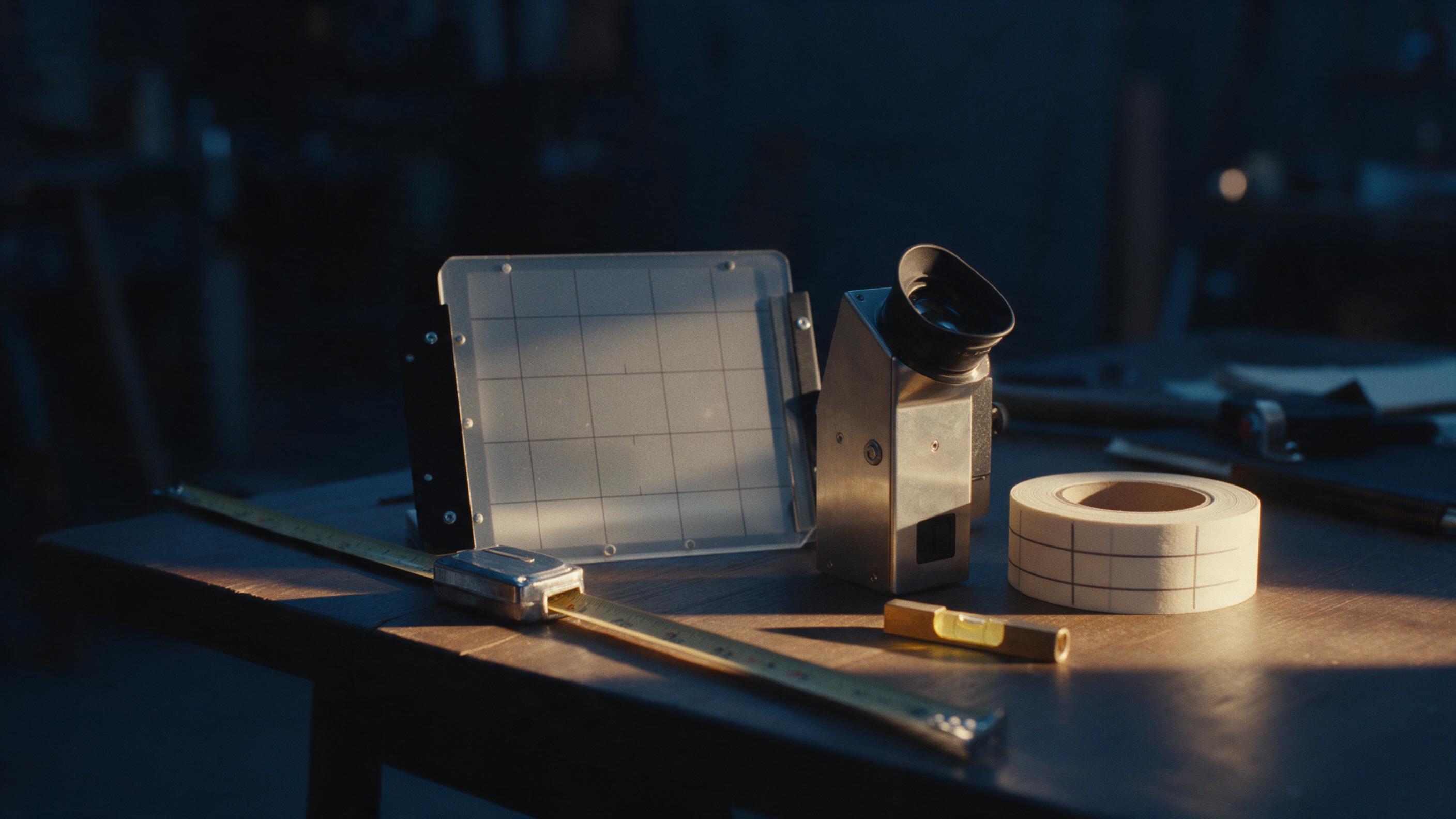
Where The Eye Goes First
Every frame answers one question before the camera moves: where do I want them looking, and what should that make them feel. Everything else, the grid, the lines, the depth, the light, is a device in service of that answer. There is no correct frame. There is a more interesting one and a less interesting one.
The Question Comes Before The Frame
A frame with no dominant point is a frame the eye refuses to enter. That is the whole failure mode, and it shows up as attention rather than taste. The eye lands on one thing first, every time. Put two elements at equal weight in front of it and it lands on neither, then drifts out of the picture.\n\nSo composition is a mechanism before it is an aesthetic. It decides which element wins. It is never decoration.\n\nTwo settings obey the same rule. In a wide shot the answer is subtraction: empty the frame until the eye has nowhere else to go. In a busy frame the subject still holds if it dominates on scale, on position, on light or on focus. One of those four is always enough. What fails is a subject that dominates on none of them.\n\nThe question is asked once, before the camera moves. Where do I want them looking, and what should that make them feel. Every device in this piece serves that answer. The grid is a device. A leading line is a device. Depth is a device. Break any of them deliberately and the frame still works, because the answer was never a rule.\n\nThere is no correct composition. There is a more interesting frame and a less interesting one, and the probability that the more interesting one arrives by accident falls with every element added without a reason.
The Grid, And The Shortcut Under It
The focal point has a default home, and it is the rule of thirds. Two horizontal lines and two vertical lines divide a 16:9 frame into nine cells, and the four intersections are where the eye settles without being told to. Nearly every subject in commercial cinema sits on one of those four points. It is not a law of perception. It is where attention goes when nothing else in the frame argues for it.\n\nThe shortcut sits under the grid and it fixes two problems at once. Put a pair of eyes on an upper intersection and the headroom and the lead room solve themselves, which makes that one placement the fastest correction in any interview setup.\n\nPick the lens before the frame and the composition is half decided. A 24 mm, a 35 mm, a 50 mm and an 85 mm do four different jobs on the same subject. The 50 mm on a full frame sensor takes in roughly 40 degrees across the frame, close to how much of a room a person actually holds in attention. The 24 mm shrinks the subject and makes the room a statement. The 85 mm compresses the background behind the face and tightens the portrait into one idea.\n\nA second grid is used less. A diagonal corner to corner, crossed by lines from the other two corners, produces a golden triangle with two focal points that balance each other. It exists for the frame that has two things to say.\n\nCenter framing is the exception, and it is strong because it is rare. It reads as authority, and it works when the subject speaks straight down the lens, teaching rather than being watched. Outside those two cases it flattens a frame that had depth available.
Space Is Scale, And Scale Is Meaning
Positive space is the area the subject is given. Negative space is everything around them, and it is never neutral. Fill the frame with a face and the reading is power, and the audience is pulled into the emotion. Put a small figure in a wide empty landscape and the reading is isolation and smallness. Same subject, same lens, different meaning, and the only variable is how much of the frame was left empty.\n\nHeadroom is the space above the head, and the instruction is to keep it minimal. Too much and the subject reads as small, as though the frame is looking over their head at something more interesting. The broadcast conventions still in use put action-safe content inside 93 per cent of the frame and title-safe text inside 90 per cent, which is where the habit of tightening headroom came from.\n\nLead room is the space in front of the subject, in the direction of the gaze, and there should be more of it than behind. Too little and the subject reads as trapped at the edge. For a moving subject the working figure is about two thirds of the frame ahead in the direction of travel, so the frame has somewhere to carry them.\n\nSpace, far from being a gap, is the cheapest way to say how important something is.
Lines, Layers, And A Frame Inside The Frame
Film is a flat rectangle pretending to be a room, and depth is how the pretence holds. Depth is built by layering: foreground, mid-ground where the subject usually sits, background. Something out of focus in the near foreground adds a layer for almost nothing, and it costs one object placed close to the lens.\n\nShallow depth of field finishes the job. Blur the background and the eye goes wherever the focus is, which is the same as saying the focus is the composition. Wider formats gave the frame more room to hold a second idea beside the first: the 1.33 to 1 academy frame of the silent era gave way to 1.85 to 1, and then to anamorphic scope at 2.39 to 1. Large-format work went the other way, to a 65 mm negative in a 15/70 frame.\n\nFlat against a wall, a subject has no depth at all. Move them forward and the wall becomes a background instead of a surface they are pinned to. Shoot into the corner of a room and two walls give two planes for the price of one.\n\nRack focus is depth used as an edit. The viewer notices a thing at the moment the lens finds it, so the pull tells them what matters without a cut.\n\nLeading lines do the same job in geometry. Roads, stairways, hallways and wall edges carry the eye rather than stopping it, and they carry the story with it, because they point at wherever the character is going next. Crossing and disordered lines do the opposite and read as confusion, which is a tool too.\n\nThe last device is a frame inside the frame. A doorway, a window, an arch, anything already in the scene that encloses the subject. It declares what matters by giving the viewer a smaller zone to watch, adds depth as a side effect, and placed between the audience and the character it turns the audience into a spectator on purpose.
Composition is never decoration. It is eye direction.
Balance, Symmetry, And The One Rule That Is Not A Preference
Balance is the part of composition nobody can name and everybody feels. A frame with more visual weight on one side simply reads wrong, and the fix is not to move the subject, it is to add something to the light side: a lamp, a shape in the background, anything with weight. Fix the frame, not the actor.\n\nHorizon shots follow the same logic in reverse. Put the subject on one of the two horizontal third lines rather than dead centre on the horizon, because the centre line flattens a body against a band.\n\nSymmetry is the exception, and it is one of the oldest devices in the medium. Both sides mirror, and the mind reads order without being asked. Kubrick built the one-point perspective into 2001 and the corridor shots in The Shining, and the effect survives because the symmetry is not merely pretty. It is pressure. Break it deliberately and the audience is uneasy before they can say why.\n\nOnly one rule in this list is not a preference. The 180 degree line exists because crossing it flips who is looking where, and a conversation that was readable becomes a geography puzzle. Its sibling is the 30 degree rule: change the angle by less than that between two shots and the image jumps. Turn the camera 90 degrees instead and the shot is a new position rather than a stutter. Everything else here can be broken on purpose. Those two cannot be broken by accident.
Light Points Last, Then The Sequence
The eye follows light and colour, and contrast decides it. The eye goes to the brightest part of the frame, so a lit subject against a dark ground locks attention on the subject permanently. Reverse it into a silhouette, dark subject against a bright background, and the pull is just as strong, with the identity withheld. Colour does the same with less force: one distinctive colour separates the subject from a monochromatic ground, and complementary colours separate them harder.\n\nThen the sequence, run in the same order every time. Pick the focal point. Pick the device that points at it: the grid, a leading line, space, or light. Decide the scale. Decide the space, headroom minimal and lead room ahead. Decide the balance. Decide the depth. Decide the frame within the frame. Then light and colour, with the brightest point held on whatever the answer was.\n\nTwo format facts belong to the delivery rather than the taste. Twenty-four frames per second has been the standard since sound arrived in 1927, and it has never been the thing that made a shot work. A 1920 by 1080 frame turned vertical is a different composition, not a cropped one, and the grid has to be redrawn because the subject no longer sits on the same intersection.\n\nThe pitfall for anyone writing this into a prompt is that framing vocabulary is where a model goes glossy. Name the framing the way a director of photography would, then anchor it: documentary film, 35 mm, natural skin texture. Without the anchor the shot arrives as a digital painting, framed by nobody.\n\nThe vocabulary is field-tested rather than theoretical. The same decision discipline that built companies across twelve countries and deployed 210 energy systems across Africa and Asia is the discipline that points a frame, and the book that came out of it runs 393 pages, published 8 April 2026, every one of them assembled one named decision at a time.
One dominant point. The eye lands there first, every time.
The map is dead. Nobody told you.
Bali State of Mind is the survival guide for the collapse of everything you were taught to believe.
Beyond this book
Building the same thing somewhere else.
Julien Uhlig is available for advisory work, board seats and media appearances. Write to media@exventure.co.
The academy that trains the operators, across every company in the group, is EX Epic Academy - 25,000 applications, 25 seats per cohort, 210 alumni across 19 countries. academy.epicsolutiongroup.com
18-20 November. Online, Las Palmas, Bali.
Three days on what happens to work, capital and institutions when the map stops matching the ground. Seats are limited by cohort.
ex-aisummit.com →