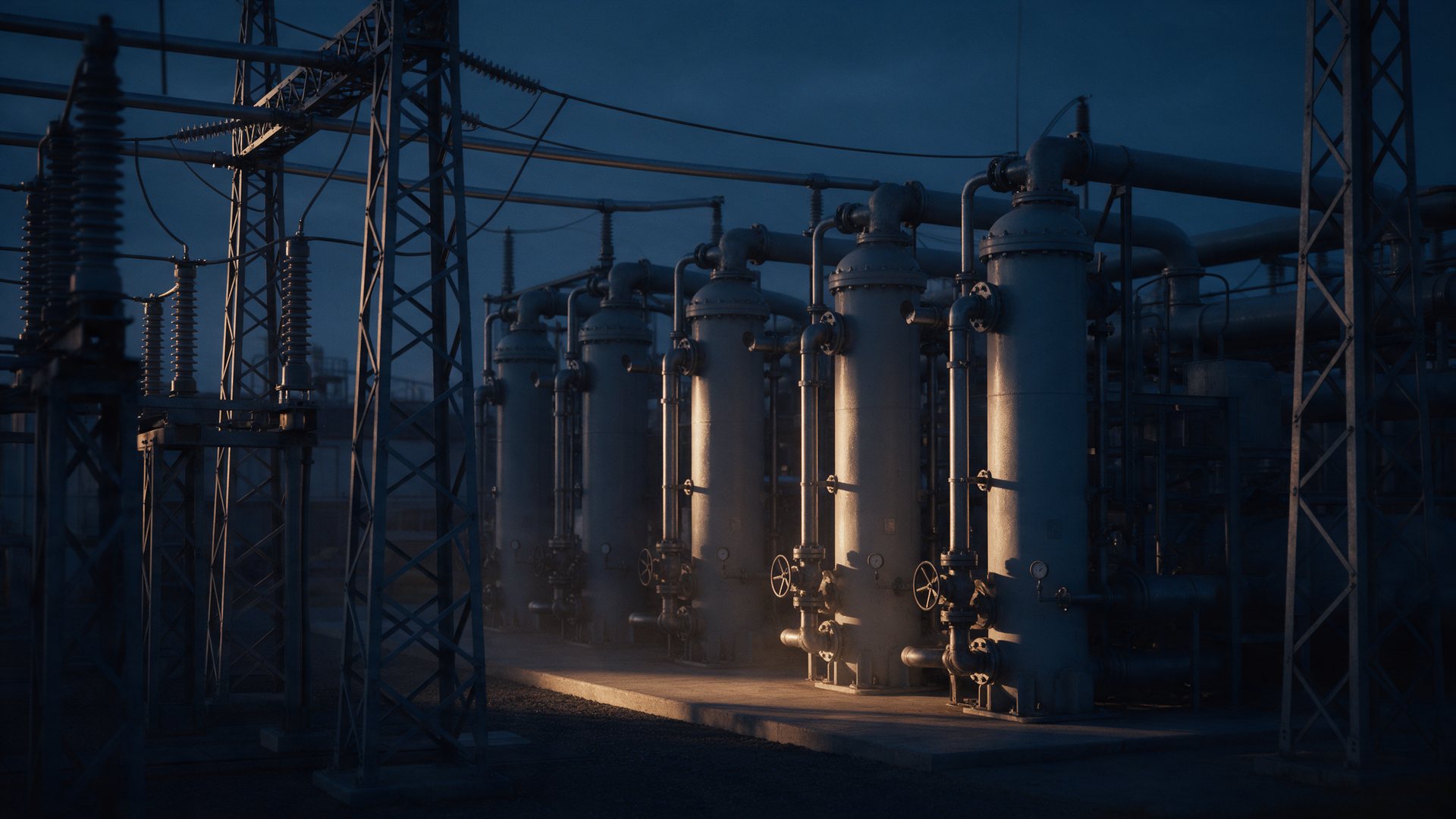
Where The Electrons Go
Fifty to fifty five kilowatt hours buy one kilogram of hydrogen, and every step downstream buys that same electricity again. The efficiency ladder, not the catalyst, sets what each molecule costs.
The One Input
Every route to a low-carbon molecule starts in the same place, and it is a wire. Proton exchange membrane electrolysis runs at 60 to 68 per cent efficiency on the lower heating value and consumes 50 to 55 kilowatt hours per kilogram of hydrogen. Alkaline electrolysis runs at 63 to 73 per cent and consumes the same 50 to 55. The consumption is nearly identical because the thermodynamics is nearly identical. The difference is hardware and cost, not physics. The levelised cost of that kilogram landed at 3.50 to 6.00 US dollars on grid power and 2.50 to 4.00 on renewables in the 2025 and 2026 projections. Capital cost runs 1,000 to 1,250 dollars per kilowatt of Western PEM capacity against 600 to 900 for Chinese supply. That is the entry ticket for every other product in this file. Electricity is not a utility here. It is the feedstock, and the kilowatt hour is the unit of account.
The Electrolyser Menu
Four families, one decision each. Alkaline is the mature machine. Readiness 9, 750 to 1,000 dollars per kilowatt in the West and 300 to 500 in Chinese domestic supply, operating at 10 to 30 bar, a stack life of 60,000 to 90,000 hours, and a current density of only 0.2 to 0.8 amps per square centimetre. Cheap, proven, physically large, and slower to ramp. PEM is the responsive one. Readiness 8 to 9, 1,000 to 1,250 dollars per kilowatt Western, 30 to 70 bar output, 60,000 to 80,000 hours of stack life, 1 to 3 amps per square centimetre. It runs on iridium at 1.3 grams per kilowatt, with a target of 0.4. That loading is the reason nobody can promise much beyond roughly 50 gigawatts a year of PEM capacity. Iridium arrives as a by-product of platinum mining and the supply does not move. Solid oxide is the efficient one. Readiness 6 to 7, 74 to 84 per cent efficiency and up to 90 with waste heat integration, 2,000 to 4,000 dollars per kilowatt with a target near 800 by 2030, running at 700 to 850 degrees Celsius. The stack lasts only 20,000 to 40,000 hours. Heat is the currency and degradation is the tax. Anion exchange is the bet. Readiness 4 to 5, a target of 600 dollars per kilowatt, alkaline chemistry without the liquid electrolyte and without the iridium. Not proven at commercial size.
The Efficiency Tax That Compounds
Every conversion downstream spends the same electron again. Carbon dioxide hydrogenation to methanol is exothermic at roughly 250 degrees Celsius and 50 to 100 bar, and the best integrated system energy efficiency measured is 56 per cent. Power to ammonia returns 50 to 65 per cent. Power to liquid aviation fuel through reverse water gas shift and Fischer-Tropsch returns 35 to 45 per cent. Follow one kilowatt hour down that chain. It buys about 0.018 kilograms of hydrogen at 55 kilowatt hours per kilogram. A little under 9 per cent of the carbon that goes in leaves as methanol, and the rest leaves as water and heat. Take the same hydrogen into jet fuel and you keep a third of the energy you started with, because the reactor makes water as readily as it makes fuel. Each industrial step writes the electricity bill again, and the arithmetic does not care how good the catalyst is. Methanol needs 1.4 kilograms of carbon dioxide per kilogram of product, which is why the carbon source is the second contract after the power purchase agreement.
What Each Tonne Costs
Green ammonia prices at 600 to 1,200 euros a tonne against 300 to 400 for the grey product made from natural gas. The plant costs 2,500 to 4,000 US dollars per tonne of annual ammonia including the electrolyser, against 1,500 to 2,500 for the fossil version. Methanol on biogenic carbon dioxide and green hydrogen prices at 900 to 1,200 euros a tonne. The same molecule on fully renewable inputs reached 4,000 to 4,510 euros a tonne in a 2026 study in Fuel. The fossil benchmark is 300 to 400 euros, and Gelten and colleagues priced the identical process on grey hydrogen at 2,244 euros a tonne. The spread between 2,244 and 400 is a hydrogen price, not a reactor design. Synthetic aviation fuel is the expensive one: 3,000 to 6,000 euros a tonne between 2025 and 2030, and 3,000 to 4,000 in the 2050 case with the plant built a hundred times over. A first-of-a-kind 200 kilotonne plant carries 1 to 2 billion euros of capital, against 100 to 200 million for a 50 kilotonne methanol plant. Hydrotreated esters and fatty acids, the biogenic route, sit at 800 to 2,400 US dollars a tonne and are feedstock limited to under 5 per cent of jet demand. None of these molecules is unaffordable. Each price is a power price with a chemical markup added.
Electricity is not a utility here. It is the feedstock, and the kilowatt hour is the unit of account.
The Molecule That Moves
The product that ships without new infrastructure wins the first round. Ammonia carries 17.8 per cent hydrogen by mass and moves as a liquid in a trade that already exists. Haber-Bosch runs at 400 to 500 degrees Celsius and 150 to 250 bar, with a yield of 15 to 25 per cent per pass and an energy consumption of 8 to 10 megawatt hours per tonne when the hydrogen comes from steam methane reforming. That process is 1.6 to 2.0 per cent of all anthropogenic carbon dioxide. The green version uses the same synthesis loop on electrolytic hydrogen, which is exactly why it can be built with existing engineering. Methane has two routes. Catalytic methanation on a nickel catalyst runs at 200 to 600 degrees Celsius and 5 to 40 bar and converts more than 95 per cent per pass. Biological methanation uses hydrogenotrophic archaea at 25 to 65 degrees Celsius and 1 to 10 bar with the same conversion, in a reactor 10 to 50 times larger, and it tolerates impurities the catalyst cannot survive. Glansager in Denmark produces 12,000 cubic metres of methane a day. Dietikon in Switzerland runs 1 megawatt of synthetic natural gas. Direct electrochemical ammonia synthesis stays in the laboratory at readiness 2 to 4. The lithium mediated route reports a theoretical faradaic efficiency near 28 per cent and has demonstrated under 10. Lithium deposition drives an effective overpotential large enough to eat the advantage. Not this decade.
The Only Thing Making It Pay
The economics of every route in this file currently rest on a legal obligation, and the obligations are published with dates. Renewable Energy Directive III asks for 29 per cent renewable energy in transport or a 14.5 per cent cut in greenhouse gas intensity by 2030, with a 5.5 per cent subtarget for advanced biofuels and renewable fuels of non-biological origin. Ports face a 1.2 per cent maritime subtarget from 2030. ReFuelEU Aviation mandates the blend at European airports: 2 per cent sustainable aviation fuel in 2025, 6 per cent in 2030 with 1.2 per cent synthetic, 20 per cent in 2035 with 5 per cent synthetic, 34 per cent in 2040, 42 per cent in 2045, and 70 per cent in 2050 of which 35 per cent synthetic. FuelEU Maritime takes the greenhouse gas intensity of the energy on board down against a 2020 baseline: minus 2 per cent in 2025, minus 6 in 2030, minus 14.5 in 2035, minus 31 in 2040, minus 62 in 2045, minus 80 in 2050. Those tables are the demand curve. Remove them and every price in the previous sections loses its buyer.
Where The Readiness Actually Sits
The ladder, from commercial to laboratory. Alkaline electrolysis at 9. PEM at 8 to 9. Catalytic methanation at 8 to 9. Power to ammonia at 7 to 8. Biological methanation at 7 to 8. Solid oxide electrolysis at 6 to 7. Power to methanol at 6 to 7. Synthetic aviation fuel through Fischer-Tropsch at 6 to 7. Anion exchange membrane at 4 to 5. Direct electrochemical ammonia at 2 to 4. Read that list as a capital allocation order rather than a research ranking. The two readiness 9 technologies are the ones with a supply chain, a service industry and an insurance market. The readiness 6 to 7 technologies are where the engineering risk has moved off the reactor and into the balance of plant. Note also what the ladder leaves out: cost. Alkaline is the cheapest per kilowatt and the largest per megawatt. Solid oxide is the most efficient and the least durable. Neither fact appears in a readiness number.
The Decision Rule
Start with the electricity contract, because it is the only input that appears in every line of the model. Then take the first conversion efficiency, because it multiplies that price. Then choose the molecule your customer already handles. Ammonia and methane travel in infrastructure that exists today. Methanol travels if the port takes it. Aviation fuel waits for an obligation with a start date, and in Europe that date has now arrived. I have built companies across twelve countries and deployed 210 energy systems across Africa and Asia, and the failures I sat inside were never chemistry failures. They were input assumptions nobody had signed. Entrade built 200 wood-gasification machines across the UK and Europe on that lesson: the machine is the easy part, and the feedstock contract is the business. The probability that the cheapest electricity in a region decides which molecule that region makes is close to one. Most business plans are still written the other way round, and the ones that survive a first financing round are the ones that were not.
Heat is the currency and degradation is the tax.
The map is dead. Nobody told you.
Bali State of Mind is the survival guide for the collapse of everything you were taught to believe.
Beyond this book
Building the same thing somewhere else.
Julien Uhlig is available for advisory work, board seats and media appearances. Write to media@exventure.co.
The academy that trains the operators, across every company in the group, is EX Epic Academy - 25,000 applications, 25 seats per cohort, 210 alumni across 19 countries. academy.epicsolutiongroup.com
18-20 November. Online, Las Palmas, Bali.
Three days on what happens to work, capital and institutions when the map stops matching the ground. Seats are limited by cohort.
ex-aisummit.com →