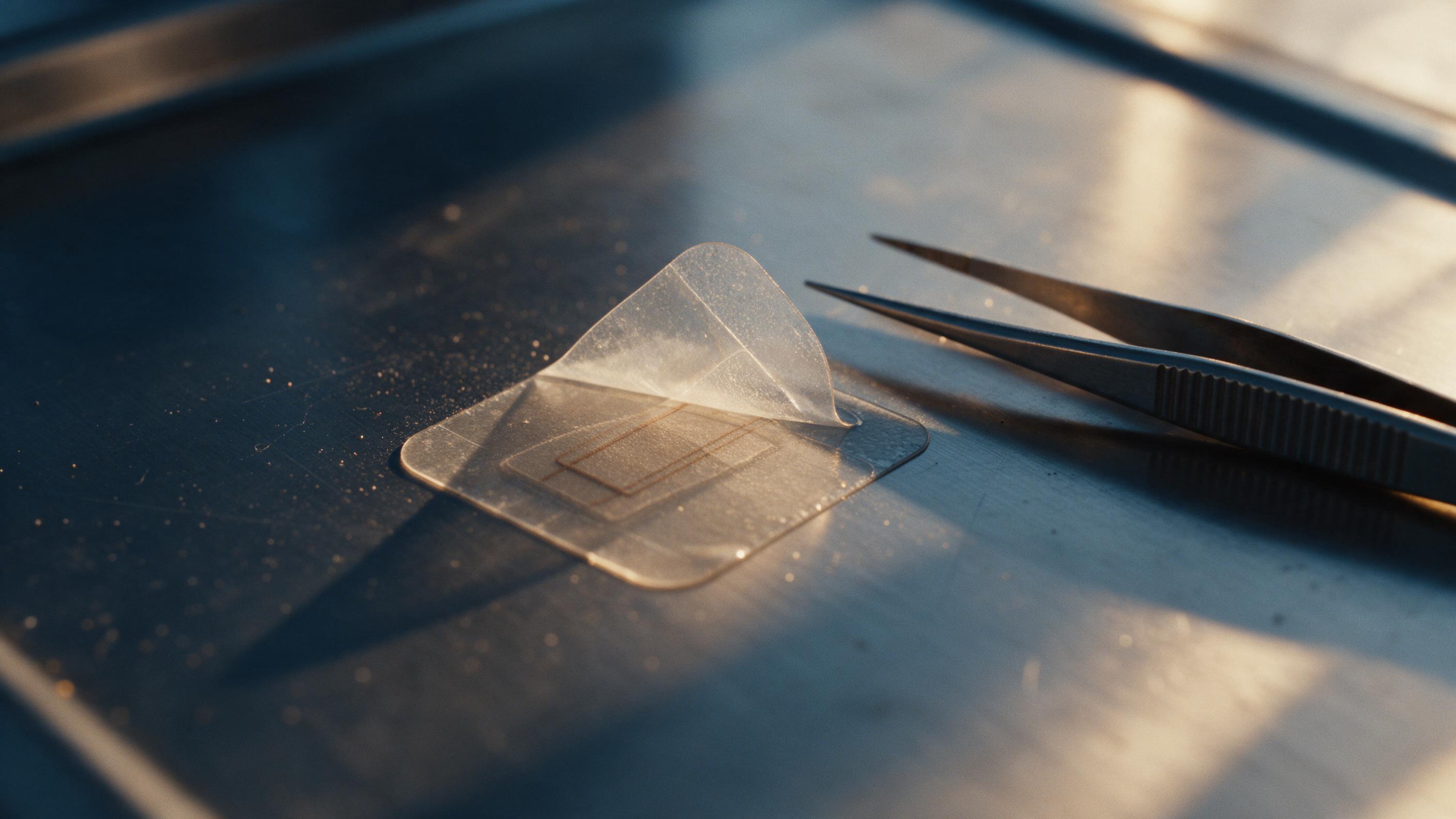
Nine Vitals On The Label, Four That Are Clinical
A conformal patch thinner than a hair claims nine vitals. Four of them are mature and inside the error bar a ward would accept. Three are research, one is early research, and the blood pressure sits in a column marked emerging. The list itself is the most honest thing in the pitch.
The Thickness Of A Hair
The patch is between 10 and 50 micrometres thick, thinner than a human hair, and it bends to a modulus of about 50 kilopascals, roughly the stiffness of the skin under it. It survives 30 to 50 per cent stretch with the rigid islands buried inside intact, and those islands are commercial amplifiers, converters and radio transmitters, the same class of parts a bedside monitor runs on. On NFC it works passive, no battery at all. On Bluetooth it lasts days. You peel it on at the gym and stop noticing it by the second set. That is not a design nicety. It is why the vitals beside a hospital bed and the vitals on a moving body have never been the same numbers.
Four Numbers That Are Done
Heart rate comes off arterial pulse pressure, the artery deforming the skin over the sensor, and it lands within 2 bpm of the clinical standard. Respiration comes off chest expansion on a stretch sensor, within 1 breath a minute. Blood oxygen comes off reflected red and infrared light, within 2 per cent. Skin temperature comes off a resistive element, within one tenth of a degree. Four vitals. Four mature measurements. Each inside the error bar a ward would accept, and none of them needing new physics. The sensor simply had to touch the body properly, and hold on. That is the quiet part of the list. The hard engineering is already behind it.
The Blood Pressure Problem
Blood pressure is the reading that looks finished and is not. The patch times the pulse as it arrives at two points and converts the difference, pulse transit time, into a pressure. Diastolic accuracy lands around 5 mmHg. The maturity column for it reads emerging, not mature. Transit time is a proxy. It moves with vessel stiffness, posture and room temperature. A cuff measures force. This measures timing, then infers. Beside it on the same list sits arrhythmia, where a Holter gets 24 hours and the patch version is asked for 14 to 30 days. The market for that one is $3B, and $2B for beat-by-beat pressure. Both readings are close. Neither is a number you would base a dose on yet.
Then It Moves Into Sweat
Glucose runs through a glucose oxidase electrode and lands within 15 per cent of a blood reading. Lactate lands within 10. Hydration uses impedance spectroscopy at several frequencies to estimate body water to within 2 per cent. Cortisol reads an aptamer changing shape as it binds, to within 20 per cent, and sits in early research. 15 per cent of a glucose reading is not something you dose insulin against. It is a number that tells you the direction of a week without a fingerstick, and for a lot of people that is the difference between a spreadsheet and a decision. Trends are useful. Nobody markets trends.
You peel it on at the gym and stop noticing it by the second set. It is why the vitals beside a hospital bed and the vitals on a moving body have never been the same numbers.
Comfort Trades Against The Signal
This is where the marketing gets shy. A rigid patch earns poor comfort ratings and excellent signal. A soft patch sits at good on both, holding one to two weeks. E-textile wins comfort outright and drops to moderate signal that depends on the wash, degrading somewhere between 20 and 100 cycles. Hydrogel sticks without tape, gives perfect contact and the best signal of the lot on day one, then dries out in hours to days. Epidermal sits at very good comfort with good to excellent signal, and costs the most. The ideal is epidermal signal, textile comfort, hydrogel adhesion. No product holds all three. The trade-off is the field, and the cost column runs the wrong way for the people who need the signal most.
Calibration Is The Gate
An Apple Watch and a Fitbit are not medical devices, and the gap is not the hardware. A wristband optical sensor estimates heart rate within 5 bpm for most people, then fails on darker skin, where melanin absorbs the light, on higher body mass, where more tissue sits over the artery, on movement, and on cold hands. Medical grade means calibrating to one person and compensating for drift, which adds cost and slows deployment. Sixteen years of field work, rural Nigeria included, taught me that a device needing a clean bench measures the operator, not the patient. The markets behind that gate: $15B glucose, $1B sleep apnea, $1B post-surgery vitals. The probability that a patch ships calibrated for darker skin and higher body mass, rather than for the easiest subject the trial could find, is not zero. Most of the market prices it at zero.
The number is good. It is not yet a number you would base a dose on.
The map is dead. Nobody told you.
Bali State of Mind is the survival guide for the collapse of everything you were taught to believe.
Beyond this book
Building the same thing somewhere else.
Julien Uhlig is available for advisory work, board seats and media appearances. Write to media@exventure.co.
The academy that trains the operators, across every company in the group, is EX Epic Academy - 25,000 applications, 25 seats per cohort, 210 alumni across 19 countries. academy.epicsolutiongroup.com
18-20 November. Online, Las Palmas, Bali.
Three days on what happens to work, capital and institutions when the map stops matching the ground. Seats are limited by cohort.
ex-aisummit.com →