What Bali Taught Me About The Number You Actually Need
A three-bedroom house with a garden costs USD 1,800 a month. A scooter costs USD 1,000 to buy. A real meal from a street cart costs USD 2. In New York the same life starts at USD 4,000 and reaches USD 15,000 once you want space. Fifteen years of field notes on the only lesson that travels: your overhead is a choice, and almost nobody is told that it is one.
The Heat, Then The Arithmetic
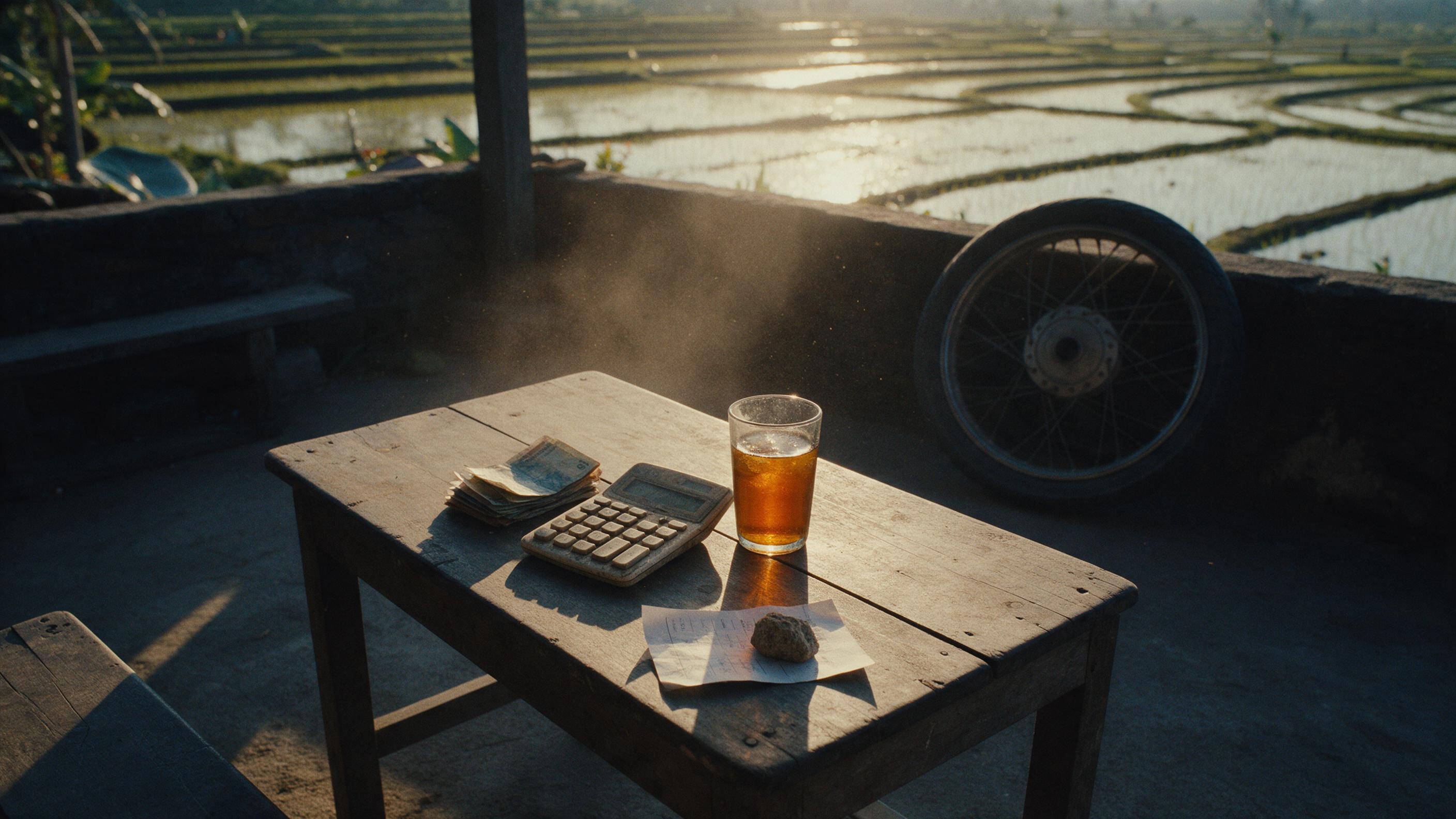
The first thing the heat teaches you is that you were dressed for a different argument. Then the arithmetic starts. A three-bedroom house with a garden and an outdoor shower facing the fields rents for about USD 1,800 a month. A scooter costs USD 1,000 to buy and 30 seconds to start. A real meal from a street cart costs USD 2. That is the price list. Not a resort, not a postcard, just what a functioning local economy charges when it has not been optimised for extraction. Now put the same life somewhere else. New York: USD 4,000 a month for a small apartment in a mediocre neighborhood, and the number climbs to USD 15,000 once you want space, a second room and children. Sardinia was better than Manhattan for property and still expensive. Switzerland was brutal in a different way. Every conversation in Zurich circled cost: what the meal cost, what the rent cost, what the car cost. A whole culture had been tuned to take as much as possible from you while you still felt like you were living well. That is when I understood the thing I had never once seen written down. The number you need to survive is a number somebody else chose for you. Almost nobody checks the arithmetic. Overhead is the weight that decides your life. Everything you earn above the overhead is what you actually get to aim at the future. Below it, you are not building, you are servicing a structure. A USD 4,000 apartment forces you to prioritise income above everything, because the lease is real and the dream is not. A USD 1,800 house leaves 60% of your capacity intact and asks you what you want to do with it. I have met very few people who can answer that question. That is the point of the number.
The Price Is A System, Not A Place
You do not get that arithmetic by landing. It took 2 years of going back, asking the same question every trip, to find where the real communities were, where the actual costs sat, and how to live instead of how to holiday. I asked everyone the same question: where do you actually live when you are serious about staying? Not the nice place. The real one. That question has an answer, and the answer is never the price list. The first 6 months of any new place are a tax you pay for not knowing the system. You buy badly. You eat badly. You pay the visitor's price for the visitor's version of everything. The 2nd year, if you keep asking, the map builds itself. You find the neighborhood where the people who build things actually live. You find the 4 restaurants where the food is real and the price reflects that. You find the mechanic who fixes the scooter for USD 12 and tells you which parts to stop buying. Here is what that teaches, and it is not about geography. Premium pricing and actual value are 2 different numbers, and in most developed markets they have drifted so far apart that people cannot tell them apart. You pay premium pricing for everything and call it quality of life. Fluency is the discount. Not the country. Every institution that sells you something depends on you never learning its system. The moment you can see the mechanism, the price you are being quoted stops being a fact and becomes an offer. That is true of rent. It is true of software. It is true of the advice you are paying for right now.
A Community That Bills You In Presence
The community is not what people imagine when they hear the word. Yes, there are 3-week visitors who stayed because the costs were low and nobody was checking. That exists. But the people I kept going back for are builders. People who walked away from a corporate title in their 30s or 40s and restarted in a place where zero had different parameters. Health people who got tired of the Western food system and started growing things or finding the people who do. Makers. The first question you are asked at a table in that community is not "what do you do". It is "what are you building". Different measure. Different assumption about whether your work means anything. Then there is the older system sitting underneath all of it, and this is the part that changed how I run companies. The island is about 87% Hindu, in the largest Muslim country on earth. The unit is the banjar, the neighborhood body. It handles the ceremonies, the maintenance, the collective life. Hundreds of offerings go out before 7 AM, every single day: flowers in small banana-leaf trays, rice, incense, on the sidewalk, on the counter, on the dashboard. A woman of 70 sitting on the ground at 5 AM arranging them, not for an audience. It has run like this for centuries, without a government mandate and without a marketing budget. Here is the mechanism, and it is brutal in its simplicity. If you stop showing up, you stop being part of it. No invoice. No performance review. No exit interview. Just the quiet arithmetic of a community that only works if everyone carries a corner of it. Karma and dharma are not abstractions in that system. They are the operating rules. That rewired the only thing I thought I had figured out. I grew up with discipline as punishment. Do the thing or take the consequence. The discipline I watched there runs on the opposite fuel entirely. You show up because you love the thing, and because the thing collapses if you don't. Same action, different engine. Every company I have built since carries that. Not a KPI theatre where people perform attendance. A structure where the work only holds if the people in it actually show up as themselves, and where the ones who stop showing up find out what that costs. Community is not built by showing up once and being charming. It is built by showing up on the days when nobody notices.
What A Small System Did In 2020
I have seen what the news takes 3 weeks to understand, because I was in the room when the structure moved. I worked crisis regions for the German Ministry of Economics. In 2003 I was inside Lehman Brothers on the day the power went out and the trading floor went dark. In 2008, 164 years of institutional permanence evaporated over a weekend. In 2013, the Cyprus bail-in took savings from people who had been told their money was safe, and I lost mine alongside everybody else's. Six major transitions, and I read each one before the headlines did, because the data had already moved. So in early 2020 I was not watching the news. I was looking at the actual variables. Outdoor life, no industrial food, clean water, strong immune systems, a health system that is small, local and personal rather than vast, distant and bureaucratic. On paper, the probability that a small self-organising community would hold together was higher than almost anywhere I could name. Then I watched it happen. The market stayed open. The farmers kept planting. The ceremonies continued, adjusted rather than cancelled. The street vendors adapted within 2 weeks. People who got sick were treated by people who knew them by name. Deaths in the immediate community: zero. Serious hospitalisations: zero. While large systems argued about masks, small systems simply kept functioning, because the people running them could see each other. That is the lesson I keep failing to explain to people who want a strategy document instead of a structure. The probability of the next 10 years looking like the last 10 is not zero. Most people are pricing it at zero, because the last 30 years were calm and they have generalised calm into a law of physics. Resilience is not a plan. It is a density of relationship and a low fixed cost. Both of those you can build before you need them, and neither of them can be bought afterwards.
The number you need to survive is a number somebody else chose for you. Almost nobody checks the arithmetic.
Ten Years Of Derisking
Ten years of derisking is what the last decade actually was, underneath the noise. Grants over venture capital. If the work improves rural life, somebody is usually already funding it, and that money does not require an exit in 7 years or a pivot toward a richer market. I have never taken a salary in 20 years. Engineers got paid. Technicians got paid. I lived off consulting and speaking, which kept every company's incentives honest. Young people over expensive engineers. A brilliant 22-year-old out of MIT or Cambridge costs less than a burned-out 45-year-old asking for USD 200,000 and equity, and is usually better, because nobody has told them yet that the thing is impossible. 220 interns a year through one door in 12 countries is a talent system, not a hiring policy. Companies, not personal assets. Everything is a separate entity. One can fail and the others keep running. In 2008 I learned that lesson at full price: I signed a EUR 20 million personal guarantee on Christmas Day because the alternative was losing a company, and the company went down anyway. The probability of success on that deal was 40% and I signed it with a net worth closer to a million. Nothing I own is leveraged against my name today, and that is not caution, that is arithmetic. No debt. If I cannot afford it, I do not do it. That constraint reads like a limitation until you notice it forces every decision through the same filter: does this need to exist at all. Entrade built 200 wood-gasification machines from a workshop that started with 1, then 2, then 3 a year, and ended at 1 a day. 210 energy systems stand today in places that had none, across the UK, Europe, Africa and Asia. Acquiring companies arrived every single year with distribution and capital and a plan to multiply us by 100. I kept asking one question instead: what happens to the village after I leave. The next owner closes the line that does not scale, and the lights go out within 18 months. So we trained people instead of exiting. Nobody gives awards for that. It also happens to be the only thing I have built that is still standing.
The Constraints I Chose On Purpose
Here is the part people get wrong about the low number. It is not a compromise. It is a deliberate constraint with a measurable return. Run the same life at USD 5,000 a month instead of USD 1,800 and the extra USD 3,200 does not buy a better life. It buys a smaller set of options. You now need contracts you do not want. You manage more money, more risk, more ROI. You spend 10 hours a week defending a standard of living instead of building something. The mental rent on expensive things is real, and it never appears on the invoice. Same with the scooter. Everyone asks why not a car. A car is maintenance, parking, insurance, fuel, registration and a monthly conversation with a mechanic. A scooter is 30 seconds and go. That is not austerity. That is choosing which machinery you want to own. That is the whole teaching, and it is the reason a book like this exists under the name Bali State of Mind. The island is not a location in the argument. It is the demonstration. Remove the overhead, keep the relationships, pick your constraints on purpose, and you get back something no amount of income replaces: the ability to say no to work that is wrong for you. Constraints are only a cage when somebody else picks them. I have had the opera career, the nightclub in New York, the banking floor, the luxury property, the portfolio, the business class and the feeling of being important because I was busy. I gave all of it the same test, and most of it failed. What passed is small, cheap to run, and hard to take from me. You cannot buy your way out of a bad structure. You can only remove the parts that were never yours. Start with the number. It is the cheapest thing you will ever change.
Community is not built by showing up once and being charming. It is built by showing up on the days when nobody notices.
The map is dead. Nobody told you.
Bali State of Mind is the survival guide for the collapse of everything you were taught to believe.
Beyond this book
Building the same thing somewhere else.
Julien Uhlig is available for advisory work, board seats and media appearances. Write to media@exventure.co.
The academy that trains the operators, across every company in the group, is EX Epic Academy - 25,000 applications, 25 seats per cohort, 210 alumni across 19 countries. academy.epicsolutiongroup.com
18-20 November. Online, Las Palmas, Bali.
Three days on what happens to work, capital and institutions when the map stops matching the ground. Seats are limited by cohort.
ex-aisummit.com →