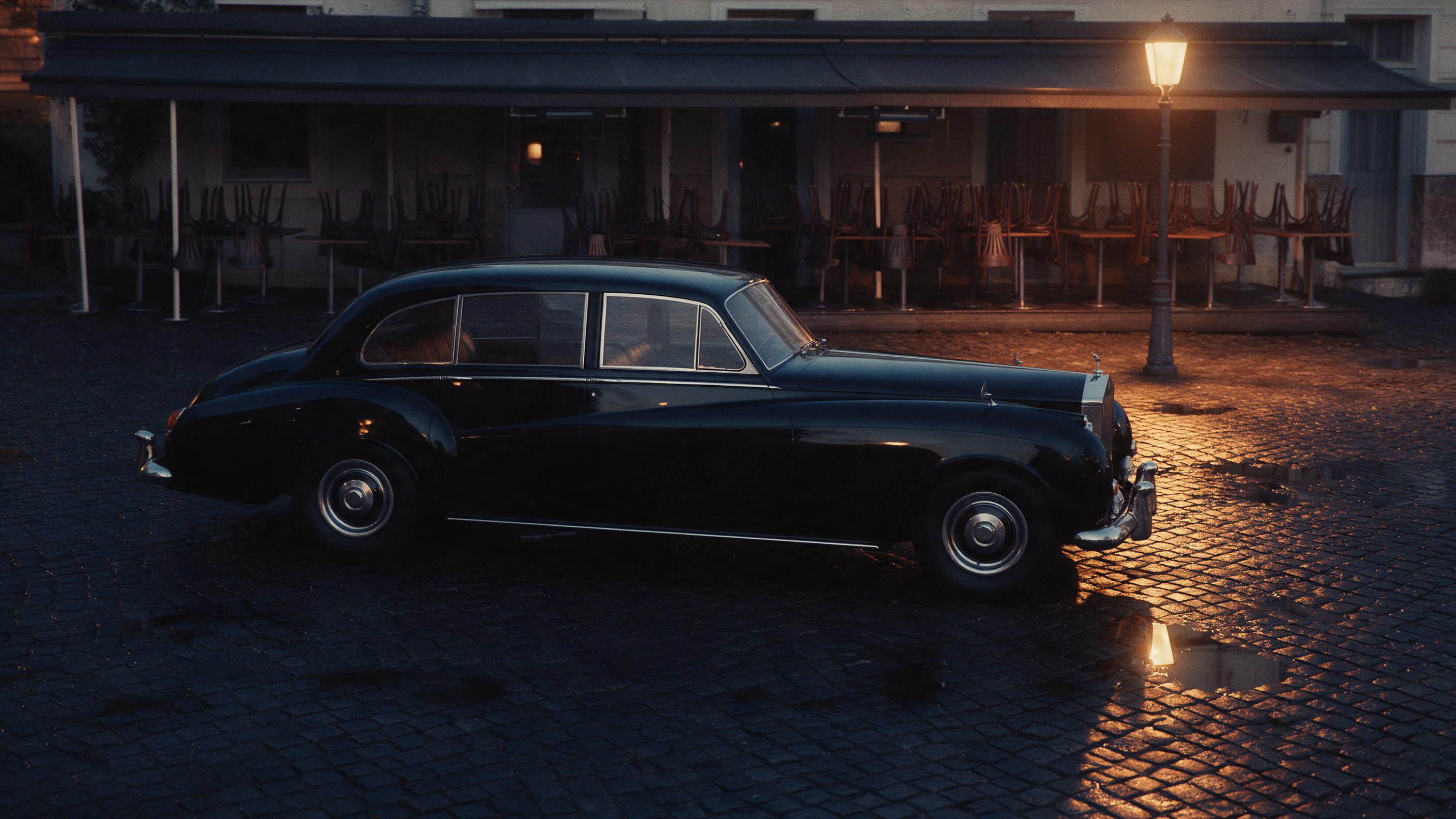
There Is No Happiness In A Rolls Royce
2007, Porto Cervo. A Rolls Royce outside a restaurant, a room full of people performing wealth at each other, and a 32-year-old in a suit he did not choose feeling absolutely nothing. I climbed to the top of the ladder everybody pointed at and found the top was empty. Here is the question almost nobody asks, and what it costs you to skip it.
Porto Cervo, 2007: The Empty Room
A Rolls Royce parked outside a restaurant in Porto Cervo, 2007. The kind of car that costs more than most people's houses. Not a vehicle. A statement. I was standing next to it in a suit I had not chosen, playing a part. Champagne in hand. A room of wealthy people performing wealth at each other. Waiters trained in a very specific kind of service that communicates one thing: you are important because of what you are spending right now. I looked at the car. I looked at the white tablecloths. I looked at the Mediterranean, which was beautiful and completely indifferent to all of it. And I felt nothing. Not sadness. Emptiness, which is worse. The kind where you are smiling and everyone thinks you are happy and inside there is no texture at all. Just the performance of a life that is supposed to matter. Then there was the moment that ended it. I made eye contact with a man across the room. He was doing the same thing I was doing. Same suit, same champagne, same smile. And in his eyes I could see the identical thought: this is hollow, this is empty, and we are at the top of the hierarchy and the hierarchy is empty. I finished the champagne. I left the party. I got on a plane, and I never went back to that world. I was 32. Everything I had been told to want, I had. It bought nothing.
The Conveyor Belt Picks Its Own Direction
That is the question underneath everything else. Not how do you survive. What are you surviving for. Most people never ask it. They assume the answer is more. More money, bigger house, better car, higher rung. Nobody decided that. It is the default heading of a conveyor belt, and the belt moves whether or not you chose it. The machine makes more money the entire time you are chasing more, so the machine keeps telling you that satisfaction is one level further up. I had the trophies first, so I can describe them precisely. Operatic training and an 85% scholarship to Mannes College of Music, performing at Carnegie Hall. A nightclub in New York that people genuinely loved. Banking at Lehman, which I was inside in 2003 when the power failed and which evaporated 164 years of history in 2008. Luxury property in Sardinia. A reality television version of myself. A portfolio, a business class seat, a calendar that made me feel important because it was full. Every one of those got the same test afterwards. Did it fill anything? Most of them did not. The nightclub years are the honest example, because they were good. I built something that mattered. Strangers became collaborators there. Artists met bankers. Teachers met entrepreneurs. In a city that destroys connection, we made a room where connection happened. It was also ego. I was the guy with the place. The guy everybody wanted to know. That is a drug and it behaves like every other drug: you need a larger dose every year to feel the same thing. When the dose stops working, you do not conclude that the drug is wrong. You conclude you need more of it. That is the trap. It does not look like a trap. It looks like ambition.
Looking Down vs Looking Sideways
The Maybach world is built on looking down. That is the mechanism, and once you see it you cannot unsee it. Create distance between yourself and other people. Then fill the distance with objects that justify the distance. A more expensive car means you are more successful. A more exclusive restaurant means you are more connected. A more guarded community means you are more valuable. The distance is the product and the stuff is the receipt. I do not buy the winner-eats-all version of business. It is not a moral position, it is an observation after 20 years and having built companies in 12 countries. The people who operate by looking down produce predatory relationships, and predatory relationships do not compound. They burn out, they get resented, and eventually the room empties. The alternative is looking sideways. Standing next to someone and saying: we are both in this, let us work out how it goes. Understanding that another person's success does not reduce yours, and that lifting someone costs you nothing. Restructuring a EUR 75 million industrial group does not happen because a genius arrives in a helicopter. It happens because hundreds of people decide that the person in front of them is worth carrying a corner for. That is the entire mechanism. Everything else is administration. And yes, I think we carry an obligation to the weakest inside our own societies. That is not weakness. It is the most accurate reading of how anything durable has ever been built.
Leopoldo And The Room At The Top
The man who taught me this ran a restaurant on the Upper West Side of Manhattan. Caffè Taci. An opera restaurant and nightclub where I spent years from 1999 onward. Leopoldo was older, Italian, serious about what he was building and completely uninterested in maximising what he could extract from it. The place could have been more profitable. Cut the staff, cut the food quality, raise the prices, trim the experience until only the margin remained. Every consultant would have told him to do exactly that. He optimised for something else. He optimised for the experience. For the community. For the fact that the room was a place where things happened and people found each other. He had a saying. There's always room at the top. I misunderstood it for years. I thought he meant there was always room for more successful people at the top of the hierarchy. That is not what he meant. He meant: if you are good, if you are real, if you are genuinely trying to build something that works, there is a place for you. You do not have to destroy anyone to make space. The pie is not fixed. Your success does not subtract from mine. That changed how I thought about competition permanently. The most valuable asset a person can build is the trust of the people around them. It is not tradeable. It is not transferable. It cannot be bought with a bigger car. It is only who you are to other people, accumulated over years. Leopoldo's business lasted because he built it on that and not on optimisation. I have watched the optimised version of that same restaurant go through three owners and three closures since.
The conveyor belt has a default direction. It moves whether or not you chose it.
What AI Does To Hidden Money
Here is the part that makes me genuinely hopeful, and I did not expect to feel that way about it. We have run a global system for 60 years with corruption built into the structure. Capital flows nobody can fully trace. Offshore accounts no single institution has a map of. Shell companies nested inside other shells. Decisions made in rooms where nobody takes minutes. Money moving through Dubai, Cyprus and the Cayman Islands until it is simply gone. The machine runs on the ability to hide what you are doing. That is the load-bearing assumption under all of it. The 2013 Cyprus bail-in took savings from people who had been told their money was safe, mine among them, and nobody went to prison for it. AI attacks that assumption directly. It can trace capital through blockchains and stablecoin rails at a speed and volume no team of auditors can match. It can fact-check claims in volume, which makes lying exponentially more expensive. It can map a shell structure in the time it used to take to locate the first shell. The moment hiding money becomes expensive, behaviour changes. Not because anyone becomes moral. Because the arithmetic changed. That should terrify anyone whose position depends on opacity. It should encourage everybody else. The world we are handing to the next generation is going to be more traceable and more honest than the one we inherited, and the people who built on secrecy are going to find their foundation was made of the one thing that stopped being scarce. I am not describing a utopia. I am describing a change in the cost of concealment, and cost is the only lever that has ever moved this system.
220 People And The Only Thing That Fills The Hole
So what am I surviving for. Not a car. I want to be precise about this, because vague answers are how people end up back on the belt. The work. Building things that change how a system operates rather than things that look like they do. 210 energy systems standing in places that had none, across the UK, Europe, Africa and Asia — that is 210 villages where the lights did not go out when the next owner wanted a cleaner margin. The 220 interns a year, drawn from 25,000 applications for 25 seats per cohort, with 210 alumni working across 19 countries. They arrive having been handed a map that was already broken. They do not know how to price a probability. They do not know how to position inside forces they cannot control. They do not know how to take responsibility for their own trajectory instead of waiting for a job description to be issued to them. Some of them are brilliant. Some of them are not. All of them are trying to work out what to do with a life, and the machinery that was supposed to help them was designed for an economy that stopped existing. Here is the part that matters. The success is not that they work for me. The success is the moment one of them stops waiting for permission, works out what is actually true for them, and goes and builds it. I have watched that happen and it does more than any exit I have signed. I am 49 and still in it. If I had exited with billions I would not be writing any of this. I would be sailing. I am here because this is the thing that fills the hole. This book runs to 393 pages and it exists for one reason: to move one reader off the belt. The Rolls Royce does not fill the hole. The bigger house does not fill the hole. Neither does the more exclusive room, the more impressive calendar, or the more expensive version of whatever you bought last year. The hole gets bigger, because you are feeding it with distance. What fills it is work that matters and conditions where other people can become better than the system would have allowed them to be on their own. That is the answer to the question. It is not an expensive answer. It was always free. It just required deciding to stop looking down.
There's always room at the top. What he meant was that you don't have to destroy someone else to make space.
The map is dead. Nobody told you.
Bali State of Mind is the survival guide for the collapse of everything you were taught to believe.
Beyond this book
Building the same thing somewhere else.
Julien Uhlig is available for advisory work, board seats and media appearances. Write to media@exventure.co.
The academy that trains the operators, across every company in the group, is EX Epic Academy - 25,000 applications, 25 seats per cohort, 210 alumni across 19 countries. academy.epicsolutiongroup.com
18-20 November. Online, Las Palmas, Bali.
Three days on what happens to work, capital and institutions when the map stops matching the ground. Seats are limited by cohort.
ex-aisummit.com →