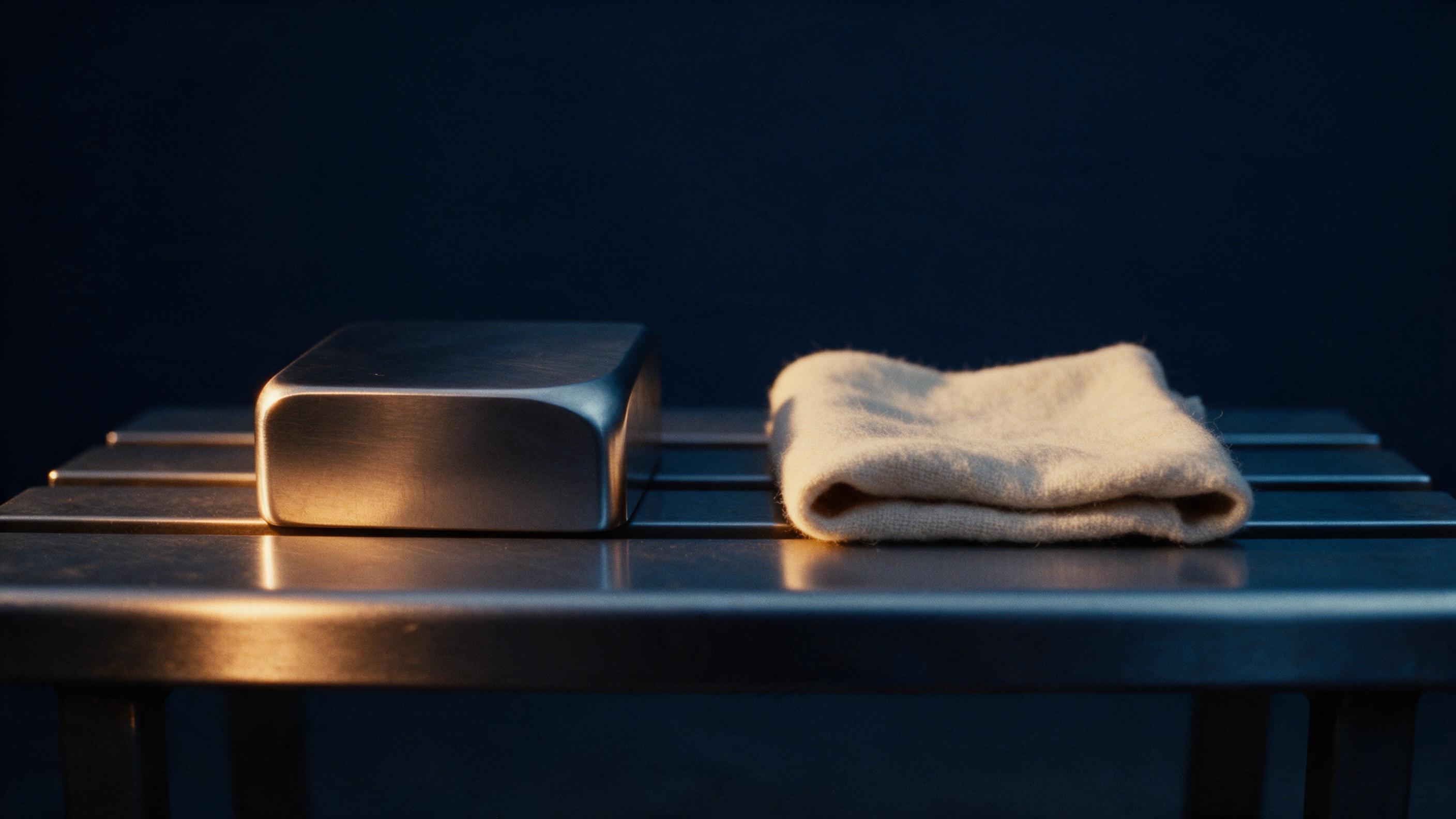
Two Senses Wearing One Name
Human touch is two parallel systems sharing one name. Discriminative touch runs on myelinated A-beta fibres at 35 to 75 metres per second into the somatosensory cortex, with 1 to 2 millimetres of resolution at the fingertip and full conscious access. Affective touch runs on unmyelinated C-tactile afferents at 0.5 to 2 metres per second into the insula, tuned to a 100 to 500 millisecond window and to stroking velocity. More than 95 per cent of electronic skin research targets the first system and under 5 per cent the second. A more sensitive pressure map does not produce a more caring touch.
Two Systems, One Word
English uses one word for touch. The body uses two systems that never share a cable. The first runs on myelinated A-beta fibres at 35 to 75 metres per second into the somatosensory cortex and answers what am I touching, where, how hard and with what texture. The second runs on unmyelinated C-tactile afferents at 0.5 to 2 metres per second into the insula and the emotional brain and answers something else entirely, which is whether this contact is safe and wanted. That is a speed ratio of roughly thirty to one, and it is the least interesting of the differences. The two systems use different receptors, different spinal tracts and different cortical targets. They are not one channel with two settings. They are two channels that never meet. Almost every design argument in electronic skin happens because the word touch lets us slide between them without noticing. Two systems. One word. No shared cable.
The Fast System Is An Instrument
The discriminative system is a measurement instrument with four transducer types and a clean wire to consciousness. Merkel cells track sustained pressure and the edges of objects. Meissner corpuscles fire at the onset of slip, in tens of milliseconds. Pacinian corpuscles read vibration with a temporal resolution in the millisecond range. Ruffini endings read stretch and the direction of skin strain. All four send through the dorsal column-medial lemniscal pathway to the primary somatosensory cortex in areas 3a, 3b, 1 and 2, then to the secondary cortex and on to the posterior parietal cortex. The performance figures are the reason this is where the engineering went. Spatial resolution at the fingertip is 1 to 2 millimetres. Temporal resolution is milliseconds. Conscious access is full: a person can report exactly where the contact was and how hard it pressed. Ask someone to describe a fingertip reading and they will, in detail, with numbers if you give them a scale. An instrument that answers questions that clearly will always attract more research than one that does not.
The Slow System Is A Channel
The affective system has almost none of those properties and does not need them. Its receptors are C-tactile afferents, free nerve endings that exist in hairy skin and are absent from the glabrous skin of the palm and the sole. They carry at 0.5 to 2 metres per second up the spinothalamic tract, the anterolateral route, to the posterior insula, the orbitofrontal cortex, the anterior cingulate and the amygdala. The response window is 100 to 500 milliseconds and it is tuned to stroking velocity. A slow stroke across the forearm in the range of 1 to 10 centimetres per second produces the strongest response; faster or slower and the signal falls away. Spatial resolution is poor and localisation is approximate. Conscious access is affective rather than spatial: the report is that feels good, not that it happened at a particular coordinate. Set an instrument against a channel and the mistake becomes easy to see. You cannot reach the insula by making a pressure map denser. It is a channel.
The Category Error
The commonest error in the field is the assumption that a more sensitive pressure sensor produces a more caring touch. Three facts break it. The receptors are different, so electrotactile and vibrotactile stimulation activates A-beta fibres and cannot reach C-tactile afferents at all, which means it cannot produce the felt sense of being cared for however precisely it is driven. The pathways are different, so a discriminative signal cannot be rerouted into the affective system by raising gain. And the perceptual dimensions are different, so pleasantness is not a function of spatial resolution. The published distribution shows what the error has cost. More than 95 per cent of electronic skin research targets the discriminative system. Under 5 per cent targets the affective one. The choice was rational at every step, because each paper was measured against the instrument. The aggregate result is a field with excellent instruments and almost no vocabulary for care. Instruments measure. They do not comfort. I have built companies across twelve countries and restructured a industrial group. The pattern repeats. Numbers get bought. Adjectives do not.
English uses one word for touch. The body uses two systems that never share a cable.
The Four Numbers A Care Robot Needs
A care robot needs both systems, and the affective half comes down to four specifications that almost nobody writes down. Compliance of 10 to 100 kilopascals, so the surface gives way under a hand rather than resisting it. Surface temperature of 32 to 34 degrees Celsius, which is skin temperature and not room temperature. Force modulation of 0.5 to 2 newtons, light enough to be read as reassurance rather than guidance. And velocity-aware control across 1 to 10 centimetres per second, which is the stroking band the C-tactile afferents are tuned to. A caress with poor spatial resolution and the right velocity, temperature and force feels like care. A perfect pressure map with the wrong timing feels like a machine. Four numbers. That is the whole specification. A surgical robot needs none of this and should optimise the discriminative system alone. A care robot needs both, and the second set of numbers is the harder half, because the first set is a sensor problem and the second is a control problem with a thermal and mechanical stack behind it.
What Almost No Paper Reports
Almost all electronic skin papers report taxel count and density, force sensitivity in kilopascals, response time and durability in cycles. Almost none report perceived pleasantness of the surface, user ratings of social touch quality, velocity-dependent response or temperature-dependent perception. That is a measurement gap, and it comes from the same assumption as the category error: that touch means discriminative touch. Every result in the literature is therefore scored against the half of the sense that happens to be easy to instrument. The probability that the first care robot to feel caring gets there by buying a denser pressure map is low. The probability that it gets there by specifying force, temperature and stroking velocity first, and treating resolution as a secondary field, is much higher, and that specification is cheap. The line that decides the outcome is whether the buyer writes four numbers into a purchase order that nothing in the current catalogue fills.
You cannot reach the insula by making a pressure map denser.
The map is dead. Nobody told you.
Bali State of Mind is the survival guide for the collapse of everything you were taught to believe.
Beyond this book
Building the same thing somewhere else.
Julien Uhlig is available for advisory work, board seats and media appearances. Write to media@exventure.co.
The academy that trains the operators, across every company in the group, is EX Epic Academy - 25,000 applications, 12 per cohort, 200+ alumni across 19 countries. academy.epicsolutiongroup.com
18-20 November. Online, Las Palmas, Bali.
Three days on what happens to work, capital and institutions when the map stops matching the ground. Seats are limited by cohort.
ex-aisummit.com →