Two Machines, One Waste Stream
A digester is a tank of bacteria at 37 degrees. A gasifier is a reactor at 1,000. Both take organic waste, both are proven, and the moisture content of the pile decides which one makes money.
Two Machines, One Pile
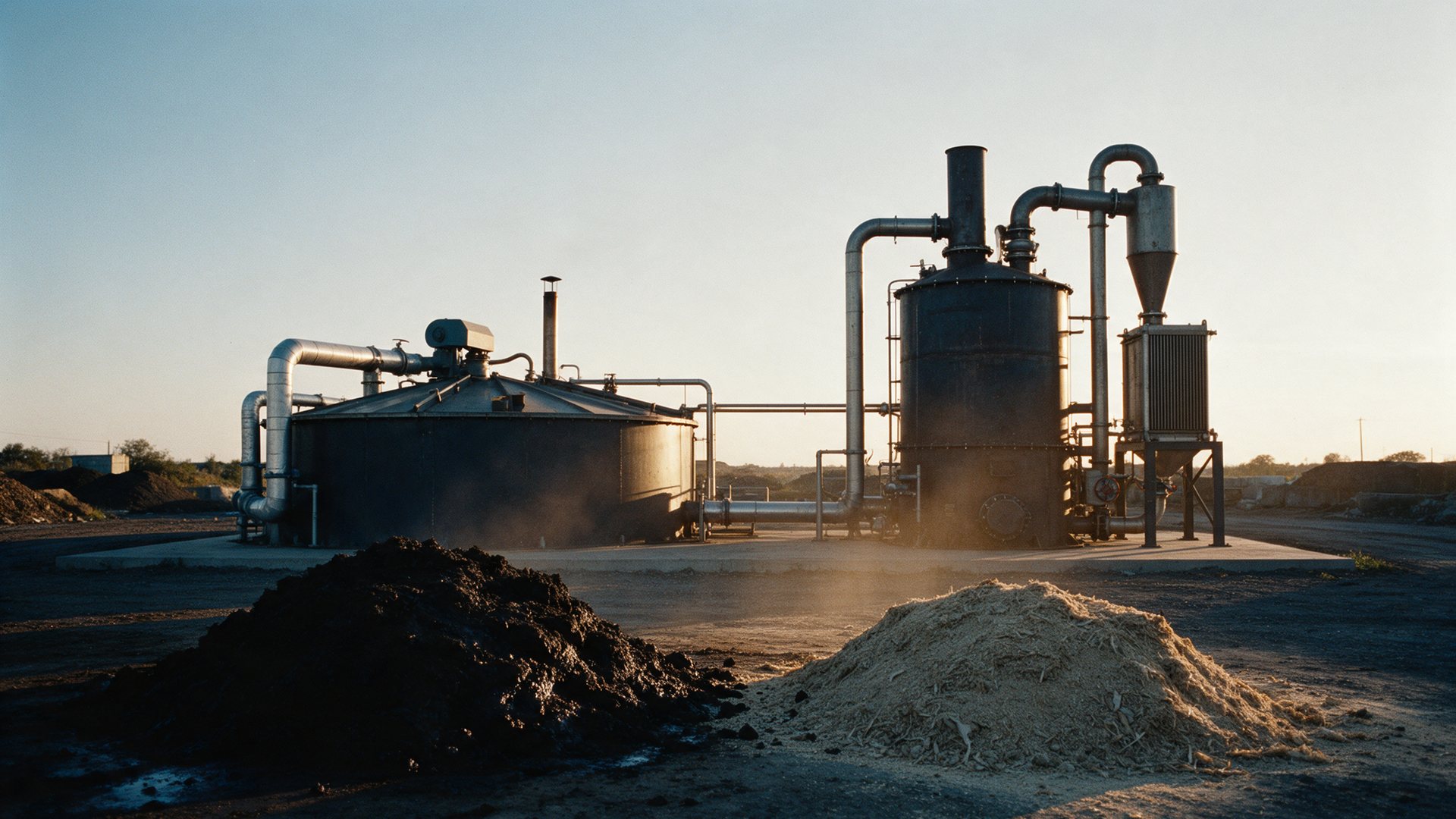
Two machines take the same organic waste and return two different products. An anaerobic digester is a sealed tank of bacteria working between 30 and 55 degrees Celsius. Hydrolysis, acidogenesis, acetogenesis and methanogenesis run in sequence over 20 to 40 days at mesophilic temperature, or 12 to 20 days thermophilic. The product is biogas at 50 to 70 per cent methane and 30 to 50 per cent carbon dioxide, with traces of hydrogen sulphide. The residue is a nutrient-rich digestate. A gasifier runs at 700 to 1,200 degrees Celsius with controlled oxygen or steam. Drying, pyrolysis, oxidation and reduction happen in seconds to minutes. The product is syngas at 15 to 30 per cent hydrogen and 20 to 40 per cent carbon monoxide. The residue is ash. Same pile. Different physics. The pile picks the machine. The probability that a project fails because the cheaper machine was chosen over the suitable one is not small, and the techno-economics are unforgiving about the difference.
The Number That Decides It
The single number that splits the two routes is moisture. Above 70 per cent moisture, the feedstock belongs in a digester. Food waste at 70 to 85 per cent moisture yields 100 to 150 cubic metres of biogas per tonne. Pig and cattle manure at 85 to 92 per cent yields 15 to 40, low per tonne but endless in volume. Sewage sludge at 92 to 97 per cent yields 20 to 40. Maize silage at 65 to 75 per cent yields 180 to 220, which is why it built an entire tariff scheme in Germany. Below 30 per cent moisture the feedstock belongs in a gasifier. Wood chips at 10 to 20 per cent moisture produce 2.0 to 2.5 normal cubic metres of syngas per kilogram. Straw and husks at 8 to 15 per cent produce 1.5 to 2.0. Plastics below 1 per cent produce 2.5 to 3.5, with tar as the price of the extra energy. Wet biomass pushed into a gasifier is dried first, and drying eats 30 to 50 per cent of the energy the feedstock carries. That one penalty settles more projects than any tariff.
What The Digester Costs
The digester is the cheaper build. Below 500 kilowatts of electrical output, anaerobic digestion costs EUR 4,000 to 7,000 per kilowatt. Between 500 kilowatts and 2 megawatts it falls to EUR 3,000 to 5,000. Above 2 megawatts it sits at EUR 2,500 to 4,000. Measured per tonne of annual throughput, EUR 100 to 300. The money goes into the tanks first, 40 to 50 per cent of the build, then the combined heat and power unit at 15 to 25 per cent, then mixing, hygienisation and digestate storage. Operating cost runs EUR 15 to 80 per tonne of input. Electricity drawn by heating and mixing is 10 to 20 per cent of output. The digestate is the quiet revenue line, EUR 5 to 15 a tonne as fertiliser replacement. And the operator is often paid to take the feedstock at the gate, EUR 20 to 60 a tonne for municipal organic waste. That gate fee is a third of the income in some plants.
What The Gasifier Costs
The gasifier costs more to build and more to run. Below 500 kilowatts, EUR 6,000 to 12,000 per kilowatt. Above 5 megawatts, EUR 3,000 to 5,000. Per tonne of annual throughput, EUR 200 to 500, roughly double the digester. The reactor is 30 to 40 per cent of the build. The gas cleaning train is 25 to 35 per cent, and that second number is the one most business plans understate. Tar and particulates have to come out before the gas can be burned or synthesised, and the equipment that removes them is a third of the plant. Operating cost runs EUR 30 to 120 per tonne. Sorbents and catalysts add EUR 5 to 20. The parasitic load is 15 to 30 per cent of output, because oxygen and air have to be compressed and the gas has to be cleaned. The thermal efficiency is higher, 65 to 80 per cent against 50 to 65. The electrical efficiency is lower, 25 to 35 per cent against 35 to 42. Heat is easier to make than electricity.
Same pile. Different physics. The pile picks the machine.
Where The Money Lands
Where the two products land is where the business case splits. Digester gas carries 20 to 25 megajoules per normal cubic metre at roughly 55 per cent methane. It can go into a gas grid as biomethane upgraded to 95 to 99 per cent methane, and that sells at EUR 60 to 90 per megawatt hour with the certificate attached. Electricity earns EUR 50 to 120. Digestate earns EUR 5 to 15 a tonne. Gasifier syngas carries 10 to 15 megajoules per normal cubic metre. Burned for power it earns EUR 50 to 100 a megawatt hour, less than the digester. Used as chemical feedstock it earns EUR 15 to 30. Biochar, the solid co-product, sells anywhere from EUR 50 to EUR 500 a tonne depending on quality. One product is worth more per unit of energy. The other is a platform. A commodity that goes into a pipe and a platform that goes into a molecule are not the same asset, and the market prices them differently.
The Readiness Gap
The readiness levels are not close. Anaerobic digestion sits at technology readiness level 9. It has been commercial on farms for decades and it is the default for municipal organic waste in most of Europe. Gasification sits at 7 to 9, and the range is the honest answer. Clean wood chips in a well-run plant are proven. Mixed municipal waste and high-ash straw are not, and the failures are rarely the reactor. That is the lesson from Entrade, the company that built 200 wood-gasification machines across the UK and Europe. The machine ran. The feedstock decided whether the money came back. I have deployed 210 energy systems across Africa and Asia, and the pattern holds everywhere. The reactor is purchased once. The feedstock has to be right every day for twenty years. A technology readiness number is a statement about the feedstock, not about the steel.
The Carbon Reversal
The carbon accounting reverses depending on what the gas displaces. Corre and colleagues, in Energy Conversion and Management in 2025, put anaerobic digestion with biomethane upgrading at minus 790 kilograms of carbon dioxide equivalent per functional unit when methane substitution is high. Hydrothermal gasification paired with solid oxide electrolysis reaches minus 1,100. Then the reversal. Run the same digester against a grid that has already decarbonised, with zero fossil methane displaced, and the figure can go positive, to plus 770 kilograms per functional unit. The plant does not change. The counterfactual does. Across the sector, digestion cuts greenhouse gas emissions 70 to 95 per cent against a fossil baseline, and gasification 60 to 85 per cent. Both ranges are wide for one reason. The number depends on what the plant replaces, and the plant does not choose that.
The Hybrid And The Decision Rule
The two machines are being combined. The solid fraction of digestate, at 25 to 40 per cent moisture, is dry enough to gasify. The syngas comes back as heat for the digester. Methane is extracted first through digestion, and the residual carbon is gasified afterwards. That cascade is the emerging design, and it is the honest one for mixed waste. The decision rule is simpler than the engineering. Feedstock above 70 per cent moisture, one megawatt or below, with a gate fee and a nutrient market, goes to the digester. Feedstock below 30 per cent moisture, above 5 megawatts, headed for chemicals or biochar, goes to the gasifier. Everything in between is a hybrid. The probability that the winning design in any given region is settled by chemistry rather than by subsidy is not zero. It is close to one.
Wet biomass pushed into a gasifier is dried first, and drying eats 30 to 50 per cent of the energy the feedstock carries.
The map is dead. Nobody told you.
Bali State of Mind is the survival guide for the collapse of everything you were taught to believe.
Beyond this book
Building the same thing somewhere else.
Julien Uhlig is available for advisory work, board seats and media appearances. Write to media@exventure.co.
The academy that trains the operators, across every company in the group, is EX Epic Academy - 25,000 applications, 25 seats per cohort, 210 alumni across 19 countries. academy.epicsolutiongroup.com
18-20 November. Online, Las Palmas, Bali.
Three days on what happens to work, capital and institutions when the map stops matching the ground. Seats are limited by cohort.
ex-aisummit.com →