Twenty Four Tables And Fifty Four Empty Cells
A build file for one ventilated container with two electric heaters in it, counted on the disk. 32,418 bytes and 31,252 characters, and the 1,166 byte gap between those two counts is exactly the weight of the 804 characters that sit above the alphabet, 442 of them carried in two bytes and 362 in three. 705 lines, 178 blank, 527 carrying content, 4,976 words, 58 headings. 24 tables, 190 rows, 638 cells, and 54 of those cells are empty, so the grid is 92 per cent full. The 54 sit in four forms, and every one of them is a column a running machine has to fill in.
Thirty Two Thousand Bytes And One Check Mark
32,418 bytes and 31,252 characters. One file, counted two ways, and the two counts do not agree. The gap is 1,166, and it is exactly the weight of the 804 characters in this document that sit above the alphabet: 442 of them cost two bytes, 362 cost three, and 442 plus 362 twice is 1,166, so the arithmetic closes to the byte. They live in 44 glyphs. 145 umlauts over the u, 93 over the a, 83 en dashes, 75 over the o, 70 approximation signs, 60 box-drawing strokes, 40 arrows, 36 degree signs, 16 superscripts and subscripts, 14 euro signs. One check mark in the entire file, and it appears once, in the header row of a form. 705 lines, 178 of them blank, 527 carrying content. 4,976 words and 58 headings: 1 title, 16 at the second level, 41 at the third, and nothing deeper than that. 101 bold runs and 0 italics. It is a German engineering document, and the reader is an English machine.
Fifty Four Empty Cells In Twenty Four Tables
24 tables over 214 table lines. Counted properly: 24 header rows, 166 data rows, 190 rows, 638 cells. 567 of them carry a value and 54 are empty, which is 92 per cent full and reads like finished work from across the room. The empty ones are not scattered. They sit in exactly four tables, and all four are forms. 21 empty cells in the pre-oxidation sheet, 14 in the cold commissioning check, 7 in the first run of the air preheater, 12 in the first run of the gas heater. 21 plus 14 plus 7 plus 12 is 54. Every one of the 54 is an actual value column or an ok box, and the only thing that can fill it is a person standing in front of a machine with an instrument in their hand. The other 20 tables are specification. They are full. The document carries 14 euro signs and 0 web addresses, so the prices are in it and the suppliers are not.
Two Heaters And Eight And A Half Kilowatts
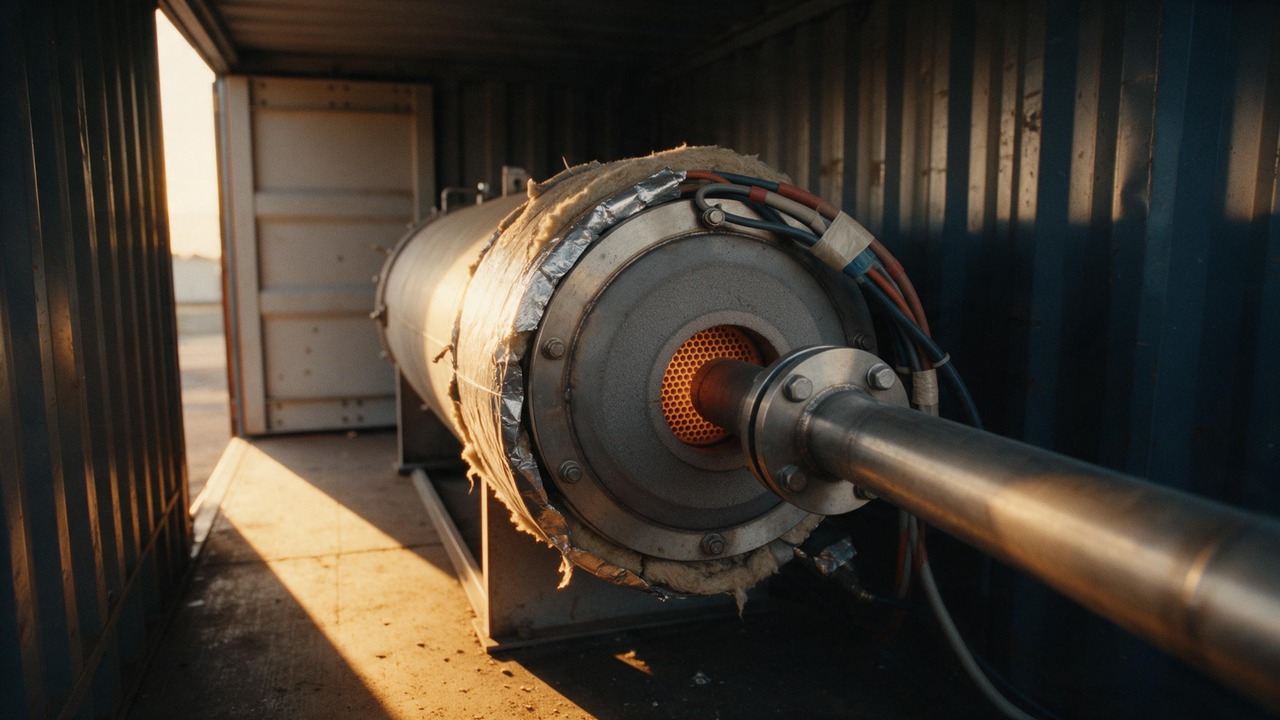
The job is a gasification rig: a wood gasifier and a solid oxide fuel cell inside one actively ventilated container, and it needs two electric heaters. The first lifts 4.81 kg/h of product gas from 300-350 °C to 750-850 °C. The second lifts 28 kg/h of cathode air from 30 °C to 850 °C, which is 22 normal cubic metres an hour, about 370 litres a minute. The heat balance chose the hardware, not the other way round. Gas side: 0.94 kW useful, 1.03 kW in the worst case, 0.30 kW lost through 100 mm of mineral wool over a metre of pipe, 0.30 kW of control reserve, about 1.6 kW in total. The chosen element is 3.3 kW, so it runs near 50 per cent. Air side: 6.95 kW useful, plus losses, plus 15 per cent reserve, so 8.0 to 8.5 kW. The chosen element is 11 kW, near 75 per cent. Nothing here is sized to its own ceiling. Every heater keeps headroom, and headroom is life.
Two Refusals With The Arithmetic Under Them
The 7.5 kW air heater was priced and refused. 6.95 kW of useful heat against a 7.5 kW element is 100 per cent duty with nothing left over for losses, for control or for a cold start, and a wire held at its stop ages faster than a wire with slack in it. The 15 kW unit was refused for the opposite reason. It is built for air volumes in the thousands of litres a minute, and at 370 the flow is too thin to cool the coil, so the heat concentrates and burns the element through in one place. Both refusals sit in the file with the sums beneath them. The spare list is where the money becomes visible: €1,400 for a spare gas heater, €2,500 for a spare air heater, €300 and €500 for the two spare coils, €120 each for four Inconel thermocouples. Leister parts and flow monitors quote 4 to 8 weeks, so one full set lives on the shelf, and the rig gets an interim inspection at 1,500 hours of a 2,000 hour target.
32,418 bytes. 31,252 characters. The gap is 1,166.
Twenty Four Hours Alone In Air Before The First Molecule Of Gas
Before the element ever meets product gas it spends 24 hours on its own in air. The wire is FeCrAl, about 5 per cent aluminium, and at full power in dry instrument air at 30 to 50 litres a minute it grows a closed alpha-alumina skin 5 to 15 micrometres thick. That skin is the entire bet. In the process gas, with 11 to 15 per cent water and 7 to 9 per cent carbon dioxide, the oxygen partial pressure sits near 10 to the minus 19 bar, and alumina only breaks down below 10 to the minus 30. Eleven orders of magnitude of margin, on paper. During the burn-in the current is watched and must not climb, because a climbing current is a wire going brittle. Then it cools with the air still moving, for at least 30 minutes. The visual check is a matte grey with a faint gold sheen and no bare spots. The probability that this holds for the full 2,000 hours is not zero. The file prices it at one. The sheet that would prove it is still blank.
A Chain That Cannot Be Argued Out Of A Trip
None of the safety inputs can be argued with. A flow monitor on the container exhaust drops the whole rig. A CO sensor in the same duct warns at 30 parts per million and trips at 60. A thermocouple on each heater opens at 880 °C and needs a hand to reset. Current transformers cut on a broken element or an arc in under 10 milliseconds. All of it sits in series through a safety relay, positively guided, manual reset only, green and red lamps on the cabinet door. Then one residual current device per heater, never one for both: leakage runs 0.3 to 1.0 milliamps per kilowatt and multiplies by five to ten on a cold start after a standstill, and a summed trip on a rig with a difficult start-up costs a day. The last metre of cable before each flange is silicone, because PVC jackets go brown and brittle near these heaters after a few hundred hours. At the foot of the file is the commissioning protocol: 14 cold checks, a setpoint ramp of 100 kelvin every 10 minutes, a two hour run, a gas side that cools below 300 °C before the gas is shut off, and three signature lines with blank dates under them. Created 2026-04-13, indexed 2026-09-23, 163 days apart. Twenty four tables, 54 empty cells, one check mark. The document is finished. The rig has not been started.
804 characters above the alphabet, in exactly 44 glyphs.
The map is dead. Nobody told you.
Bali State of Mind is the survival guide for the collapse of everything you were taught to believe.
Beyond this book
Building the same thing somewhere else.
Julien Uhlig is available for advisory work, board seats and media appearances. Write to media@exventure.co.
The academy that trains the operators, across every company in the group, is EX Epic Academy - 25,000 applications, 25 seats per cohort, 210 alumni across 19 countries. academy.epicsolutiongroup.com
18-20 November. Online, Las Palmas, Bali.
Three days on what happens to work, capital and institutions when the map stops matching the ground. Seats are limited by cohort.
ex-aisummit.com →