The Salzburg Director Gave Her 9. The Regional House Gave Her 4.
One soprano, one aria, three minutes, 250 people in the room. The director of the Salzburg Festival scored her 9 out of 10. The director of a 300-seat house in southern Germany scored her 4. Same voice. Two verdicts. Neither of them wrong.
Two Verdicts, One Voice
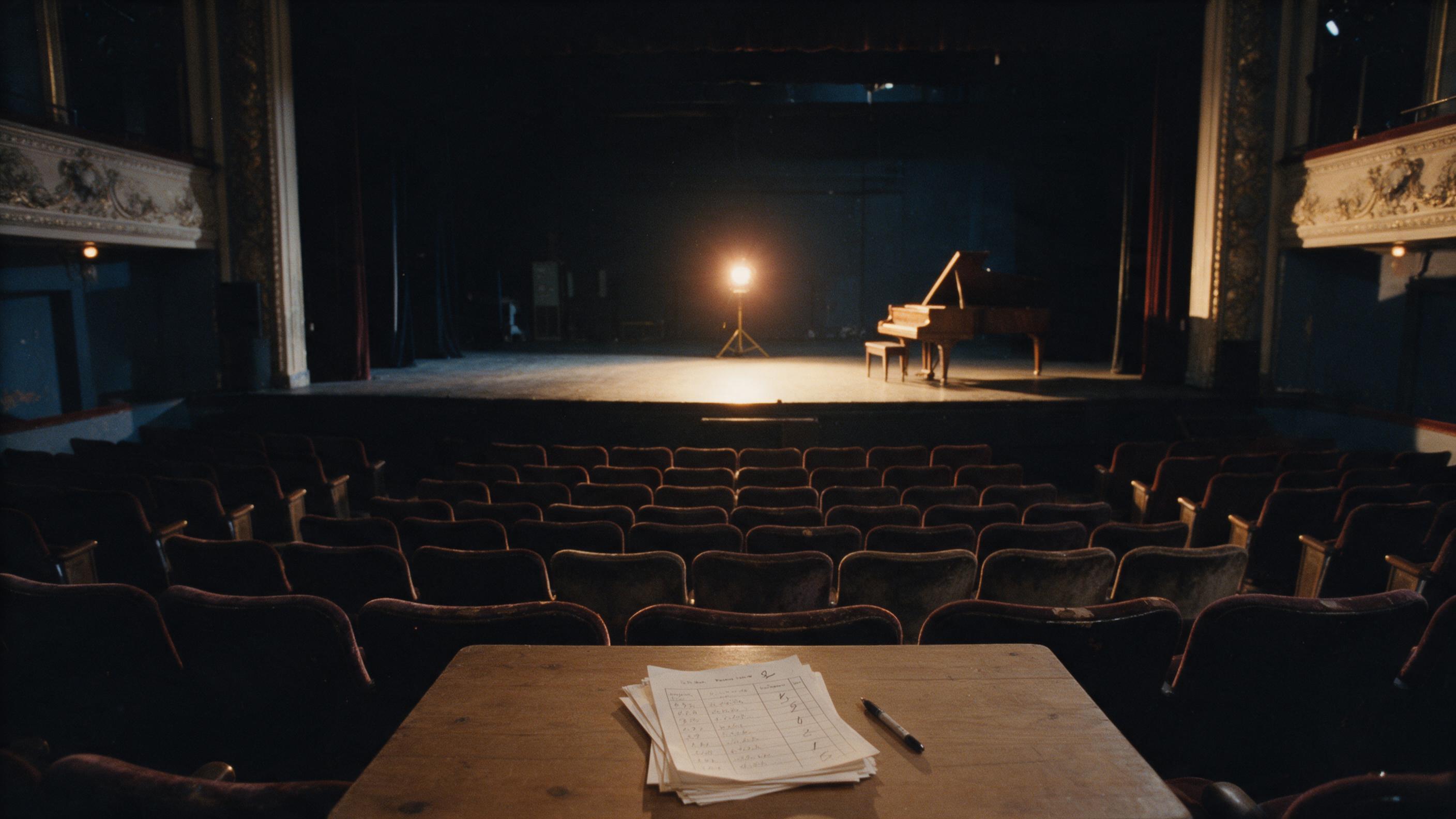
The audition room at NYOP is 50 feet long and 40 feet wide. Professional stage at one end, warm front lights, a grand piano at stage right. It seats 300. Today there are 250 people in it: opera directors, casting agents, managers, the people who decide who works. A soprano walks to centre stage. She is 26. Conservatory-trained, regional productions behind her, an aria from Verdi prepared. The kind of three-minute piece where you can hear whether someone is a real singer or just a voice with good technique. She is exceptional. Technique, musicality, presence. I stop watching her and watch the room instead. Some directors take notes. Some daydream. Most are calibrating what they just heard against their own internal scale. The rating sheets come back. The director of the Salzburg Festival writes 9 out of 10. World-class technique, premium tier, serious consideration for major European houses. The director of a 300-seat house in southern Germany writes 4 out of 10. Limited commercial potential. Not appropriate for our programming calendar. Pass. Same singer. Same aria. Same three minutes. Two men with the power to hire her, and they heard two different people.
A Small Business Is Not a Small Big Business
The Salzburg director is listening for one thing: can this voice fill 1,500 seats, night after night, at premium ticket prices. The regional director is listening for something else entirely: can she cover three roles, rehearse on my calendar, and sing for 300 euros a performance. Neither is wrong. They are standing on different maps. That is the part most people miss. Scale does not make an operation bigger. It makes it a different organism with different rules. The management structure that works at 50 people breaks a 500-person company. The founder who decides everything at 50 people becomes the bottleneck at 500. The decision process that saves a 5,000-person company is bureaucratic theatre at fifty. The venture model that works for software is useless for manufacturing. The marketing that builds a viral account is poison for a business that sells to procurement departments. Different games. Different rules. Different winners. And the trap is that most people learn the rules of exactly one game. They get very good at it. Then the context shifts and they are still playing the old rules in a new room, wondering why the same moves stopped working.
Six Collapses, One Lesson
I have been inside six collapses. Institutions that looked permanent, gone. The border guards at the Berlin Wall knew that border better than anyone alive. They had spent entire careers on every metre of it. When it fell, almost none of it transferred. I stood inside Lehman Brothers in 2003, the night the grid went dark across the north-east, and the people around me understood leverage, positions and how to make money in that environment better than anyone I have met since. The academics who studied the stability of the financial system were surprised when it stopped being stable. The central bankers whose entire job was to see it coming did not see it coming. The reason is always the same. They priced the probability of disruption at zero. Not low. Zero. Every position, every career, every mortgage in the room was built on the assumption that next year would look like last year. I was inside one of those collapses myself, in a boardroom in Munich, and I have described it elsewhere in this book. What matters here is the mechanism, not the story. The people with the most authority were the least prepared, and they were the least prepared precisely because the thing that gave them authority was a track record.
Promotion Runs On Last Year's Game
The system promotes people for winning the game that has just ended. That is not a conspiracy. It is a default. The trader who makes money gets the management job, even though trading and managing people are not the same skill. The administrator who is good at handling a board becomes artistic director, even though board politics and artistic judgement are not the same skill. The partner who made money in 2015 raises the next fund in 2025 with the pattern that worked fifteen years ago, into a market that has already changed shape. Past success becomes current position. Current position becomes authority over the future. So the people with authority over the future are optimised for the past, and they hold the resources needed to resist anything that contradicts their own experience. I have watched it happen in an opera house, in a bank, and in a venture fund. Same mechanism, three industries. The competence was real. It was just real about a world that had already been replaced.
Talent that is elite in one game is mediocre in another. Most people never find out which game they are actually playing.
The Only Qualification Is Staying In The Room
There is a second filter, and it is the harsher one. The qualification most people at the top actually hold is keeping other people out of the room. A senior manager is promoted because they manage upward well. The boss is never embarrassed. The boat is never rocked. The numbers arrive on time. Not because the decisions were right. Then they promote people who are good at exactly that, and the organisation starts running on organisational logic instead of business logic. Decisions get made to protect positions. Risks get avoided to protect careers. Information gets hoarded to protect power. Nobody in the room notices, because they are inside it. Look at what it produces. Universities still run a 17th-century format: one professor, one room, passive students. It was a rational design in 1650, when the professor was the only source of information in the building. Every fact in that lecture is now a search away, and students pay 30,000 pounds a year for the format anyway. Governments are writing rules for artificial intelligence using frameworks built for automobiles. Executives cut the research budget to hit this quarter, because the bonus is real and the collapse is nine years out.
Price The Probability Honestly
So ask the question directly. What game are you actually playing, and are the rules you learned the rules in front of you. The probability that the framework you built your career on is still valid in five years is not zero. Not ten percent either. Most people are running it at zero, which is why a transition always feels like an ambush instead of a schedule. I have restructured a 75 million euro industrial group, and in one of those restructurings the entire argument was irreplaceability. Sixty-five engineers. 1.5 million euros a month to employ them. A company that had not been profitable in three years. A promise that the building falls down the moment they walk out. It did not fall down. The system was rebuilt a different way and it stood, because irreplaceability was never a property of the people. It was a property of a design nobody had been forced to question yet. The engineers who understood that found a way forward. The ones who clung to their own irreplaceability left anyway, and discovered their expertise was worth less on the open market than it had been inside the building. Sixteen years of field work, from rural Nigeria and post-conflict Serbia to Kazan and Fukushima, taught me the same thing every time. The ones who survive a transition are never the ones who were certain. They are the ones who worked out which game they were in, and priced the probability of it ending above zero.
The people in charge are not there because they deserve to be. They are there because they won the last game.
The map is dead. Nobody told you.
Bali State of Mind is the survival guide for the collapse of everything you were taught to believe.
Beyond this book
Building the same thing somewhere else.
Julien Uhlig is available for advisory work, board seats and media appearances. Write to media@exventure.co.
The academy that trains the operators, across every company in the group, is EX Epic Academy - 25,000 applications, 25 seats per cohort, 210 alumni across 19 countries. academy.epicsolutiongroup.com
18-20 November. Online, Las Palmas, Bali.
Three days on what happens to work, capital and institutions when the map stops matching the ground. Seats are limited by cohort.
ex-aisummit.com →