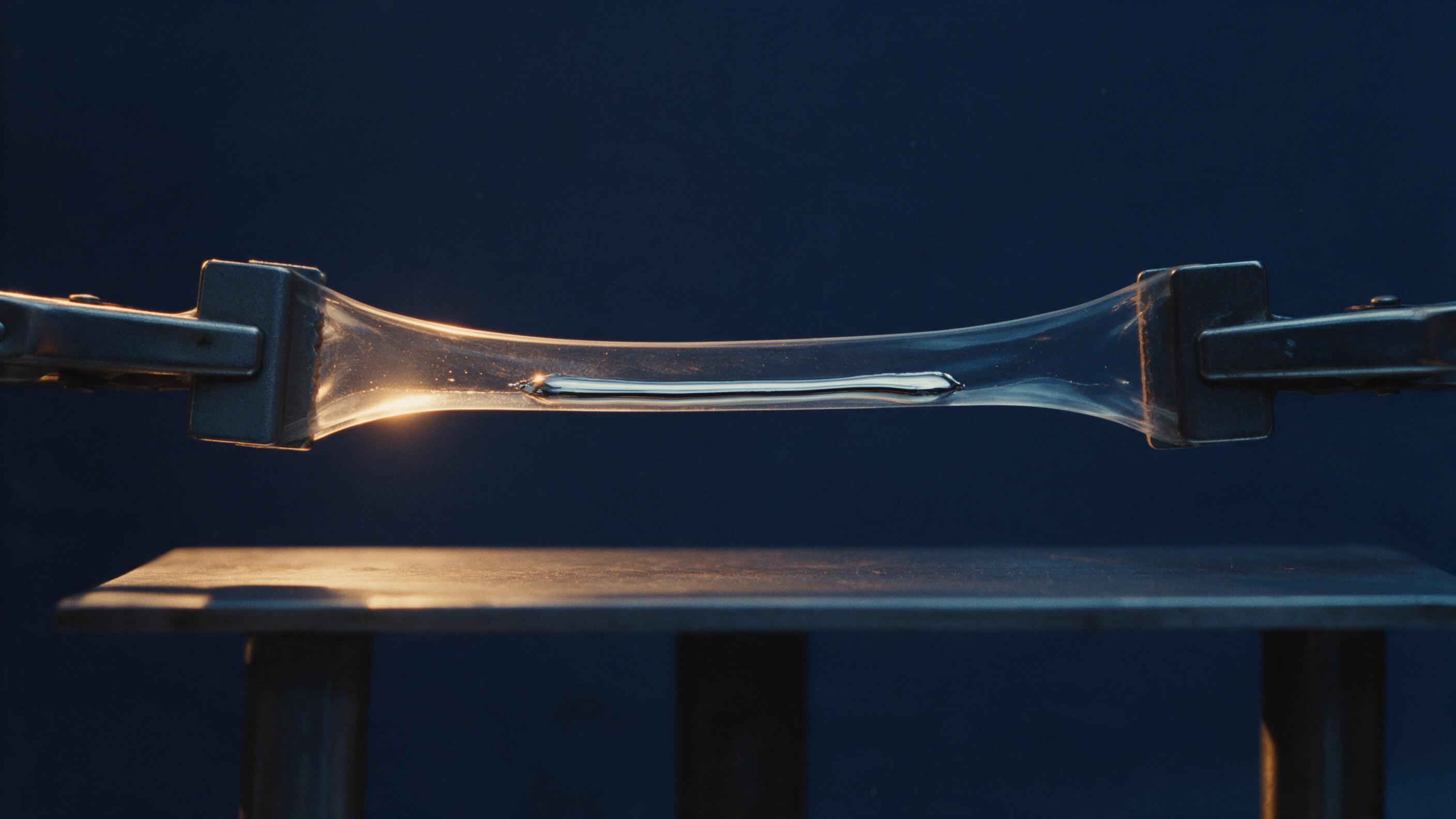
The Wire That Stretches
Eutectic gallium-indium melts at 15.7 degrees and carries 34,000 siemens per centimetre against copper's 580,000, and it cannot fatigue-fail because it is already liquid. The bill arrives as a five-nanometre oxide skin that has to be broken before it conducts, a seal that fails catastrophically rather than gradually, and gallium that diffuses into the aluminium beside it.
A Wire That Is Already Broken
Solid metal fails by fatigue. Bend a copper trace 100,000 times and the grains inside it work-harden, a crack opens at a surface defect, and the crack walks across the section until the trace is open. The mechanism needs a crystal lattice to travel through. Eutectic gallium-indium has none. It is 75.5 per cent gallium and 24.5 per cent indium by weight, and it is liquid at room temperature, melting at 15.7 degrees. There are no grain boundaries to work-harden, no dislocations to pile up, no fracture path through a material that has already given up its strength. A wire that is already broken cannot break again. That single property is why the material keeps appearing in robotic skin. Every other stretchable conductor is a compromise between conductivity and stretch, and the compromise is paid in fatigue: the trace necks, thins, crazes and opens. A liquid conductor removes the failure mode instead of delaying it.
What The Conductivity Costs
Copper carries 580,000 siemens per centimetre. EGaIn carries 34,000. That is a factor of 17, and it is the price of admission: seventeen times the cross-section for the same current, or seventeen times the Joule heating in the same cross-section. What the metal gives up in conductivity it keeps in flow. Viscosity is around 2 centipoise, close to water, so it moves through a channel under modest pressure. Density is 6.3 grams per cubic centimetre, which starts to matter the moment the trace is vertical. Surface tension is roughly 0.5 newtons per metre, high enough that the liquid resists being pulled into a corner. Against the other soft conductors the gap runs the other way. EGaIn is around 10,000 times more conductive than PEDOT:PSS and about 100 times more conductive than a percolation composite, and unlike both it holds its resistance when the substrate stretches, because the conductor does not change geometry. The channel deforms. The liquid inside it does not neck.
The Skin Is The Whole Problem
Gallium oxidises the instant it meets air. The skin that forms is 1 to 5 nanometres of gallium oxide, and it does three things at once. It stabilises the shape, which is why a droplet of liquid metal can be patterned into a structure that holds under stress below 100 pascals. It insulates, which keeps adjacent traces from shorting. And it blocks electrical contact, which is the problem, because a contact that must be broken before it conducts has a resistance you cannot trust. The skin also makes the metal non-Newtonian. It drips like a liquid and holds shape like a solid, depending on how fast it is pushed. Traces self-heal when two cut volumes touch again, because the oxide reforms across the join: the same layer that ruins a connector is the layer that closes a broken circuit. Every manufacturing step then has to be designed around that film. Break it mechanically, break it chemically, or accept the contact resistance and calibrate it out.
Pouring A Wire Into A Channel
The reliable route is microfluidics. Cast an elastomer, PDMS or Ecoflex, with the channel geometry, seal a second layer over it, inject the liquid metal through inlet ports at 200 to 500 kilopascals, then seal the ports. Channel widths run from 10 to 500 micrometres, and the resulting traces hold under 1 ohm per centimetre and stretch past 100 per cent. The comparison is where the choice gets made. A microchannel trace conducts around 30,000 siemens per centimetre at 0.1 to 10 ohms per centimetre, stretches 200 to 500 per cent, and holds a minimum feature of 10 micrometres; it does not fatigue, because the conductor is a liquid and only the channel walls can wear. A printed trace conducts 10,000 at 1 to 50 ohms per centimetre, stretches 50 to 200 per cent and stops at 100 micrometres, and its channel walls fatigue. An injected fibre sits between them at 20,000 siemens per centimetre, 0.5 to 5 ohms per centimetre, 100 to 300 per cent stretch and 50 micrometres, with the same wall-fatigue limit. Resolution and fatigue both trace back to one question: is the metal enclosed or exposed. Enclosed, the liquid is protected and the walls take the strain. Exposed, the metal is its own structure and it wears like one.
A wire that is already broken cannot break again.
The Bill Comes Later
Sealing is the first cost. A microfluidic trace is only as good as its bond, and when the seal fails the failure is not gradual. Liquid metal bleeds out, reaches the neighbouring trace, and shorts it; on a dense array the leak path is the shortest distance between two nets. Gallium migration is the second. Liquid gallium diffuses into the grain boundaries of aluminium and several other metals, so an adjacent solid component that was sound on day one cracks along boundaries that have been chemically weakened. It is not a slow loss of margin. It is a joint that passes test and then fails. Gravity is the third. In a vertical or large-area panel the liquid pools at the bottom, the cross-section changes with orientation, and the resistance changes with it. Temperature is the fourth. The metal freezes at 15.7 degrees, so anything outdoors, anything unheated, anything shipped cold is a solid. Galinstan, the gallium-indium-tin option, pulls that floor down to minus 19 and no further.
Where It Wins And Where It Fails
The sufficiency test is short. If the interconnect must stretch past 100 per cent, if it must survive more cycles than a solid trace can take, if the array is dense enough that 10 micrometres of resolution matters, and if the assembly can be sealed and kept above its melting point, then liquid metal is the only conductor on the table that removes fatigue rather than postponing it. The failure set is just as short. High current density, because a factor of 17 in conductivity is a factor of 17 in heating. Cold service below 15 degrees. An aluminium housing anywhere near the trace. A seal that cannot be guaranteed for the life of the part. A vertical panel, where pooling moves the cross-section and the resistance with it. The material is not a better wire. It is a different one, chosen for the failure it cannot have. The probability that a solid trace wins that comparison on an equal stretch budget is not zero, while most people price it at zero.
Copper carries 580,000 siemens per centimetre. EGaIn carries 34,000.
The map is dead. Nobody told you.
Bali State of Mind is the survival guide for the collapse of everything you were taught to believe.
Beyond this book
Building the same thing somewhere else.
Julien Uhlig is available for advisory work, board seats and media appearances. Write to media@exventure.co.
The academy that trains the operators, across every company in the group, is EX Epic Academy - 25,000 applications, 12 per cohort, 200+ alumni across 19 countries. academy.epicsolutiongroup.com
18-20 November. Online, Las Palmas, Bali.
Three days on what happens to work, capital and institutions when the map stops matching the ground. Seats are limited by cohort.
ex-aisummit.com →