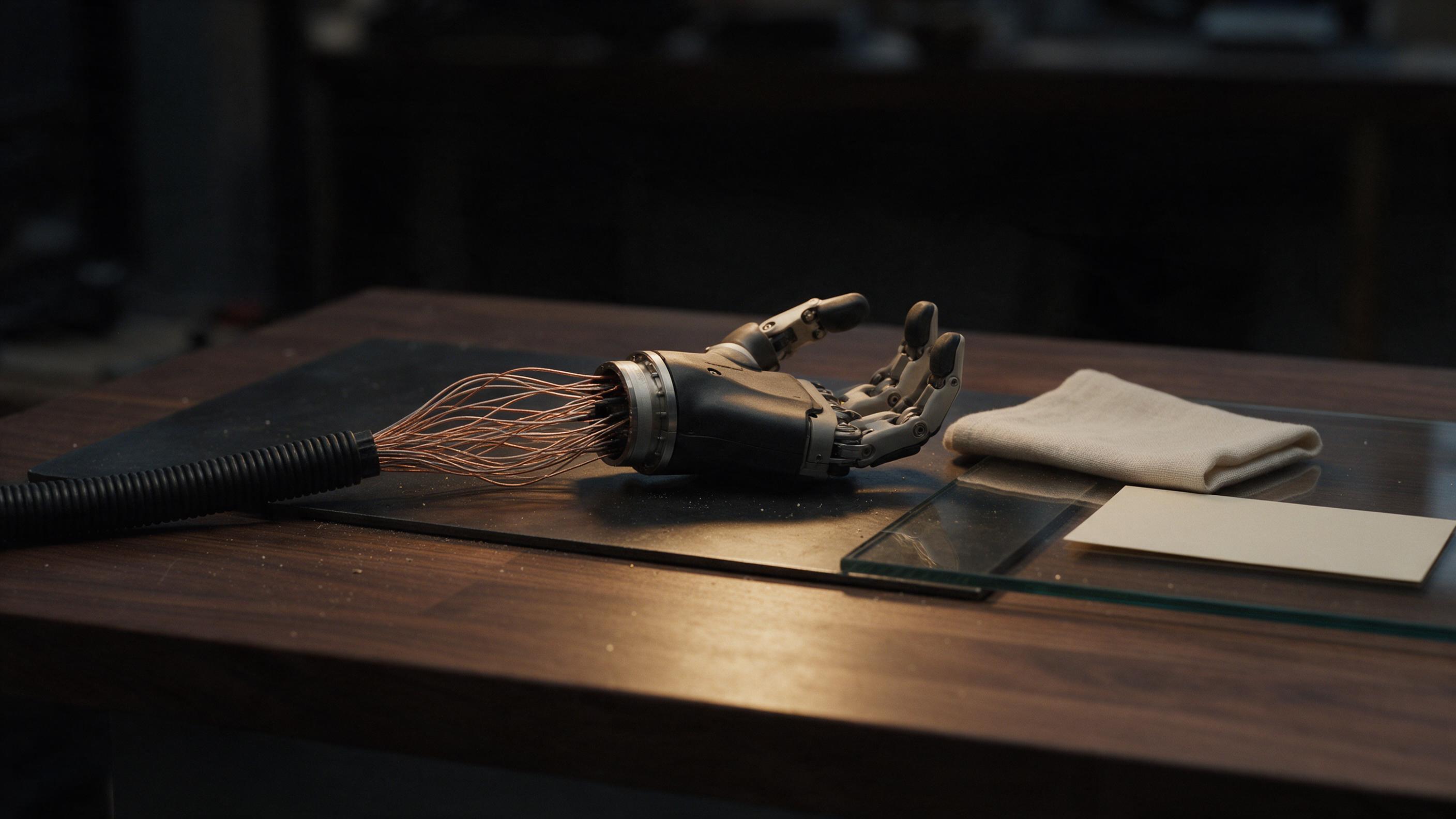
The Wire That Breaks First
Cover a robot hand with a thousand sensors and the interesting problem stops being the sensors. A thousand signals have to leave a curved, moving, deforming surface through joints that flex half a million times a day, and the published failure rates say the harness gives out long before the transducer does. The human hand solved this with 38,000 nerve fibres at the wrist and no joints that fail.
Human Skin Is Wireless By Comparison
A human hand carries roughly 17,000 mechanoreceptors and about 38,000 nerve fibres crossing the wrist, and it moves all of that sensory traffic at something close to a gigabit per second with zero fatigue failures across a lifetime. A typical robot hand in 2020 ran 10 to 50 taxels at about 10 kilobits per second over 10 to 100 wires. A strong research hand in 2025 runs 100 to 500 taxels, up to 1,000 in the best published work, at 1 to 10 megabits per second over 30 to 300 wires. The sensor count grew by an order of magnitude. The failure rate on a flexing joint did not fall. It sits at 1 to 5 per cent per million cycles on the good hardware against zero in the organism.
The Arithmetic Is Not Close
1,000 taxels at 10-bit resolution sampled at 100 hertz comes to about 1 megabit per second, which one finger can carry. Ten fingers plus a palm takes that past 10 megabits per second. A whole hand at 10,000 taxels lands above 100 megabits per second, and that traffic has to travel one to ten metres to a readout computer. At that point the interconnect is not a detail of the design. It is the design. Every published architecture comparison runs into the same wall, which is why the question shifted from how many sensors a hand can hold to how many signals a wrist can pass.
Five Ways A Harness Fails
Mechanical fatigue comes first. A wire crossing a knuckle sees around 500,000 flex cycles in a single day of active manipulation, and standard wire fails somewhere between 10,000 and one million cycles depending on bend radius, so the crossover is a matter of days. Mass comes second: 300 shielded wires weigh 30 to 100 grams crossing the wrist joint, which is inertia the actuators then have to move. Stiffness comes third, because a wire bundle resists deformation and changes the contact mechanics of the skin it is supposed to be reading. Crosstalk comes fourth, as capacitive and inductive coupling between adjacent conductors carrying high-frequency signals corrupts the measurement. The connector comes last and matters most, because the interface between a moving skin and a stationary readout is the single most failure-prone point in any tactile system.
Route One And Route Two
Matrix addressing is the standard answer: scan rows and columns and N squared taxels need only 2N wires. It is simple, proven and cheap in component count. It also ghosts, because current sneaks through unintended paths, and time-multiplexed scanning caps the frame rate at N times the per-taxel integration time, so signal-to-noise falls as taxel count rises. Active-matrix backplanes put a thin-film transistor at every taxel the way an OLED display does, which isolates each site, removes crosstalk and scales from a thousand to a hundred thousand taxels with true random access. The cost is manufacturing: depositing uniform thin-film transistors on a flexible substrate is hard, and threshold voltage varies across the plastic.
The bottleneck is not the sensor. It is the wires.
Route Three Sends Nothing Until Something Changes
The third response is the biomimetic one. Every taxel transmits only when its reading changes meaningfully, asynchronously and sparsely, the way a sensory nerve fires. Under the contact conditions that dominate manipulation, that collapses the data rate by 10 to 100 times before any compression is applied. It also fits the events a grip actually cares about, which are slip and contact onset rather than a full frame of pressure. The price is per-taxel circuitry, a threshold comparator plus memory at every site, a more complex readout protocol, and no standard. The engineering consensus in the published work is that something in this family wins, and nobody has yet settled which.
The Metric That Decides It
The honest measure is bits per wire per second. A passive matrix delivers about 1 to 10 bits per wire per second at useful taxel counts. An active matrix delivers 100 to 1,000. An event-driven architecture delivers 10,000 to 1,000,000 during the sparse contact conditions that dominate real manipulation. That spread is the whole story, and it says the skin has to process locally rather than ship raw pressure to a computer at the end of a thousand wires. I have built companies across twelve countries and restructured a industrial group, and the pattern in every physical system I worked with is the same: the component that gets the attention is rarely the component that fails. The probability that a better transducer alone solves whole-hand touch this decade is not zero, and it is well below the confidence the demonstrations carry. Count the wires first.
Three hundred shielded wires crossing one wrist weigh up to 100 grams, and that weight is inertia the actuators now have to carry.
The map is dead. Nobody told you.
Bali State of Mind is the survival guide for the collapse of everything you were taught to believe.
Beyond this book
Building the same thing somewhere else.
Julien Uhlig is available for advisory work, board seats and media appearances. Write to media@exventure.co.
The academy that trains the operators, across every company in the group, is EX Epic Academy - 25,000 applications, 12 per cohort, 200+ alumni across 19 countries. academy.epicsolutiongroup.com
18-20 November. Online, Las Palmas, Bali.
Three days on what happens to work, capital and institutions when the map stops matching the ground. Seats are limited by cohort.
ex-aisummit.com →