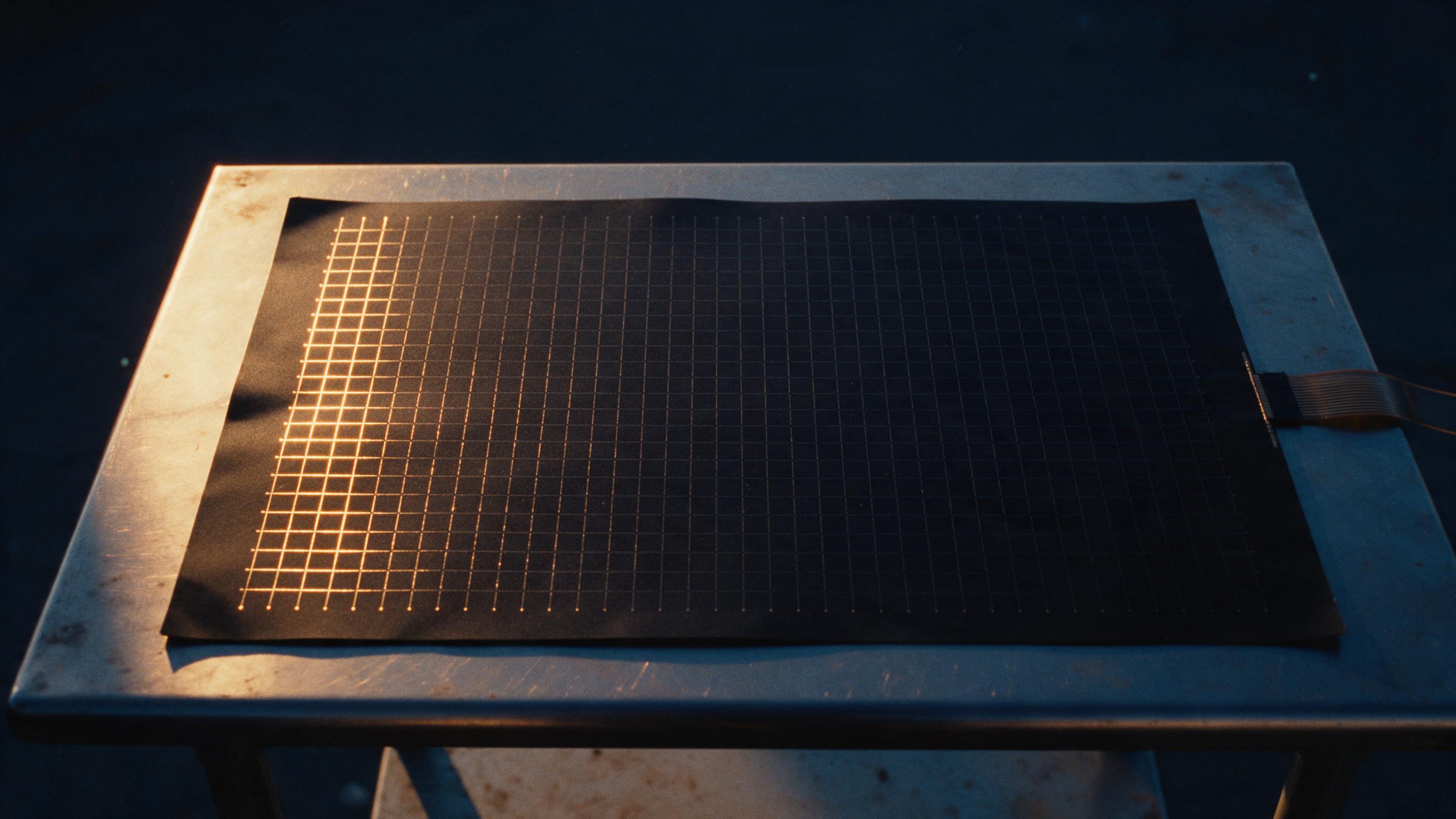
The Wire Count Decides The Resolution
Row-column addressing turns ten thousand taxels into two hundred wires, and then physics takes part of it back: at 100 microseconds of settling time an 8 by 8 array frames at 1,500 Hz while a 100 by 100 manages 10, ghost readings appear past 16 by 16 on resistive arrays, and signal-to-noise falls as 1 over root N until it drops under 10 dB past 50 taxels per column. The wiring is not the bottleneck. The scan is.
Two Wires Where There Were A Hundred
A passive matrix puts a sensor at the crossing of a row and a column. A hundred row electrodes and a hundred column electrodes give ten thousand taxels, and the wire count is two hundred. Read every taxel directly and you need ten thousand wires and ten thousand amplifiers, which is why almost nobody does it. Each taxel is a two-terminal device, resistive or capacitive. The readout is a loop. Bias one row, leave the others floating, read the current or charge off every column at once, then move to the next row. One frame is N scans. The scheme is simple, it is proven, and it has been the default for sensor arrays for four decades. The elegance is real. The bill arrives later, in three places: speed, crosstalk and noise.
The Scan Is The Frame Rate
Frame rate is one over N times the per-taxel settling time. Settling time is set by the RC constant of the taxel and its column line, so the number is not a designer's choice, it is a consequence of the geometry. At 100 microseconds of settling, an 8 by 8 array frames at about 1,500 Hz. A 16 by 16 drops to roughly 390 Hz, a 32 by 32 to 100 Hz, a 64 by 64 to 25 Hz, and a 100 by 100 to about 10 Hz. Moving from 64 taxels to 10,000 taxels costs you 150 times the frame rate, and it gets worse than the arithmetic, because a longer column line carries more capacitance, which lengthens the settling time you were dividing by. The two effects compound. A slip event begins and resolves inside a few milliseconds. Sample it at 10 Hz and you get one reading every 100 milliseconds, which is a still photograph of the aftermath. The hand that dropped the glass was fast. The array that should have caught it was slow.
The Ghost At The Mirror
When row i is biased, current from taxel (i,j) is supposed to reach column j and stop. It does not. Current sneaks through alternate paths, through neighbouring taxels sitting on the same column and the neighbouring rows, and the array reports touches that never happened. The signature is specific. A light touch on one taxel appears as a correct reading at that taxel plus a ghost reading at the mirror position. Past 16 by 16 on a resistive array, and past 50 by 50 on a capacitive one, the ghosts are severe enough that the image is unusable. The amplitude scales with the ratio of the selected taxel's impedance to the parasitic impedance of the unselected paths, which is why the failure arrives at different densities for different materials. The fix is old and known. Put a diode at every node and the sneak paths close, at the cost of fabrication complexity, which is what passive-matrix OLED displays do. Put a transistor at every node and crosstalk disappears entirely, along with the simplicity of the passive matrix. That device has a different name and a different bill.
The Noise Falls As The Array Grows
Here is the trade nobody puts on the specification sheet. As the array grows, the signal per taxel stays the same, because the taxel area stays the same. The column line capacitance rises, because more devices hang off it, and the readout noise rises with it, thermal noise plus flicker noise from longer traces. Signal-to-noise therefore falls as one over the root of N for resistive arrays and as one over N for capacitive ones. The linear case is brutal. Past 50 taxels on a column, a capacitive array sits under 10 dB of signal-to-noise, which is marginal for reliable touch detection. So a share of the resolution you added is cancelled by the noise that came with it. Density and clarity are the same budget line, and the row count is what spends it.
Ten thousand taxels on two hundred wires is a bargain. The scan is the price.
What Buys It Back, And What It Costs
Six techniques are on the table and they sort cleanly by what they cost. At the cheap end, a diode at each node reduces ghosting for modest process complexity, and a differential readout rejects common-mode noise without changing the array. Charge integration readout beats voltage readout on signal-to-noise for capacitive arrays, and it is well understood. At the other end, a transistor at each node removes crosstalk completely and turns the array into an active matrix, which is a different engineering problem with a separate roadmap. Frequency-division multiplexing reads several rows at once and is still research. Time-division with compressed sensing samples below the Nyquist rate on the reasonable assumption that contact is sparse, and it is the most interesting idea in the list and the least mature. The pattern is plain. Everything above the diode line either raises the cost per taxel or moves the work from manufacturing into signal processing, and neither is free at volume.
Where The Matrix Is Enough
Matrix addressing is sufficient when the array is under 16 by 16, the frame rate requirement is under 100 Hz, force precision is not critical, and cost sensitivity is high enough that a per-taxel amplifier is unthinkable. That covers a great deal of commercial touch today, and it is why the scheme survives. It fails at density above 32 by 32, at dynamic capture, meaning slip and texture scanning above 200 Hz, at absolute force measurement where crosstalk corrupts the reading itself, and on capacitive arrays sitting in electrically noisy environments. I deployed 210 energy systems across Africa and Asia. Most of the failures in that fleet were not component failures. They were interfaces specified on a desk against numbers that only held in a lab, and then handed to a field that never read the assumptions. The probability that the first skin good enough to make a robot hand genuinely useful is a passive matrix is close to zero. So the question to put to a supplier is not how many taxels. It is how many rows, and how long each row is allowed to settle before you read it. That answer tells you what the device can actually feel.
Every row you add hands you resolution and takes back time.
The map is dead. Nobody told you.
Bali State of Mind is the survival guide for the collapse of everything you were taught to believe.
Beyond this book
Building the same thing somewhere else.
Julien Uhlig is available for advisory work, board seats and media appearances. Write to media@exventure.co.
The academy that trains the operators, across every company in the group, is EX Epic Academy - 25,000 applications, 25 seats per cohort, 210 alumni across 19 countries. academy.epicsolutiongroup.com
18-20 November. Online, Las Palmas, Bali.
Three days on what happens to work, capital and institutions when the map stops matching the ground. Seats are limited by cohort.
ex-aisummit.com →