The Wave Goes Where The Target Is
Light direction and character direction are 1 discipline, and both are settled once per scene and then held. The key light gets 1 direction. The characters get 1 geography. Every wave, point, look and reach is a vector that has to point where its target actually sits, and the fastest way to break a world you built is to aim a gesture at the lens while the other character stands behind the waver.
The Key Has 1 Direction And Then It Stops Moving
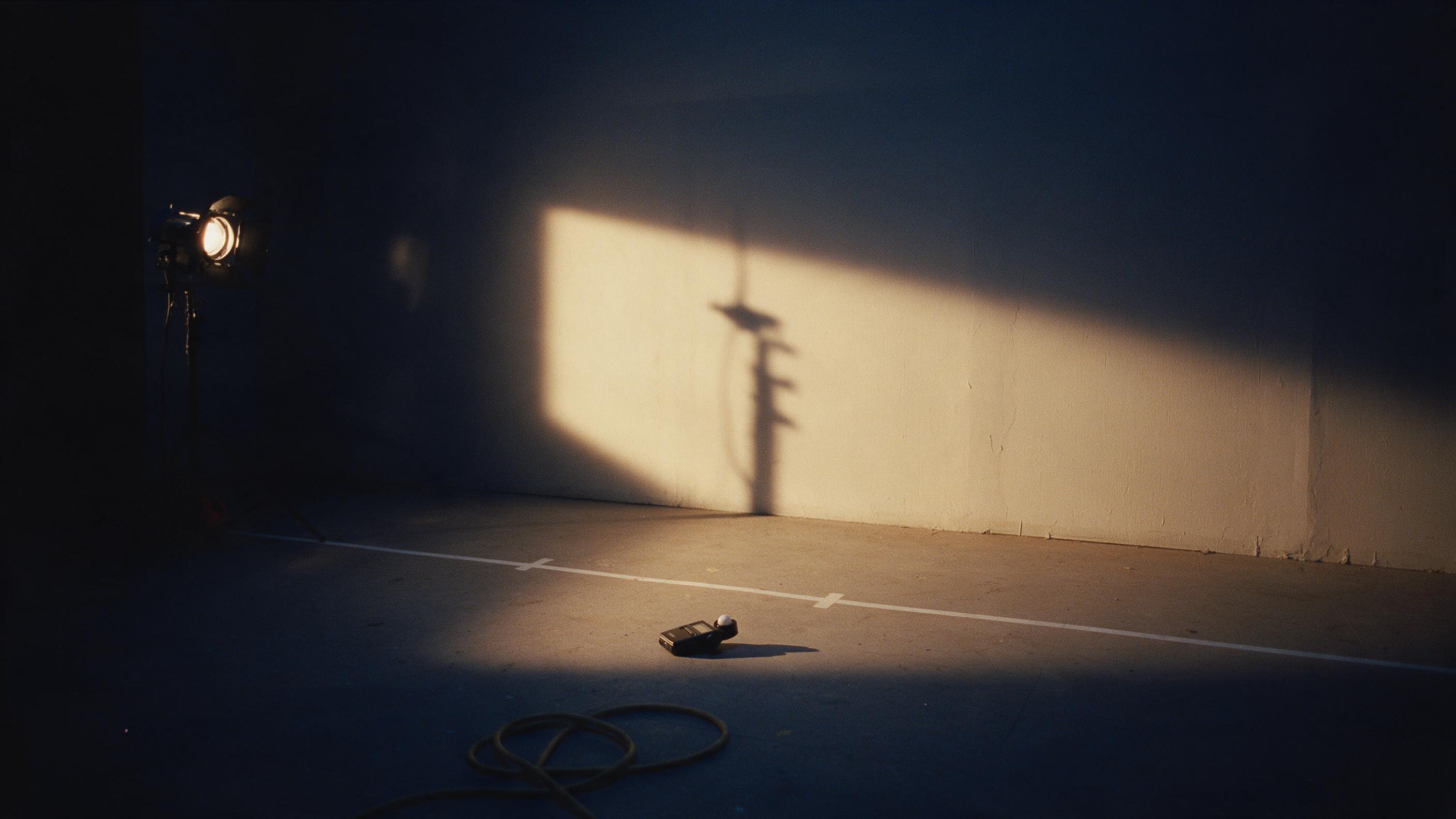
Set the key light from 1 direction and leave it there for the whole scene. Camera-left, camera-right, far-side, top. The direction gets chosen once, written into the shot notes verbatim, and every camera position for the next 20 shots inherits it. A face lit from the left in 1 shot and from the right in the next does not read as the same person in 2 setups. It reads as 2 different rooms, and the audience reads it that way in under 2 seconds without being able to name what moved. The default that keeps a scene directional is the far-side key, where the light sits on the far side of the line between the players and touches only the hot side of the face, leaving the rest in shadow. Christopher Nolan has run that default for 2 decades. It is directional rather than flat, and it is the reason his faces stay readable across a 2 hour film: the shadow is doing the describing. Flat lighting is what happens when nobody chose. The 3 point setup taught in every beginners course keeps the key somewhere near the lens so a face at 180 degrees to the camera is lit straight on and reads as a passport photograph. It is safe, it is the model default, and it costs you the entire mood of the room in 1 decision. A key also has a colour temperature that has to hold across the scene: 3200 K for tungsten, 5600 K for daylight, and the 2 never shared inside 1 room. 1 light, 1 direction, 1 identity for the scene. When the key moves between shots you have not made a lighting choice. You have made 2 scenes that happen to share a location.
The 180 Degree Line Is The Spine Of The Scene
Draw the 180 degree line between the 2 characters, or between 1 character and the object they are attending to. Every camera for the scene stays on 1 side of it. That is the whole apparatus. The line is not a rule about cameras. It is the map of the space, and once it is drawn the geography stops being a question. Then assign screen position and never flip it. A is frame-left, B is frame-right, and that holds across 30 setups if the scene runs that long. The audience builds a floor plan in their head out of nothing but 2 people and a wall of sound, and they will hold it for 2 hours. Cross the line and the plan collapses. A and B swap sides on the cut, and the viewer reads it as 2 people who turned around, or as a second room, or as a mistake. There are exactly 2 legal crossings. The first is a continuous move that carries the camera over the line and shows the audience the turn. The second is a neutral insert, a shot with no screen direction in it, placed between the 2 sides so the eye has somewhere to reset. The illegal crossing is the jump cut, and it is illegal for 1 reason: the audience sees a flip with no cause. Draw the line once and it stands for the whole 12 hour day, not just the master. Keep 30 degrees of camera movement between 2 shots of the same subject and the cut lands invisibly. Take the second shot from 10 degrees off the first and the frame jumps even though nothing in it moved.
The Eyeline Carries What The Axis Promised
Each character looks toward where the other actually is, not toward the camera and not toward the middle of the frame. A looks screen-right at B, so B looks screen-left at A, and the reverse shot has to place each of them where the other was looking, at the same height. Match it and 2 separate shots fuse into 1 exchange. Miss it and the audience feels 2 people talking past each other in different rooms, which is a strange sensation to sit through when both of them are looking the right way on their own. Height matters as much as direction. A standing character looking down at a seated one and the reverse shot from eye level are 2 different relationships. The 15 cm difference between a standing performer and a seated one read as status, and the audience assigns it before anyone speaks. The lens ties into the same geometry. A 32 to 35 mm lens on the over-the-shoulder keeps both the speaker and the listener inside the frame, so the eyeline is visible and the geography proves itself with no cutting. A 50 mm close-up, or a 65 to 75 mm on the big close-up, drops the listener out of frame and leaves the direction of the look as the only evidence of where they are. That is a fair trade when the direction has been locked, and a headache when it has not. A 20 degree eyeline error is enough for the room to feel wrong. Nobody in the audience can point at the shot and say why.
A Wave Is A Vector, Not A Prop
Every gesture in a scene points at a target: a wave, a point, a reach, a look, a nod. The gesture has to point in the screen direction where that target really sits. That is the entire rule, and it is the one that gets broken most often, because the instinct in front of a camera is to perform for the camera. Take the wave. If the second character stands behind the waver, the wave goes over the shoulder and away from the lens. If it goes straight into the lens while the other person is behind them, the shot stops being a scene and becomes an actor performing for the camera, and no amount of good lighting rescues it. The reader of the frame knows instantly which of the 2 people the wave was aimed at, and it is the wrong 1. The same logic covers the quieter vectors. A look goes past the camera to the person behind it, screen-right, where they actually are. A reach goes screen-left to the character who is off-camera but present in the scene. A point goes at the door, the horizon, or the object, and the object has a screen position that the earlier shots already taught the audience. There is exactly 1 case where a gesture belongs on the lens: when the camera is the target. Direct address, the look that opens the door, the fourth wall broken deliberately. That is a named choice, made once, and it earns its effect by being the only time in the film it happens. Make it the default and the film has no world left to break.
Light has 1 direction. Characters have 1 geography. Gestures point where their targets are.
4 Locks Written Before The Camera Moves
Four decisions carry the whole scene, and all 4 can be settled on 1 page in about 20 minutes: key direction, axis, screen direction, gesture vectors. Do it on paper and the shooting day saves 12 hours of re-setting light and re-blocking performers while 30 people stand around waiting for somebody to decide where the sun comes from. Lock 1 is key direction, written verbatim. Key from camera-right, far-side, half the face in shadow. Lock 2 is the axis: the line runs screen-left to screen-right and the camera stays on the A side for the whole sequence. Lock 3 is screen direction: she is frame-left facing right, he is frame-right facing left, and neither of them changes side without a turn the audience sees. Lock 4 is the gesture vectors: every wave, look and reach with its target named and the screen direction of that target stated. Once those 4 lines exist, the scene stops being a set of separate shots and becomes 1 continuous space that happens to be photographed from 12 angles. The crew can carry it without asking. The editor can cut it without guessing. And the audience gets a room they can live inside instead of a sequence of photographs arranged in a line. The failure mode is always the same: the locks get decided in the moment, shot by shot, by whoever is holding the light meter. A scene built that way has no geography, and by minute 3 of the edit nobody can tell which side anybody is on.
Direct The Direction Or Get The Model Default
A text to video model does not know where your key light is, because it has no scene state. Leave it alone and it returns its own default: front light near the lens, subjects centred, everyone facing the camera, and every gesture floating in the general direction of the viewer. It is the same default for every prompt, and it reads as generated in about 2 seconds. The fragments that work are plain and physical. Key from camera-left, far-side key, half the face in shadow. The axis runs screen-left to screen-right, camera on the A side. She waves over her shoulder toward the door where he stands, not toward the camera. His gaze goes past camera to the person behind him, screen-right. Her gesture points screen-left, to where the other character is, off camera. Name the direction, the side and the target in the same sentence and the model has something to hold. Then hold it across shots, because a generator will happily give you a left-facing close-up in 1 shot and a right-facing 1 in the next from the same prompt. Restate the key direction and the screen direction in every prompt in the sequence, and re-check each returned frame against the 4 locks before it goes into the timeline. A sequence of 12 shots with 1 key direction reads as 1 scene even when the frames came from 12 separate generations. The book that came out of building in 12 countries runs 393 pages, published 8 April 2026, and the chapter on scene geometry sits near the end for the reason this piece does. 6 years of building these sequences returned the same lesson that 16 years of field work across rural Nigeria, post-conflict Serbia, Kazan and Fukushima had already made plain: the physical facts have to be decided before the machinery is pointed at anything. Light has 1 direction. Characters have 1 geography. Every gesture points where its target actually is. The probability that a sequence holds together when those 3 facts are left undecided is close to zero, and most people are pricing it at zero while they re-roll the same 8 second clip in the hope that the 9th attempt gets lucky.
A face lit from the left in 1 shot and the right in the next reads as 2 different rooms.
The map is dead. Nobody told you.
Bali State of Mind is the survival guide for the collapse of everything you were taught to believe.
Beyond this book
Building the same thing somewhere else.
Julien Uhlig is available for advisory work, board seats and media appearances. Write to media@exventure.co.
The academy that trains the operators, across every company in the group, is EX Epic Academy - 25,000 applications, 25 seats per cohort, 210 alumni across 19 countries. academy.epicsolutiongroup.com
18-20 November. Online, Las Palmas, Bali.
Three days on what happens to work, capital and institutions when the map stops matching the ground. Seats are limited by cohort.
ex-aisummit.com →