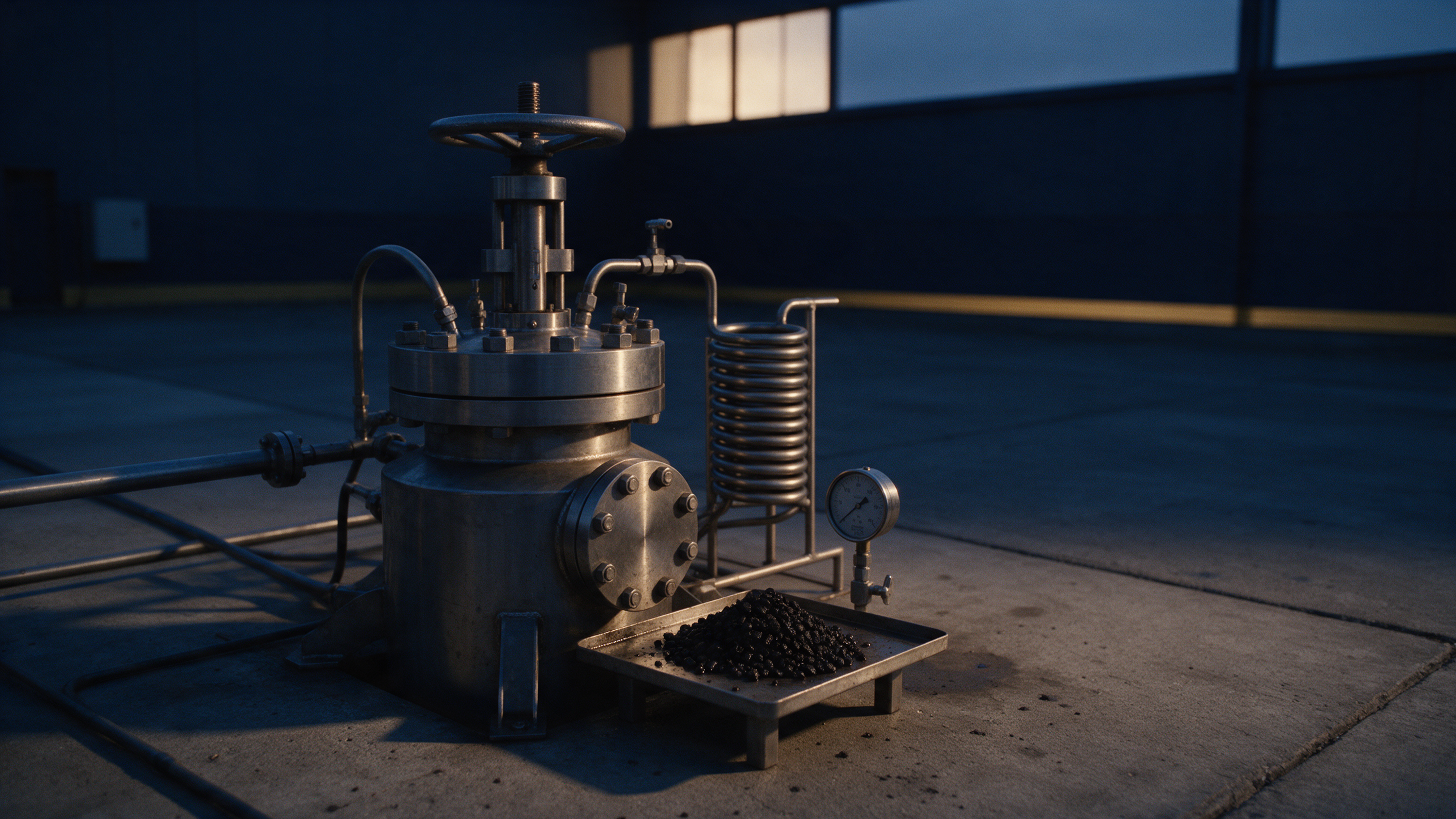
The Water Does The Drying
Every dry-route plant pays to drive water out of wet biomass first, and the hydrothermal family runs the same chemistry inside the water instead, at 180 to 600 degrees Celsius and 10 to 350 bar, with the published product list already in the literature.
The Dryer Is The Bill
Wet biomass carries 80 to 95 per cent water. The first machine in any dry-route plant is the dryer, and the dryer is most of the operating bill. Pyrolysis, dry gasification, torrefaction - all of them start with the same arithmetic. How many kilowatt-hours per kilogram of input to drive the water out. What share of the cost of a tonne of product that line item eats. The published answer for a sewage sludge dryer sits north of 800 kilowatt-hours per tonne of water removed, and the published share is north of 30 per cent of the operating cost of the whole plant. The hydrothermal family removes that line item by running the chemistry inside the water. The published temperature window is 180 to 600 degrees Celsius. The published pressure window is 10 to 350 bar. Three processes sit inside that window, each with its own product, its own yield and its own TRL. The dryer was the bottleneck. It still is.
The Three Routes And Their Numbers
HTC - hydrothermal carbonization - runs at 180 to 260 degrees and 10 to 40 bar of autogenous pressure, for 1 to 24 hours. The product is hydrochar, a solid. Mass yield 40 to 75 per cent. Energy yield 60 to 90 per cent. Carbon content 45 to 70 per cent. Higher heating value 20 to 30 megajoules per kilogram. Surface area 5 to 20 square metres per gram. HTL - hydrothermal liquefaction - runs at 250 to 400 degrees and 50 to 250 bar, for 10 to 60 minutes. The product is bio-crude, a liquid. Mass yield 30 to 60 per cent on a dry feed basis. Oxygen 10 to 20 per cent, against 35 to 50 per cent for pyrolysis bio-oil. Higher heating value 30 to 36 megajoules per kilogram, against 42 to 45 for petroleum crude. Nitrogen 2 to 6 per cent, depending on the feed protein. TAN - total acid number - 50 to 200 milligrams of KOH per gram. That last number decides whether the bio-crude can sit in a steel tank or eats through the wall. HTG - hydrothermal gasification, also called supercritical water gasification or SCWG - runs above the critical point of water, which is 374.15 degrees Celsius and 22.1 megapascals (221 bar). The product is hydrogen-rich syngas, with hydrogen at 30 to 55 per cent, carbon dioxide at 30 to 45 per cent, methane at 10 to 20 per cent, carbon monoxide at 1 to 5 per cent. Gas yield 20 to 50 moles per kilogram of biomass. Hydrogen yield 10 to 15 moles per kilogram without a catalyst, up to 18 with one. The TRL line goes HTC 7 to 8, HTL 5 to 7, SCWG 4 to 6. The lower the TRL, the higher the pressure, the thicker the wall, the lower the count of plants running today.
Critical Water Is A Different Solvent
Above 374.15 degrees Celsius and 22.1 megapascals, water stops behaving like water. It becomes a supercritical fluid, with gas-like diffusivity, liquid-like density, and the ability to dissolve non-polar organics that a kettle of liquid water cannot touch. That change in solvent is what unlocks the chemistry. The same carbon that tar-cracks in a dry gasifier at 800 degrees hydrolyses cleanly in supercritical water at 450. The same lignin that chars in a pyrolysis reactor at 500 depolymerises in subcritical water at 300. The reaction temperature is lower. The pressure is what pays for it. The reactor pressure is the technology. The reactor pressure is also the bill. I have built process plants across twelve countries and watched a industrial group restructure through a corporate reorg. The pattern is the same every time. The published chemistry is in the literature. The published plant list is short. The pressure vessel is the published line the auditors keep coming back to.
HTC Is The Mature One
HTC plants are running today. Ingelia in Spain. TerraNova Energy in Germany. SunCoal Industries in Germany, with CarboREN. C-Green in Sweden, with OxyPower HTC for sludge. AVA-CO2 in Switzerland. The published TRL sits at 7 to 8, first-of-a-kind commercial, with continuous-flow reactors replacing batch processing in the last decade. The product slots are published too. Solid fuel for co-firing or pellets at 5 to 15 euro per gigajoule. Soil amendment for carbon sequestration at 20 to 100 euro per tonne of carbon credit. Activated carbon precursor at 500 to 3,000 euro per tonne. The remaining bottlenecks are documented in the published LCA/TEA review at ScienceDirect S095965262500188X and the Lachos-Perez 2022 Bioresource Technology review. High CAPEX from the high-pressure reactors and the heat exchangers. An energy demand of 0.6 to 0.8 kilowatt-hours per kilogram of input. A process water stream that needs treatment. A hydrochar quality that varies with feedstock heterogeneity. The Mordor Intelligence market report for 2024 calls the global HTC market stable-growth. Stable-growth is the published label for a route that has been built but has not yet been built at the published commodity scale.
The cheapest tonne of sludge is the one that never sees a dryer.
HTL Pays A Tax
HTL bio-crude is closer to petroleum crude than pyrolysis bio-oil will ever be. The oxygen is lower. The heating value is higher. The hydrodeoxygenation bill to drop-in fuel is smaller. The tax is the aqueous phase. HTL produces significant AP - process water - carrying 20 to 40 per cent of the biomass carbon. TOC at 10 to 20 grams per litre. Organic acids, alcohols, phenolics, nitrogen heterocycles. The aqueous phase has to be treated or valorized, and every published valorization route has a published limit. Anaerobic digestion for biogas: the phenolics may inhibit the archaea. Recirculation as reaction medium: the carbon builds up until the reactor needs to be flushed. Microalgae cultivation: works in the published papers, has not been built at the published scale. Catalytic steam reforming: an extra reactor with its own CAPEX. Struvite precipitation for nitrogen and phosphorus recovery: it works, it does not pay for the rest of the stream. Steeper Energy in Denmark and Canada, with Hydrofraction HTL. Licella in Australia and the UK, with Cat-HTR. MUIR in the United States, on sludge and manure. Three published names. Pilot to early demo. The aqueous phase is the open problem. The published name for the open problem is AP valorization.
SCWG Is The Pilot Nobody Has Reached
Above the critical point, water behaves differently and the reactor pays differently. Supercritical pressure vessels are the most expensive published reactor on the CAPEX curve. The published CAPEX line for SCWG sits between 5,000 and 15,000 euro per kilowatt of input. That is two to three times the published dry gasification line. Corre et al. published in 2025 in Energy Conversion and Management the most useful single number in the hydrothermal literature right now. HTG of sewage sludge at 80 to 90 per cent moisture, standalone, achieves 10.2 per cent exergy efficiency. The same reactor, integrated with co-electrolysis through a co-SOEC stack, reaches 62.2 per cent exergy efficiency. That is the route that proves it at all. It is also the route that nobody has built. Karlsruhe Institute runs VERENA as a pilot. EPFL runs HTG with co-SOEC as a lab-pilot. The commercial line is empty. The pilot line is two published names. The bench line is the published literature. Above 374 degrees the water stops behaving like water. Above 374 degrees the bill also stops behaving like the dry-route bill.
The Reactor Pressure Is The Bill
The published CAPEX per kilowatt of input: HTC at 1,000 to 3,000 euro. HTL at 2,000 to 5,000 euro. SCWG at 5,000 to 15,000 euro. Dry gasification at 3,000 to 6,000 euro. The best-performing route for wet feedstock is the least built route. That is not an accident. That is the published CAPEX line. Dry gasification has been built at industrial volume because the pressure is low and the feedstock has to be dry. Wet feedstocks - sewage sludge, brewery waste, food processing waste, digestate from anaerobic digestion - cannot reach the dryer economically. The hydrothermal routes were built for that feedstock. The published CAPEX is what is keeping them off the field. The product is published. The chemistry is published. The pilot line is two or three published names. The commercial line is HTC only. The CAPEX line is what the next five years of EU Innovation Fund and Horizon Europe calls will spend themselves on. The cheapest tonne of sludge is the one that never sees a dryer.
What I Would Read First
Six papers, in this order. The Corre 2025 paper on HTG with co-SOEC, published in Energy Conversion and Management, sits at the centre. The Lachos-Perez 2022 Bioresource Technology review of HTC sits at the entry. The published LCA/TEA review at ScienceDirect S095965262500188X is the audit-grade reference for the published numbers. The three patent landscapes - HTC, HTL, SCWG - sit at the end. The patent file is the honest map of who is building what, and the published company names are the published company names. Ingelia. TerraNova. SunCoal. C-Green. AVA-CO2. Steeper Energy. Licella. MUIR. Karlsruhe with VERENA. EPFL with co-SOEC. I have built process plants across twelve countries and watched a industrial group restructure through a corporate reorg. The pattern is the same every time. The technology is published. The chemistry is published. The commercial plant list is short. The bottleneck is the pressure vessel, and the pressure vessel is the published CAPEX line. The dossier is the route. The probability that the dossier is the bottleneck is not zero, and most people are pricing it at zero.
The dryer was the bottleneck. It still is.
The map is dead. Nobody told you.
Bali State of Mind is the survival guide for the collapse of everything you were taught to believe.
Beyond this book
Building the same thing somewhere else.
Julien Uhlig is available for advisory work, board seats and media appearances. Write to media@exventure.co.
The academy that trains the operators, across every company in the group, is EX Epic Academy - 25,000 applications, 12 per cohort, 200+ alumni across 19 countries. academy.epicsolutiongroup.com
18-20 November. Online, Las Palmas, Bali.
Three days on what happens to work, capital and institutions when the map stops matching the ground. Seats are limited by cohort.
ex-aisummit.com →