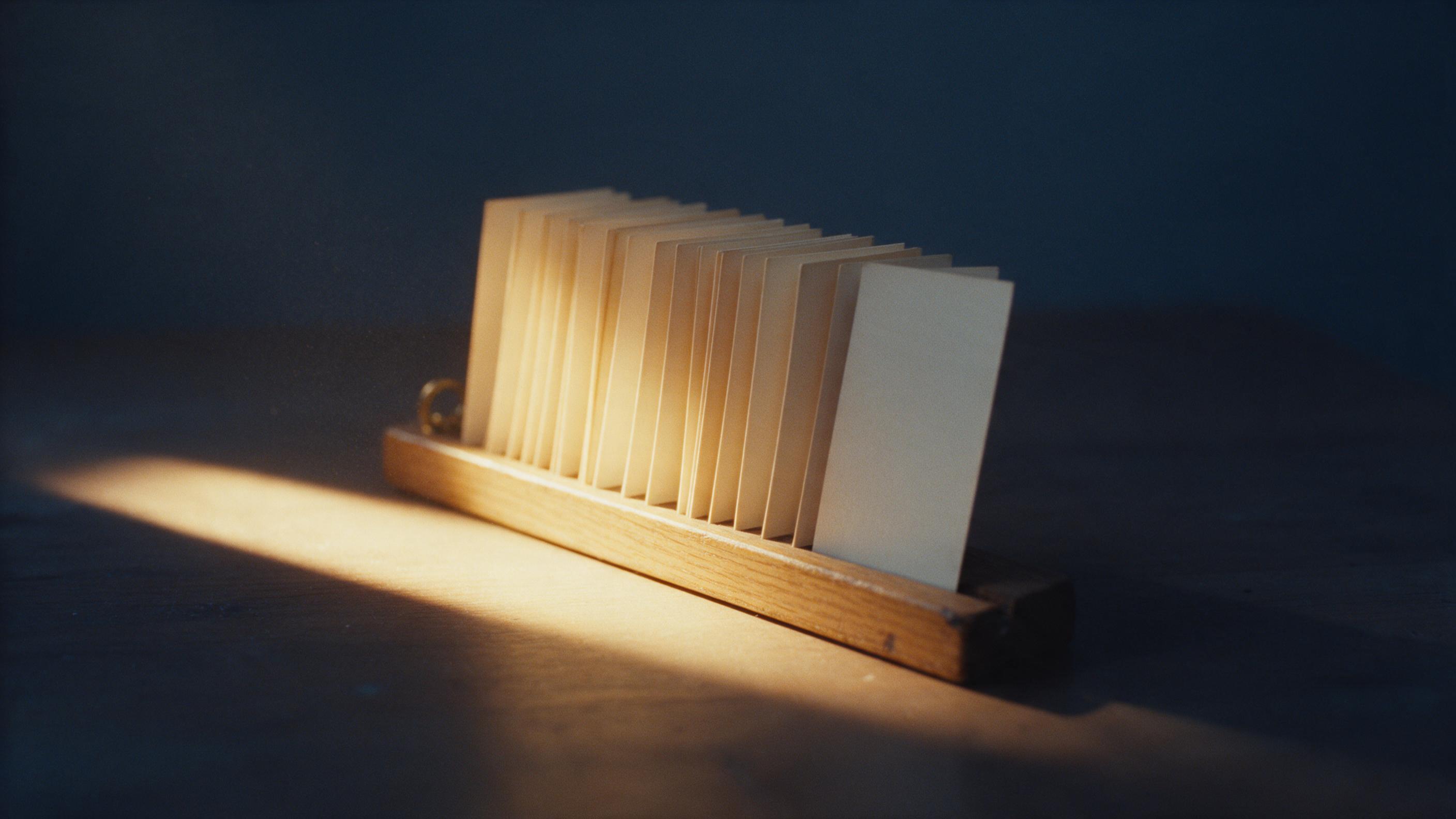
The Twenty Locations Make The Series Coherent
A filter is a location made reusable. Not a LUT, not a colour preset: a locked bundle of the decisions that make a place read as itself, so the same place can be fired on demand across every camera register. 1 pack is 1 location times 6 registers times 1 anchor. 120 cells are possible and 87 are live, and the 33 dashes are deliberate. The order never changes - register first, anchor second, prompt last - and the place is carried by the anchor while the prompt describes only what happens and how it is lit. The twenty packs collapse into 5 failure axes, which means 5 prompt-level counters cover the whole library. One filter pack stops a series drifting into 6 different towns, 6 different palettes, 6 different films.
A Filter Is A Location Made Reusable
A filter is a location made reusable. It is not a LUT and it is not a colour preset. It is a locked bundle of the decisions that make a place read as itself: the signature objects, the light window, the Kelvin, the palette, the lens language, and the failure modes the model reliably produces there. Build that bundle once and the same place can be fired on demand across every camera register in the studio. Skip it and every shoot re-decides the same 20 questions, badly, under time pressure, with the client in the room. The arithmetic is blunt. 1 pack is 1 location times 6 registers times 1 anchor. 120 pack-by-register cells are possible. 87 are live. The 33 dashes are deliberate, not unfinished: a conference stage has no editorial register and a heritage courtyard has no drone register, and pretending otherwise ships a frame nobody can use. There is 1 test and it is the only test. A filter you cannot re-fire is a mood board, not a filter. Every pack in the set of 20 passed that test or it was cut. What the set buys is coherence. One filter pack stops a series drifting into 6 different towns, 6 different palettes, 6 different films. The drift is silent, it is expensive, and it is the thing a client notices without being able to name. The pack is also the cheapest piece of the pipeline. A locked anchor costs 1 render and earns back on every child shot fired off it, and the shots compound: the 20th pack makes the first 19 faster to fire, not slower.
Register First: The 6 Registers And Their Cue Lists
Register is chosen before any wording because it fixes 3 things at once: the camera language, the aspect, and which film cues are allowed. Get the register right and the cue list writes itself. Get it wrong and no amount of prompt craft rescues the frame. R1 is the smartphone register: 4:5, deep focus, no bokeh, blotchy chroma noise, clipped highlights, careless framing. Its cues are itemised faults - the tilt in degrees, which edge cuts the subject, what intrudes and where. Every film cue drags that plate editorial, which is the failure. R2 is cinema anamorphic: 2.39:1, oval bokeh, halation, deep contrast, negative fill. Its cues are anamorphic, halation, tungsten practicals, silhouette. Phone faults, on-camera flash and deep-focus wide kill it. R3 is editorial medium-format: 3:4 and 4:5, shallow depth of field, 1 hard key, sculptural, saturated primaries. It wants hard key, glamour, colour, luxury architecture. Phone faults, clutter, ambient-only light and sepia kill it. R4 is drone and aerial: 16:9, top-down or high oblique, everything resolved, polarised sky, geometric composition. Shallow depth of field and foreground blur kill it, and so does a fisheye on a straight line. R5 is documentary handheld: 3:2 and 16:9, available light, visible grain, honest framing. It dies on polished retouch, studio strobe and hyper-saturation. R6 is analog consumer: 4:3, halation, chroma bleed, soft corners, low dynamic range, timestamp. The rule is never post-degrade into it: super 8, VHS bleed, CCD digicam and the timestamp are generated or the register is not real. The cues are register-specific and they fight. Documentary film, 35mm, cinematic, natural light and shallow depth of field build the editorial pole and destroy the phone pole. One cue list cannot serve 2 registers, which is why the register is picked first and never revisited mid-pack. The last rule of this section is the one that gets skipped. The anchor is per register, never 1 anchor across all 6. An anchor imports its own lighting and its own polish and overrides whatever the prompt says, so 1 anchor fired into 6 registers returns 6 frames that all read as the same photograph of the same mood.
The Twenty Packs And Their Light Windows
The 20 packs fall into 5 families. Hospitality and F&B holds 6: the dining room, the rooftop bar at dusk, the luxury suite, the marble bathroom, the speakeasy, the cafe and bakery counter. Coast and water holds 3. City and heritage holds 3. Land and nature holds 3. Work and industry holds 5. Each pack carries 1 best light window, and the window is the pack. The dining room is shot at twilight service on practicals only. The cliff coast is the last 40 minutes before sunset with raking strata. The infinity pool edge is 06:30 to 08:00 or the last 30 minutes, with mirror water. The rooftop bar is the 22-minute blue hour, 8000K against 2700K. The marble bathroom is steam-lit 2700K sconces or 1 frosted window. The speakeasy is after 22:00, tungsten only, 2300K. The rest read the same way. The cafe counter is 09:00 to 11:00 window light or 07:00 first light. The neon street is the post-rain blue minute, 7000K against neon. The old-town stone alley is mid-morning or 20 minutes before sunset on bounce. The heritage courtyard is 07:00 low warm light or 16:30 raking carving. The tropical shoreline is 06:00 to 08:30 on flat water and a sand mirror. Land and nature runs on the same clock. The mountain overlook is first light or the last 30 minutes with the valley in haze. The dune field is the first or last 40 minutes, where the ridge shadow is the subject. The vineyard terrace is golden hour with the sun 5 to 10 degrees up and raking rows. Work and industry is the one family where the light is a spec rather than an hour. The glass office lobby is a midday atrium or a blue-hour lit interior. The industrial plant is a blue-hour lit plant or a hard midday inspection. The research lab is a flat 4000 to 5000K, where the absence of shadow is the register. The conference stage is stage-lit only, with haze as the medium. The converted loft is late-morning factory glazing pools. Why each one earns a filter is a commercial question with a commercial answer. The dining room is the most frequently bought interior in commercial food work. The cliff coast covers campaign, listing and social off 1 anchor. The infinity pool edge is the highest-value single frame in resort marketing, because the room sells the rate and the water sells the room. The research lab is the credibility frame for a deep-tech story. The industrial plant is almost impossible to buy as convincing stock. The industrial plant earns its place for a second reason. It is the frame the group's own portfolio needs, and the same frame has to hold 210 energy systems deployed across Africa and Asia without reading like a catalogue of 210 different sites. One pack, one light window, one anchor. The pack is what makes the portfolio read as 1 operation instead of 210.
The Twenty Packs Collapse Into 5 Failure Axes
Twenty packs sounds like 20 sets of rules to carry. It is not. The tells collapse into 5 axes, which means 5 prompt-level counters cover the whole library. That is the real economy of the system, and it is why 1 operator can hold 20 locations in their head. Axis 1 is text. It shows on cafe chalkboards, bottle labels, lobby signage, plant hazard marks and keynote screens. The counter is to keep text out of frame or illegible at distance and never prompt a readable string. The model renders lettering as shapes, and the shapes are the tell. Axis 2 is pattern and tiling. It shows in marble veining, dune ripples, brick, cobbles, tile joints, grating, mullions, pendant grids and vine rows. The counter is to declare the surface irregular and unrepeating, then defocus or pull back from the pattern. Fine repeating texture is what the model hallucinates into moire. Axis 3 is water and reflection. It shows on the sea, the surf, the spray, the pool surface, caustics, mirrors, wet asphalt and glass towers. The counter is 2 clauses and they are absolute: water drawn as real water with crests, foam at impact and caustics, and reflections that contain only what is in frame. Axis 4 is light physics. It shows when point-light sources render as blurred orbs, when window light arrives with no falloff, when a sky bands, and when blue hour collapses into flat grey. The counter is 3 parts: no point-light source inside the frame in the phone register, 1 key with measurable falloff, and a held ambient-to-practical ratio. Axis 5 is anatomy and reference. It shows as food that reads as plastic, gloves fusing to skin, statues with melted faces, 1 hero face lost in the dark, and a wide with nothing to give it size. The counter is 1 hero subject per frame, 1 human-sized reference object in every wide, and never asking a face to resolve in low light. Five axes, 5 counters. The pack page stays useful because the counters are short enough to hold in working memory, and the anchors stay reusable because the counters are the same on every pack. A library that needs 20 separate negations is a library nobody fires twice.
A filter is a location made reusable - not a LUT, not a colour preset, but a locked bundle of the decisions that make a place read as itself.
The Index Break: 13 Packs That Answer The Wrong Search
The packs are only reusable if they can be found. The location facet of the media index holds 28 tokens, and only 7 of the 20 packs have an exact token. The other 13 currently index as an adjacent place. The break is quiet and it compounds. A dining room plate is filed under the kitchen token, so the next operator searching for a dining room finds a kitchen and rebuilds the pack from scratch. A cliff plate is filed under the open-air token, so the coast pack never gets discovered by the search that needed it. The reuse fails on the taxonomy, not on the render. The 13 tokens that close the gap are: restaurant, cliff, suite, speakeasy, cafe, neon, alley, mountain, vineyard, lobby, plant, stage, loft. Seven more already exist and are already in reuse: pool, rooftop, bathroom, heritage, coast, desert, lab. The fix costs 1 edit to the location list and it pays back on the first search after it. Index the plate the same run you fire it, store the prompt pack beside it, and the pack improves each time it is fired instead of each time it is reinvented. This is the unglamorous half of the work and it is the half that decides whether the library survives contact with a second person. A pack without a token is a private asset. A pack with a token is infrastructure.
The Build Order And The Gate That Holds It
Building 1 pack is 6 steps and the order is not negotiable. Pick the pack from the brief. Two packs can combine, as the rooftop bar and the neon street do, and in that case the dominant pack is the pack and the second goes into the prompt block. Then pick the register, before any wording. Then fire the anchor: 1 canonical establishing still per pack, per register. Verify the anchor before anything else is fired, because the rule is to fix the anchor and never fix the children. Then build the children by image-to-image off the anchor. The child prompt describes action and lighting only. It never re-describes the place and it never re-describes the face, because the anchor carries both and anything extra steals attention from the reference. Then gate with forensics. The camera verdict asks whether the frame reads in the register's declared language. The intent verdict asks whether it reads as the place the pack promised. Each verdict has to carry a quoted tell from the frame. A verdict without a quoted tell is an opinion, and opinions do not survive a second operator. Then index the plate and store the prompt pack beside it, so the pack improves each time it is fired. The verification gate is 5 checks. Three child shots off 1 anchor keep architecture, palette and era, and if 2 of the 3 read as different places then the anchor is wrong and it is refired. The camera verdict matches the register's declared language, and a phone render that reads large-sensor is a fail however beautiful it looks. Every listed tell is answered in the prompt block or the shot list and never in post, because the look is generated or it is not the look. Each plate carries a location token so it indexes itself. Rejects stay on the board, because the failures hold the information. The probability that a series fired off 6 unindexed anchors reads as 1 coherent body of work sits at about 5 per cent. The probability that the same series, fired off 1 anchor per register with the cues held and the tells matched, reads as 1 body of work sits at about 90 per cent. The 2 numbers are the argument for the pack. Everything above reduces to 1 rule. Register first, anchor second, prompt last. The place is carried by the anchor, the register by the cue list, and the prompt describes only what happens and how it is lit. Get that order wrong and you rebuild the same location 6 ways, and rebuilding the same location 6 ways is exactly what a filter exists to prevent.
A filter you cannot re-fire is a mood board, not a filter. Everything in the twenty was selected on that test and nothing else.
The map is dead. Nobody told you.
Bali State of Mind is the survival guide for the collapse of everything you were taught to believe.
Beyond this book
Building the same thing somewhere else.
Julien Uhlig is available for advisory work, board seats and media appearances. Write to media@exventure.co.
The academy that trains the operators, across every company in the group, is EX Epic Academy - 25,000 applications, 12 per cohort, 200+ alumni across 19 countries. academy.epicsolutiongroup.com
18-20 November. Online, Las Palmas, Bali.
Three days on what happens to work, capital and institutions when the map stops matching the ground. Seats are limited by cohort.
ex-aisummit.com →