The Trade That Never Moves
Conductivity and stretch run in opposite directions in every soft conductor we have. PEDOT:PSS holds 100 to 1,000 siemens per centimetre out to 20 to 50 per cent stretch, silver flakes reach 10,000 and give up at 5 to 20, and the one dial that sets both charges you twice.
The Line Runs Downhill
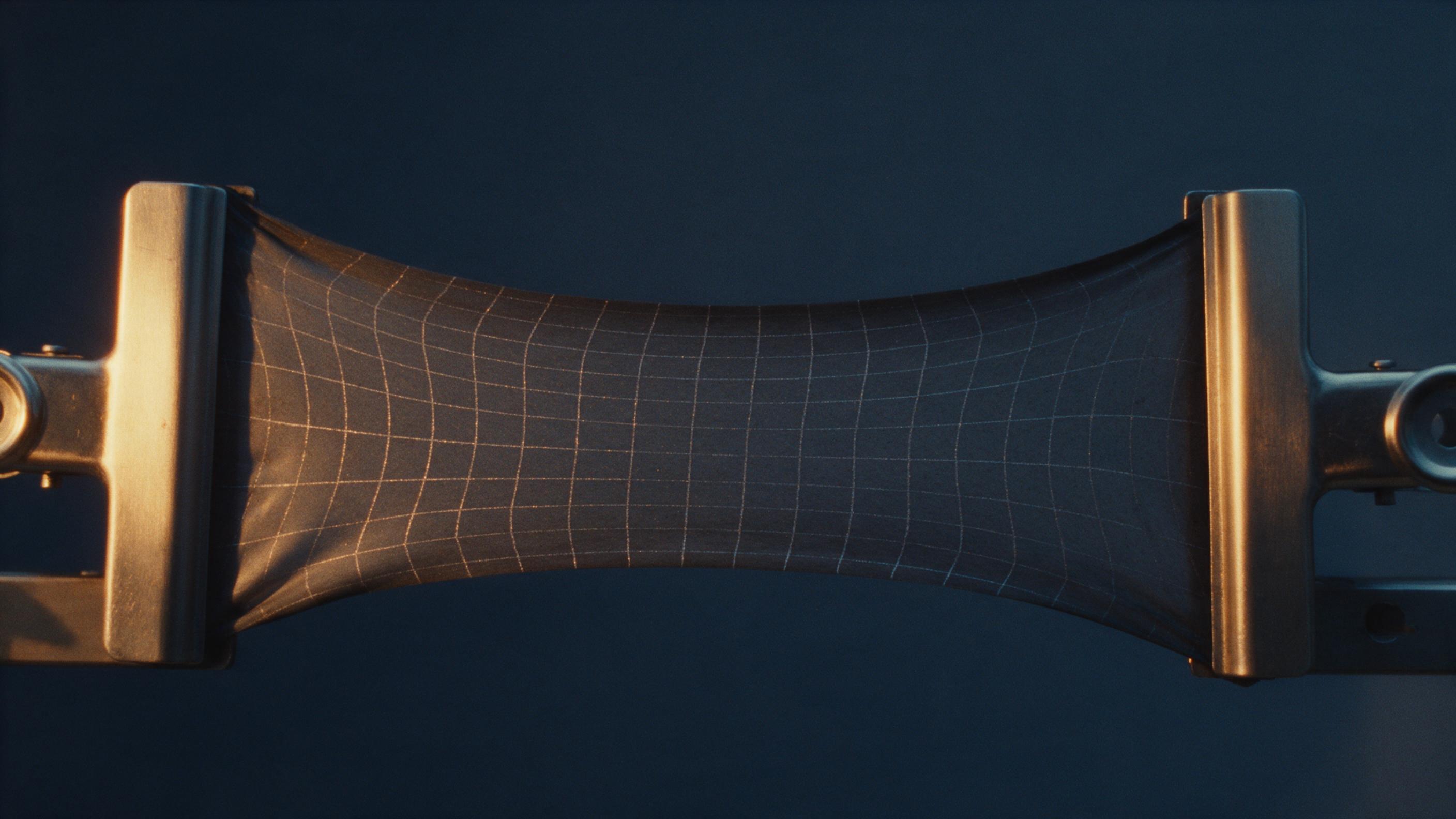
Conductivity and stretch run in opposite directions. That is the first fact about every soft conductor, and it is not a processing problem or a manufacturing problem. It is mechanical. Current needs dense, connected pathways through a material. Stretching pulls those pathways apart. The connections break, the resistance climbs, the signal goes. The more conductive a stretchable material is, the less stretchable it is. Every class of intrinsically stretchable material sits somewhere on that one line: conductive polymers, percolation composites, liquid metal, ionic conductors. The line is the whole design space. It does not move. Most of the engineering effort in electronic skin goes into geometry instead. Rigid islands, serpentine traces, meandering interconnects — all of it exists to dodge this line. The other path drops the geometry and takes the material as it comes: soft conductor, soft semiconductor, soft everything, and whatever electrical performance a polymer will give you.
Three Polymers, One Falling Number
PEDOT:PSS is the workhorse. It reaches 100 to 1,000 siemens per centimetre and holds that to 20 to 50 per cent stretch. It is water-processable, which is why it prints. It is moderately conductive, which is why it blends. Blended with PDMS or an SEBS elastomer it will pass 100 per cent stretch, at a price. The price is the same mechanism every time. Conduction in PEDOT:PSS runs through PEDOT-rich domains. Stretch separates those domains and the conductivity falls with the strain. Polyaniline sits lower and narrower: 10 to 100 siemens per centimetre at 10 to 30 per cent stretch, pH-sensitive, and losing ground. Polypyrrole is the shortest of the three. Ten to 100 siemens per centimetre, 10 to 20 per cent stretch, brittle in film. Three different chemistries, one column that falls as the other rises.
One Dial, Two Bills
A percolation composite is an elastomer — PDMS, Ecoflex, a polyurethane — loaded with conductive filler past the percolation threshold, the loading at which the particles finally touch and a path exists. From there it is one dial. Carbon black needs 10 to 30 per cent by weight to reach 0.1 to 10 siemens per centimetre, and it gives up at 20 to 50 per cent strain. Carbon nanotubes reach 1 to 100 siemens per centimetre at 1 to 10 per cent loading, and stretch 50 to 100 per cent. Silver nanowires reach 100 to 1,000 siemens per centimetre at 10 to 30 per cent loading across 50 to 100 per cent strain. Graphene flakes sit at 5 to 20 per cent loading for 1 to 100 siemens per centimetre, but hold only 20 to 50 per cent strain and fatigue poorly. Silver flakes are the extreme. One thousand to 10,000 siemens per centimetre at a loading of 60 to 80 per cent by weight, and a stretch of 5 to 20 per cent. Read the two columns together and the dial is obvious. More filler buys conductivity and costs stretch and stiffness. At 60 to 80 per cent filler content the material is not really a rubber any more. It is a filled plastic wearing a rubber's name.
The Network Forgets
Percolation does not fail only under a single pull. It fails under repetition. Cycling makes filler particles lose contact, and the network that comes back is not the network that left. The companies that built the first sensing pads hit this column late, after the datasheet numbers. Carbon black and silver nanowires fatigue moderately. Carbon nanotubes hold up well. Graphene flakes and silver flakes are poor. For a sensor this is the column that decides deployment. A pad whose rest resistance has drifted is a pad that needs re-zeroing. A skin with a thousand of them needs a calibration protocol before it needs a better gauge factor.
Conductivity and stretch run in opposite directions. That is mechanical, not a process problem.
Where The Line Bends
Two materials leave the line at different ends. Liquid metal, EGaIn, conducts at 10,000 siemens per centimetre, stretches past 500 per cent, and barely fatigues at all. Its problem is at the ends of the process: sealing and processability. Not physics. Ionic conductors sit at the other extreme. Ions in a polymer or water matrix conduct at 0.01 siemens per centimetre — two orders of magnitude below the electronic materials — while stretching past 500 per cent, staying transparent, sitting at 1 to 100 kilopascals of stiffness, and healing themselves. Then the frontier, the one case where the line bends upward: materials that gain conductivity under strain. Self-aligned nanowires that line up as the substrate stretches. Strain-induced crystallisation in a conductive polymer. Both demonstrated in a laboratory. Neither is practical.
Soft Covers, Rigid Measures
The best current performer is not the most conductive material on the list. It is PEDOT:PSS blended with an SEBS elastomer: about 100 siemens per centimetre held at 100 per cent strain, stable across 1,000 cycles. Moderate number, extreme strain, surviving cycling. That is what the trade pays out today. The consequence for anyone building a skin is a division of labour. Intrinsic stretchables belong where the material must be soft and everywhere — a whole-arm cover, a wearable patch, a soft robot. The sensing area can be stretchable, but it should meet rigid readout at the edge, at the wrist or the forearm, rather than spreading rigid electronics through the skin. For high-performance tactile sensing the percolation composites are the wrong tool: too noisy, too hysteretic. The split that works is simple. Rigid islands measure. Intrinsic materials connect. The probability that a soft conductor arrives this decade holding silver-flake conductivity at silver-nanowire stretch is low. The probability that the products shipping in the meantime are built on the trade rather than against it is close to one.
More filler buys conductivity and costs stretch. One dial, two bills.
The map is dead. Nobody told you.
Bali State of Mind is the survival guide for the collapse of everything you were taught to believe.
Beyond this book
Building the same thing somewhere else.
Julien Uhlig is available for advisory work, board seats and media appearances. Write to media@exventure.co.
The academy that trains the operators, across every company in the group, is EX Epic Academy - 25,000 applications, 25 seats per cohort, 210 alumni across 19 countries. academy.epicsolutiongroup.com
18-20 November. Online, Las Palmas, Bali.
Three days on what happens to work, capital and institutions when the map stops matching the ground. Seats are limited by cohort.
ex-aisummit.com →