The Tolerance Moves Into The Loop
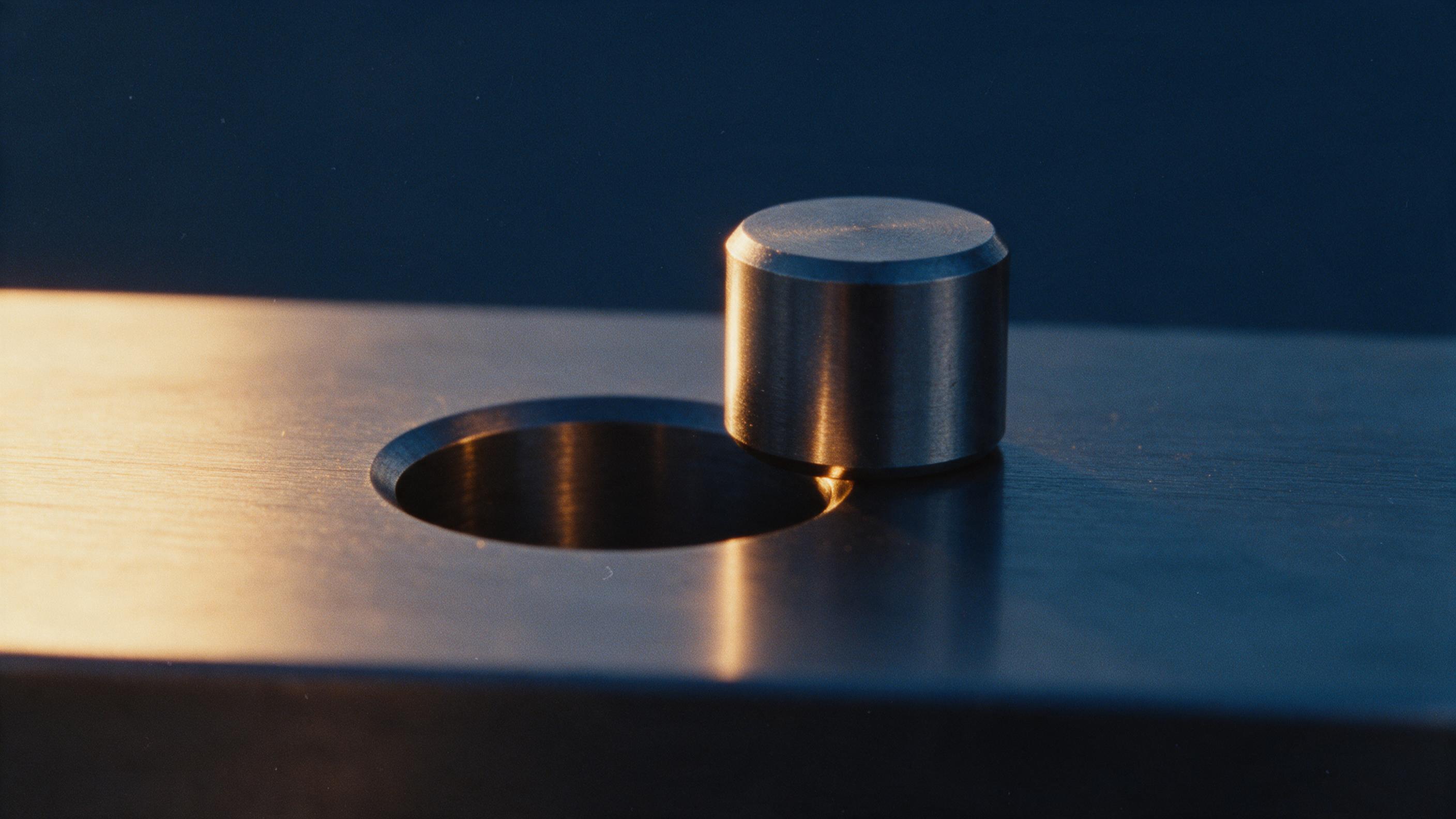
A blind peg-in-hole move needs plus or minus 0.01 millimetres of clearance. The same insertion with a tactile fingertip runs at plus or minus 0.50 millimetres, because the robot searches by feel until it finds the hole. The precision leaves the hardware and moves into the control loop, where it costs a sensor instead of a machining spec.
Fifty Times The Clearance
A blind insertion has to be built to a tolerance, and that tolerance has to cover every error in the chain at once. The peg is machined to a size, the hole is machined to a size, the arm repeats to a position, the tool deflects under load, the frame drifts as the cell warms through a shift. Add those errors together and the clearance between a peg and a hole has to be plus or minus 0.01 millimetres before the move can be planned at all. Put a tactile sensor in the fingertip and the same insertion runs at plus or minus 0.50 millimetres. That is fifty times the clearance for the same task, on the same arm, with the same motors and the same gearbox. Nothing in the machine got more precise. The machine got looser, and the loop absorbed the difference. The tolerance did not disappear. It moved out of the metal and into the control software, where it costs a sensor instead of a machining spec.
Searching By Feel
A blind insertion is a computed move. The controller plans a straight path, the arm executes it, and if the alignment is off by a hundredth of a millimetre the peg lands on the face of the plate. The robot cannot tell a hole from a wall, because both are something the peg has not reached yet. A contact sensor changes the task from a move into a search. The peg touches down, the sensor reports where the contact sits on the fingertip, and the controller slides the peg across the face. The force profile over the lip of a hole is not the force profile over flat stock. The peg follows the edge, finds the opening, and drops in. A search is slower than a planned move. It is also the only one of the two that survives an error no plan would have swallowed, which is why the trade is worth making on a line where a stalled cycle costs more than a few extra seconds.
Ninety To Ninety-Five Per Cent
The measured gap is not marginal. GelSight-equipped hands complete contact-rich manipulation tasks at 90 to 95 per cent success, against 60 to 75 per cent for the same tasks on vision alone. Thirty-five points of success rate separates a research demonstration from a line that runs unattended. Vision-based tactile sensing earns that gap for reasons that have nothing to do with force. It delivers a dense map of contact geometry instead of a single number. Its output is an image, so it feeds a standard machine-learning stack. And it can be rendered in simulation, which means a policy can be trained on synthetic contact before anything is built. The same fingertip that measures a cable tip plugs into ROS, MuJoCo and Isaac without a new pipeline behind it. That compatibility is why the sensor spread through manipulation research faster than the force-torque sensors that came before it, and why it is now the default fingertip on a humanoid hand program.
The Fragile-Firm Trade-Off
Grip force has one correct value per object, and the value changes with the object. Too little force and the part slips out of the hand. Too much and a ceramic substrate cracks, an apple bruises, a cable jacket deforms. The correct grip is the minimum force that holds against slip, and that force depends on weight, on surface friction and on how fragile the thing is - three quantities the robot does not know in advance. Closed-loop control finds the value instead of assuming it. The sensor watches for the onset of slip, the controller trims the grip, and the loop settles at a force that is enough for the object in the hand right now. A worst-case assumption is replaced by a measurement. The worst case is what costs money: the dropped part, the cracked part, the complaint. A single fixed preload is the cheapest control law to write and the most expensive one to run, because it has to be set for the most delicate object the cell will ever see, and it then under-grips everything else.
Nothing in the machine got more precise. The machine got looser.
From Pick And Place To Dexterous
Industrial robotics does mostly pick and place: grasp, move, release, repeat. Every step above that tier needs continuous contact information rather than a binary contact signal. In-hand reorientation turns an object without dropping it. Regrasping adjusts a grip mid-task. Tool use reads the environment through the tool, with vibration sensors carrying the distal signal back to the hand. Assembly handles several parts at clearances tighter than the arm can repeat. Vision gets a robot most of the way to a grasp and then stops. A cable tip is not visible through the fingers holding it. Cloth hides its own layers. A part already in the hand is occluded by that hand. These are the cases where a camera has no view to offer and a taxel does, because the contact is the observation. That is the tier the sensor unlocks. The machines built for pick and place are not the machines that will do this, because the change is not in the arm. It is in what the controller is allowed to know while it moves.
What The Loop Still Cannot See
Under all of it sits one quantity nobody has measured well: the probability that a vision-only system and a touch-only system are ever fully interchangeable is not zero, and most of the field prices it at zero. The blind-move clearance is real. The 90 to 95 per cent result is real. The fragile-firm trade-off is real. Each one is a statement about a task family, not about a robot, and what the loop cannot see is the object it has never held. The timeline is longer than the results suggest. GelSight was invented at MIT in 2009. GelSlim compressed the sensor to a fingertip in 2014. Meta AI open-sourced DIGIT in 2019 and 2020 alongside OmniTact and the soft-bubble fingertip. Commercial sensors arrived in 2022, humanoid hands began integrating them through 2023 and 2024, and the first industrial assembly lines with tactile feedback landed in 2025. The projection for 2026 to 2028 is that the sensor becomes standard on an advanced hand. Sixteen years from a bench demonstration to a production line is the ordinary pace for a sensing technology. The tolerance did not vanish in that time. It moved, task by task, out of the hardware and into the loop, and the loop is where it will stay.
A blind insertion is a computed move. A contact sensor turns it into a search.
The map is dead. Nobody told you.
Bali State of Mind is the survival guide for the collapse of everything you were taught to believe.
Beyond this book
Building the same thing somewhere else.
Julien Uhlig is available for advisory work, board seats and media appearances. Write to media@exventure.co.
The academy that trains the operators, across every company in the group, is EX Epic Academy - 25,000 applications, 12 per cohort, 200+ alumni across 19 countries. academy.epicsolutiongroup.com
18-20 November. Online, Las Palmas, Bali.
Three days on what happens to work, capital and institutions when the map stops matching the ground. Seats are limited by cohort.
ex-aisummit.com →