The Test Nobody Runs
One peer reviewed engine test, forty six citations on the first result, and twelve years of claims from interested parties. The independent number is the only one that survives contact with a buyer.
The Only Test Anybody Ran
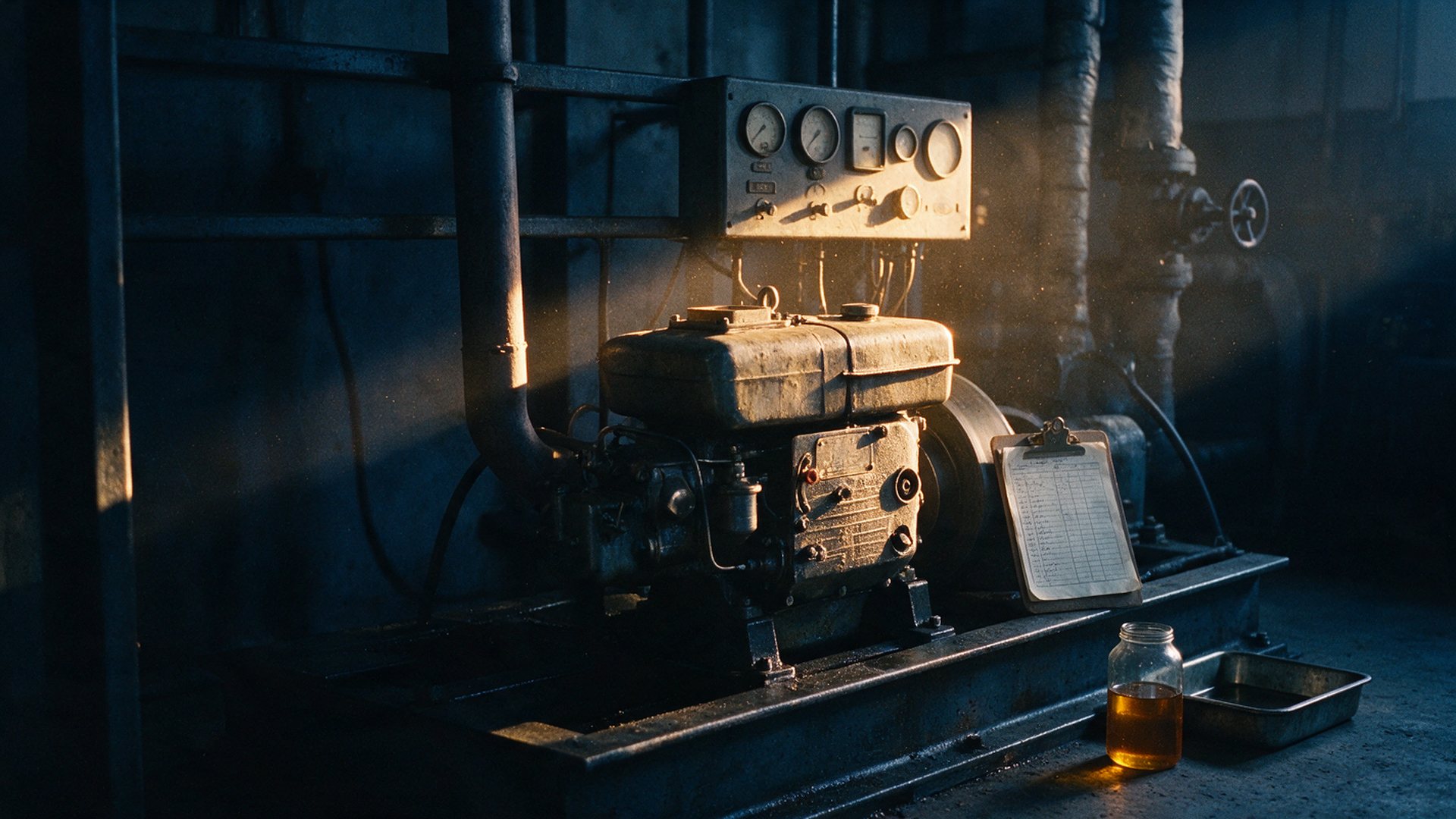
Energy Conversion and Management, volume 66, 2013, pages 173 to 188. Labeckas and Slavinskas took the fuel from the Eppendorf plant in Saxony, put it into a 60 kilowatt direct injection diesel engine on a test bench, and published what the instruments said. Cetane came out at 33 to 43. The European diesel standard asks for a minimum of 51. Sulphur came out at 40 to 80 parts per million against a maximum of 10. Nitrogen oxides rose 3 to 13 per cent against conventional diesel. Carbon monoxide rose 31 per cent. Hydrocarbons rose 8 per cent. Smoke opacity fell 14 to 22 per cent. The paper concluded the fuel is not compliant with the standard without upgrading, and it has been cited 46 times on ResearchGate and 35 times on ScienceDirect since. One test. One engine. One afternoon of measurements. That is also the entire independent performance record of the process. Everything else on the subject is a simulation, a student thesis, a brochure or a press release.
The Second Opinion
Ghent University did the chemistry. Gonzalez-Quiroga, Djokic, Van Geem and Marin published in Energy and Fuels, volume 30, number 10, 2016, pages 8292 to 8303, from a pilot plant running 150 litres an hour on demolition wood and municipal solid waste. Oxygen content below 0.4 per cent by weight. Paraffins above 40 per cent. Flash point 46 to 54 degrees Celsius, where the standard requires at least 55. Sulphur 40 to 80 parts per million. Cetane 33 to 43, the same window as the engine test three years earlier. Cold flow is where it wins: the cold filter plugging point at minus 14 to minus 15 degrees, the cloud point at minus 15 to minus 44. The carbon range runs C5 to C29, which is why the recommendation was hydrotreating. Two laboratories. Two continents. Three years apart. The same cetane window. That is not a coincidence. That is the process.
The Optimisation Nobody Scaled
TUBITAK Marmara Research Centre in Turkey ran the only published optimisation study. Unsal, Isik-Gulsac, Uresin and Budak, Waste Management and Research, volume 38, number 3, 2020, pages 322 to 331. The feedstock was sawdust plus waste lubricating oil plus catalyst. Response surface methodology, the standard statistical design for finding a peak. The answer: 279 degrees Celsius plus or minus 2, 2 per cent catalyst by weight, half an hour of reaction time. Maximum specific product yield 970.17 grams per kilowatt hour. Reaction time, not temperature, was the most influential factor. Read the run again. Half an hour. One batch. It is a laboratory result, and it is the best process result in the public record.
Two Theses, Two Countries
KTH Royal Institute of Technology in Stockholm holds both. Wang wrote the screening life cycle assessment in 2014 for a proposed plant in Jamtland County in Sweden, with primary data from Swestep, the licence holder. Wood to diesel, cradle to gate, greenhouse gas emissions below fossil diesel. A master thesis, not peer reviewed. Wongmaha followed in 2018 with a feasibility study for Thailand, catalogue number diva2:1209351, looking at cassava chips and pulp. Viable in principle. Blocked in practice by feedstock logistics and capital cost. Two students. Two countries. One technology. Twelve years later the questions they could not answer are still open, and neither they nor anybody else has published the pilot that would settle them.
One test, one engine, one afternoon. It is also the entire independent record.
What The Reviewers Actually Wrote
Tiwari, Azad, Dutta and Kumar covered plastic waste recycling in Science of the Total Environment in 2023, DOI 10.1016/j.scitotenv.2023.163433, and noted that the studies on the reactor reactions are not thoroughly researched. Ragaert, Delva and Van Geem placed it among the chemical recycling routes in Waste Management, volume 69, 2017, pages 24 to 58, a review cited more than 3,500 times. It gets a listing. MDPI Polymers, volume 17, number 12, article 1614, in 2025, lists catalytic pressureless depolymerisation among the technologies. Wang and colleagues do the same in Polymer Chemistry in 2026, DOI 10.1039/d5py01031d. Four reviews. Four paragraphs. That is what a technology looks like when the field knows it exists and does not know what it does.
The Claims Without A Certificate
The numbers in circulation come from parties with a position. The Alphakat brochure describes plants from 150 to 5,000 litres an hour and a scenario in Tarragona. The holdings website puts diesel at EUR 0.16 per litre from brown coal at EUR 25 a tonne. Alphakat Canada claims TUV Rheinland accreditation and publishes no certificate number. Biocon Energy gives efficiency of 20 per cent on biomass rising to 80 per cent on plastic and oil. A foundation page claims 65 to 85 per cent with 5 to 15 per cent self consumption. Another claims below 250 degrees with no dioxins or furans. Every one of those figures is from a seller. Not one of them is a measurement.
The Gap Is The Story
What is missing is a list, and the list is the point. No independent techno-economic analysis. No catalyst lifetime data on any feedstock. No continuous operation longer than one week. No peer reviewed mass and energy balance. No comparison against pyrolysis on the same feedstock. No reactor model, no kinetics, no computational fluid dynamics. No catalyst characterisation by X-ray diffraction, surface area or temperature programmed desorption. No environmental study beyond the 2014 screening assessment. No published TUV report. No levelised cost of fuel. The competing technology has all of it. The 2023 National Renewable Energy Laboratory analysis for catalytic fast pyrolysis of mixed plastic waste puts the minimum selling price of the aromatic product at 1.07 US dollars per kilogram and finds greenhouse gas emissions 2.4 times those of virgin production. The patents say why, because a patent has to describe the problem it solves. EP3177698B1, granted to Leaves AG, names residual moisture, oxygen ingress, foaming and dioxin formation. WO2016116484A1, priority 2015, adds a friction turbine, micro-comminution and combined heat and power on top of Koch EP1538191A1. DE102010018320A1 reaches for desulfurisation with nascent hydrogen from cellulose and a cobalt molybdenum rare earth perovskite catalyst. Read those four problems again. Residual moisture. Oxygen ingress. Foaming. Dioxin formation. That is the engineering agenda, written down by the people who own the claims.
The Decision Rule
An internal performance claim costs nothing to make and nothing to repeat, which is exactly why it is worth nothing in a diligence file. The independent number costs money, time and a test bench, and it is the only number that survives contact with a buyer. Ask for the third party test first. Ask who paid for it second. Ask for the run length third, because one week is not a plant and one afternoon is not a fuel. Ask for the failed runs, because a process that has never failed has never been run beyond a bench. I have built companies across twelve countries and deployed 210 energy systems across Africa and Asia, and Entrade built 200 wood gasification machines across the UK and Europe. The machines ran. The failures were never in the engineering. They were in what nobody measured before the money moved. The probability that a claim is true is not zero. Most people selling one are pricing it at zero, and the test that would tell you costs less than the mistake. Nobody runs the test. That is the whole story. Run it.
Two laboratories, two continents, three years apart, the same cetane window.
The map is dead. Nobody told you.
Bali State of Mind is the survival guide for the collapse of everything you were taught to believe.
Beyond this book
Building the same thing somewhere else.
Julien Uhlig is available for advisory work, board seats and media appearances. Write to media@exventure.co.
The academy that trains the operators, across every company in the group, is EX Epic Academy - 25,000 applications, 25 seats per cohort, 210 alumni across 19 countries. academy.epicsolutiongroup.com
18-20 November. Online, Las Palmas, Bali.
Three days on what happens to work, capital and institutions when the map stops matching the ground. Seats are limited by cohort.
ex-aisummit.com →