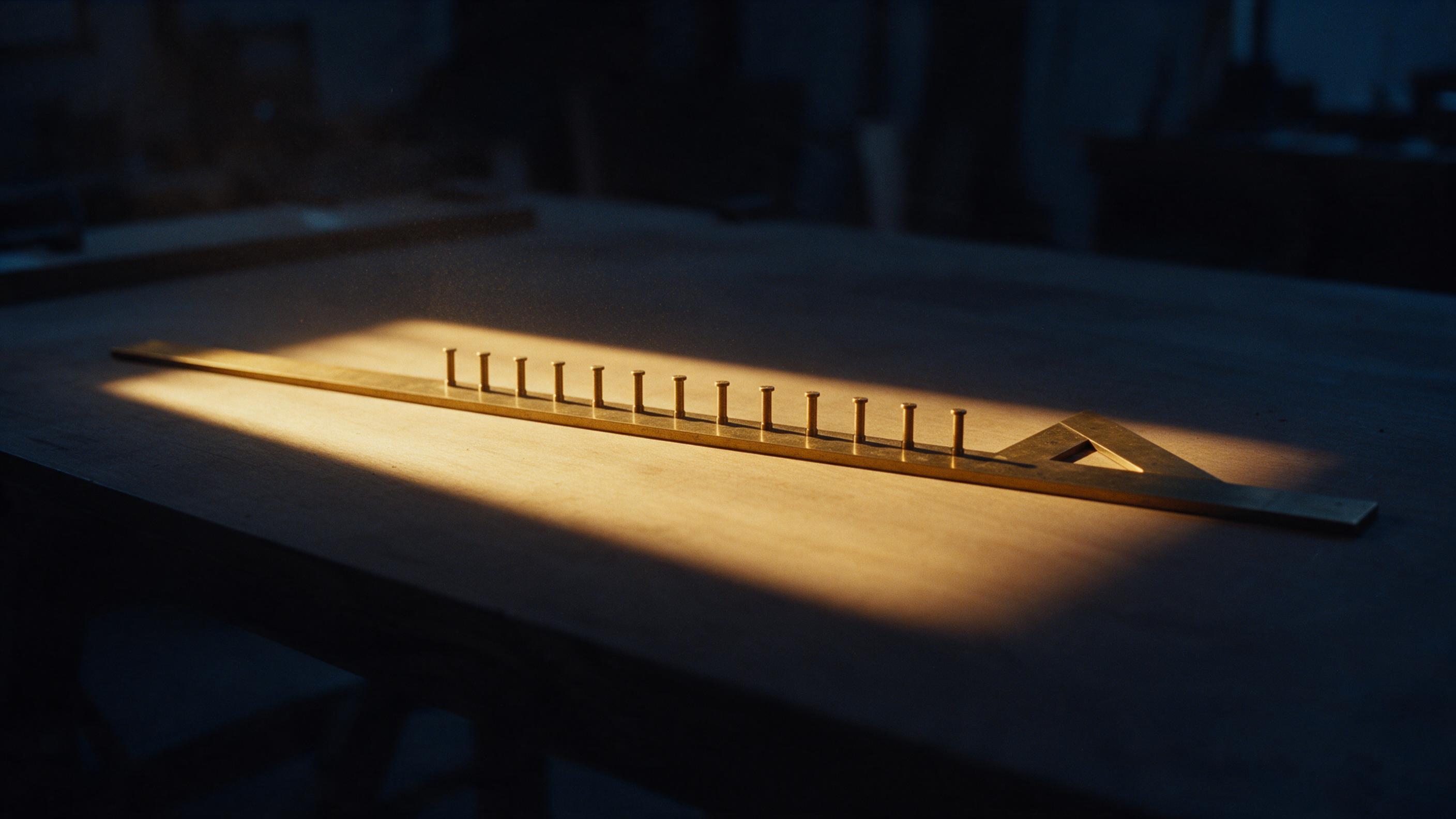
The Template Is The Track
A film is a track and every shot runs on the same rails. The template is locked before the first image is generated: 14 fields, 1 feeling, held for the whole film. Skip it and every shot is a different film.
14 Fields, Locked Before Image 1
A film made with a model fails in a specific way. Not because a shot is ugly. Because 40 shots are beautiful and unrelated, and each 1 is a different film. The fix is not taste. It is a document, and it is written before the first still is generated. The production template has 14 fields. FILM, the title and the song. LORA, the style preset. ONE FEELING, the emotion the whole piece serves. FORMAT, 35mm or 16mm or IMAX 65mm or HD-digital, with grain, aspect ratio, resolution and depth locked in the same line. LENSES, the focal ladder per beat group. TEMPERATURE, the climate, the time of day and the Kelvin per scene. SCENES, the beat breakdown in order with the anticipation arc. LOCATIONS, every place defined down to which room, which windows, and what light it gets. CHARACTERS, the identity and body blocks. LIGHT, the key direction per scene. PALETTE, the 1 signature colour. LOOK, the depth of field, framing, movement, stock and grain. NEGATIVE, Tier 1 global on every render plus Tier 2 body and anatomy on the nude and sexual frames. RENDERER, Nano Banana for stills, Wan for video, Wiro for the nude and sexual scenes. 14 fields, 1 document, and nothing is rendered until it is locked.
The LoRA Is A Fingerprint
The style side of the template is a named bundle of 5 decisions: the lenses, the temperature, the look, the palette and the wardrobe. Load the same bundle into every generation and every still carries the same fingerprint. It is reselectable. Nolan is the default. A Deakins, a Wong Kar-wai or a Malick can be defined, and the whole film renders in that style, shot after shot, without re-deciding anything per shot. That is the difference between a style and a style file. A style is an adjective you keep typing into a prompt. A style file is a block you prepend, identically, 240 times.
The Ladder Is Held Per Beat Group
The focal ladder is 24 and 35 to show the world, 50 to carry movement, 85 to isolate a face. What makes it a ladder rather than a menu is that it is held per beat group, not per shot. The lens that opens a scene is the lens that closes it. Cut from 24 to 85 inside 1 beat group and you have not made an interesting choice. You have made a different film, in the middle of this 1. The same logic holds the 180 degree line per scene and the identity block across all of them, so the subject is the same person from shot 1 to the last.
Temperature, Light, Palette, Wardrobe
Temperature is 3 decisions stacked into 1: the climate, the time of day, and the Kelvin per scene. The temperature that lights a room is the temperature of every shot in that room. Change it between 2 shots of the same room and the audience reads a cut in time they were never told about. Light is a key direction per scene, decided before the first render rather than found in the grade. A motivated source with 1 key direction is not the same image as flat uniform light, and it is not fixable later. Palette is 1 signature colour, captured flat and graded in post. Wardrobe is locked to match the temperature, and a wardrobe item never changes colour between shots. Green before the grade, green after it.
A film does not fail because 1 shot is ugly. It fails because 40 shots are beautiful and unrelated.
2 Blocks And 3 Fields
The character line is 2 blocks and 3 inner fields, and the split matters. The identity block carries face, ethnicity, skin and hair. The body block carries anatomy plus wardrobe. Those 2 blocks have to be byte-identical in every shot or the person changes between cuts, and no grade repairs a different nose. The 3 inner fields are the wish, the insecurity and the motivation. A character with a label has no film. A character with a wish and an insecurity does, because the model needs something to play toward and something to protect, and a placeholder performance is the visible result of giving it neither.
Fix The Template, Not The Shot
There is 1 rule and it is worth the whole document. Define the template before the first image, and never break it. Every shot card is filled from the template, not beside it. So when a shot needs something the template does not contain, 1 of 2 things is true. Either the shot is wrong, or the template was wrong. It is almost always the template. Fix the template and re-render the shots that inherited the gap. That is the whole cost control. A shot is cheap to re-render. A film is not cheap to re-shoot, and 40 unrelated beautiful frames are the most expensive thing in the pipeline because they have to be abandoned together. Built companies across twelve countries. Restructured a EUR 75 million industrial group. Deployed 210 energy systems across Africa and Asia. Took a company through a Frankfurt IPO. Entrade built 200 wood-gasification machines across the UK and Europe. 16 years of field work from rural Nigeria to Fukushima. 393 pages in paperback and Kindle, published 8 April 2026. The probability that a film locked to 1 template fails to read as 1 film is close to 0. The probability that a film assembled shot by shot reads as 1 film is close to 0 as well, and not because the models are weak but because consistency that is not written down is consistency that is not held. Under all 14 fields there is 1 feeling, and it is the only line on the document that cannot be computed. Name it before the first image and the other 13 fields inherit a direction. Leave it blank and you have built a folder of good clips, which is not a film, and which no template will rescue afterwards because the template was the thing you skipped.
The lens that opens a scene is the lens that closes it.
The map is dead. Nobody told you.
Bali State of Mind is the survival guide for the collapse of everything you were taught to believe.
Beyond this book
Building the same thing somewhere else.
Julien Uhlig is available for advisory work, board seats and media appearances. Write to media@exventure.co.
The academy that trains the operators, across every company in the group, is EX Epic Academy - 25,000 applications, 25 seats per cohort, 210 alumni across 19 countries. academy.epicsolutiongroup.com
18-20 November. Online, Las Palmas, Bali.
Three days on what happens to work, capital and institutions when the map stops matching the ground. Seats are limited by cohort.
ex-aisummit.com →