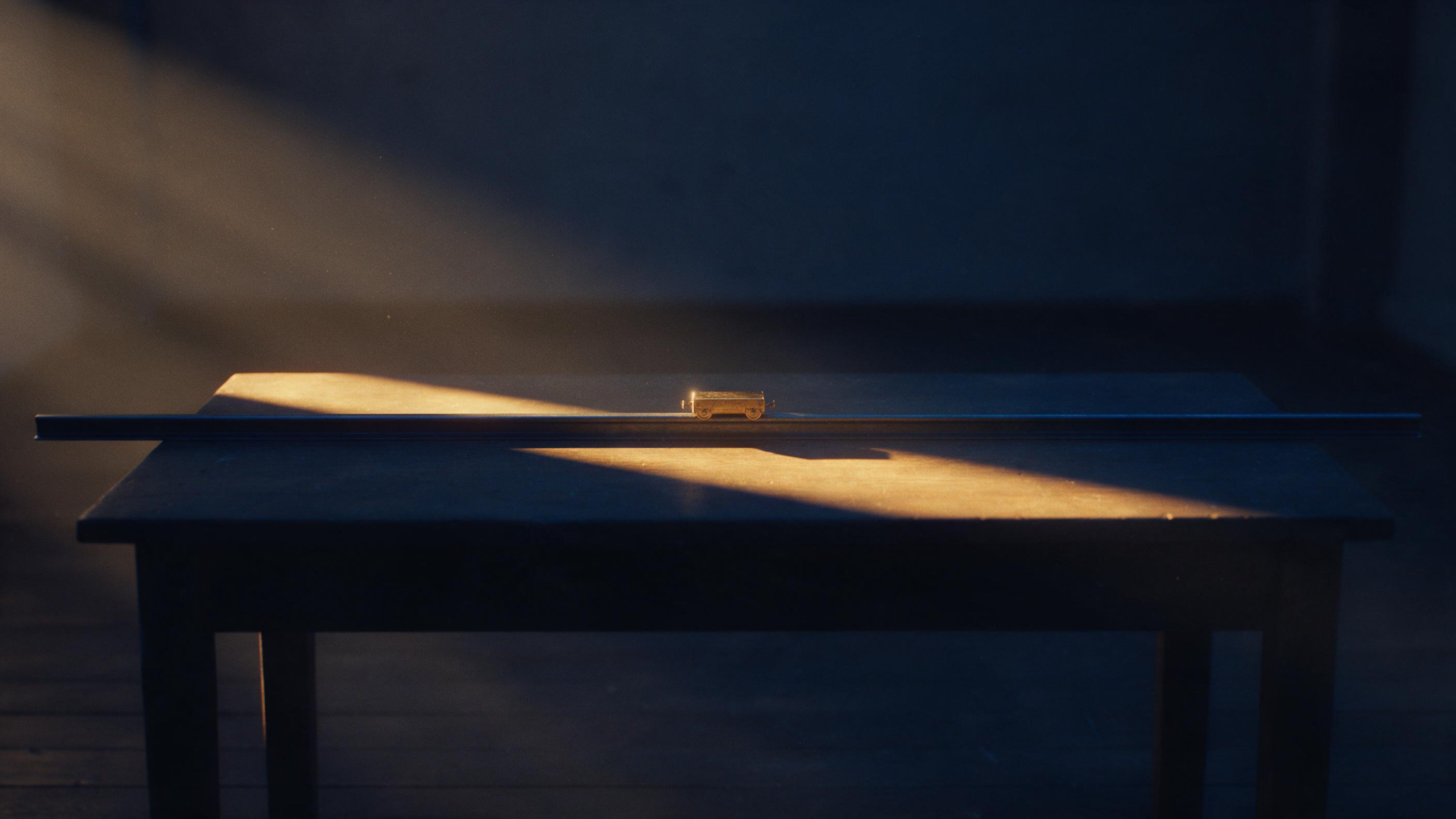
The Take That Never Cuts
1 continuous take with no cut in it, held together by 5 decisions that all point the same way, and a duration ceiling that is a real product limit rather than a preference. The take is designed around the ceiling, never trimmed to fit it afterwards.
The Take With No Cut In It
A crane comes down out of a high angle through steam and rain. It tracks in on 1 lone figure standing under 1 sodium streetlamp. It pushes past his shoulder as headlights bloom through the rain behind him, then follows him to the car door. The camera never cuts. Not once inside 10 seconds. That is the entire shot, and the reason it reads as 1 piece is that nothing interrupts it. A cut is a reset. Every reset buys a new setup and spends the tension that was just built, so a hero moment delivered in 6 cuts is 6 moments, each 1 weaker than the last. A take with no cut in it cannot hide. There is no edit to remove the 2 seconds where the framing drifts, no insert shot to cover the light that does not match the previous angle. The take is honest from the first frame to the last, and it is honest because there is nowhere in it to lie. The camera moves. The world holds still.
The Camera Moves, The World Holds Still
The move and the subject move for different reasons, and only 1 of them should. The camera travels - crane down, slow track forward, push past the shoulder, track with him. Everything else holds. The figure stands still until he turns. The lamp does not swing. The steam rises on its own clock. Rain falls in the same direction for the whole take. That split is the engine of the shot. If the camera moves while the world is also moving, the eye has no anchor and the frame turns into noise. If the camera moves while the world is still, the move reads as intention - 1 decision, made by the operator, held for 10 seconds. Pull the camera move out and the shot is a portrait. Pull the world's stillness out and it is a fire hose. The 2 halves only work as a pair, which is why the move gets decided before the shoot and the stillness gets defended on the day. The camera moves. The world holds still.
The 5 Decisions Inside The Take
The grammar of the take is 5 decisions, and every 1 of them points the same way. 1 is the framing. Centre-punched, with negative space around the subject, so the figure sits dead in the middle and the empty street does the rest. 2 is the lens - a wide-to-medium prime and no zoom, because a zoom is a second camera move arguing with the crane. 3 is the far-side key, so the single lamp lights only the hot side of the face and the other half stays in deep shadow. 4 is shallow depth of field, so the eye lands where the operator put it and the distant alley falls soft. 5 is the plausibility test, which gets its own section because it is the 1 that fails quietly. Change any 1 of those 5 and the take stops being the same take. A zoom in the middle of a crane move is 2 operators fighting over 1 shot. A front key flattens the split face. Deep focus hands the background the same weight as the subject. 5 decisions, 1 direction, no negotiation between them. The move is the move. There is no zoom to come and save it.
Every Light Must Be Able To Exist
Plausibility is the test that separates a shot from a composite. Take any light in the frame and ask whether it could actually be standing in that street on that night. Not whether it looks good. Whether it could exist. The backlit rain passes because the sodium lamp is rim-lighting the droplets from behind, 1 light source doing 2 jobs. The green edge glow passes because it is a sign at the far end of the alley, so the alley has a reason to be green. The steam passes because there is a manhole in the frame and steam comes out of manholes. Now the same test on the failures. A soft fill from the left with no lamp on the left is a light with no source, and every viewer feels it even when they cannot name it. A cold rim on the coat when the only lamp in the frame is sodium amber is a colour that has no author. 1 impossible light costs you the whole take, because a viewer who stops believing the light stops believing the man standing under it. 3 sources, each with a home in the frame. If the light cannot exist in that place, the frame is a lie.
The camera moves. The world holds still.
Design Around The Ceiling
The duration ceiling is not an opinion about ambition. On the tier being used it is 10 seconds at 768P, and on the higher-resolution tier it is 6 seconds at 1080P. That is the product, and it does not move because the story wants 15. This is where most takes get lost. The shot is written as a 15 second arc, the ceiling delivers 10, and the last 5 seconds get trimmed off the end at the edit - which is exactly the 5 seconds that carried the turn, the walk and the door. The take was designed past the ceiling and paid for it afterwards at the worst possible moment. The 2 fixes are both cheap. Cut 1 beat out of the arc so the move lives inside 10 seconds, or decide at the front that the 15 second hero shot belongs on a different product tier, which is a billing decision and not a prompt problem. What never works is a longer prompt against a shorter ceiling, because the ceiling is a clock and the clock does not read the prompt. So the arc gets drawn against the ceiling before the camera moves. 10 seconds, 4 moves, 1 turn. Nothing trimmed afterwards, nothing missing at the end. 10 seconds at 768P, 6 seconds at 1080P. That is the product, not a preference.
Verify The Take Before You Ship It
4 checks before a take leaves the room, and none of them is a glance. Read the take back at speed and confirm the world held still, because a lamp that swings in the last 2 seconds undoes every decision behind it. Then confirm that every light in the frame still has a source, which is 1 pass with the shot card open beside the monitor. Then confirm the subject stays centre-punched through the push past the shoulder, because a move that drifts off centre quietly turns a hero shot into a tracking shot. Then confirm the whole arc lands inside the ceiling with the turn and the walk both still in it. Here is the arithmetic behind all of it. Built companies across 12 countries. Restructured a industrial group. Deployed 210 energy systems across Africa and Asia. Took a company through a Frankfurt IPO. 16 years of field work from rural Nigeria to Fukushima. Entrade built 200 wood-gasification machines across the UK and Europe. Signed a personal guarantee on a company that folded on Christmas Day 2008, and lost savings in the 2013 Cyprus bail-in. 393 pages in paperback and Kindle, published 8 April 2026. None of it arrived as 1 uninterrupted take. All of it arrived as 5 decisions pointing the same way, held long enough to be seen. The probability that 1 long uncut take carries a whole body of work is close to 0. The probability that a handful of decisions pointing the same way does is close to 1. Most people price the first at 100 and the second at 0, which is why they arrive with 1 camera move and no shot. 1 take, no cut. The whole grammar lives inside it.
1 take, no cut. The whole grammar lives inside it.
The map is dead. Nobody told you.
Bali State of Mind is the survival guide for the collapse of everything you were taught to believe.
Beyond this book
Building the same thing somewhere else.
Julien Uhlig is available for advisory work, board seats and media appearances. Write to media@exventure.co.
The academy that trains the operators, across every company in the group, is EX Epic Academy - 25,000 applications, 12 per cohort, 200+ alumni across 19 countries. academy.epicsolutiongroup.com
18-20 November. Online, Las Palmas, Bali.
Three days on what happens to work, capital and institutions when the map stops matching the ground. Seats are limited by cohort.
ex-aisummit.com →