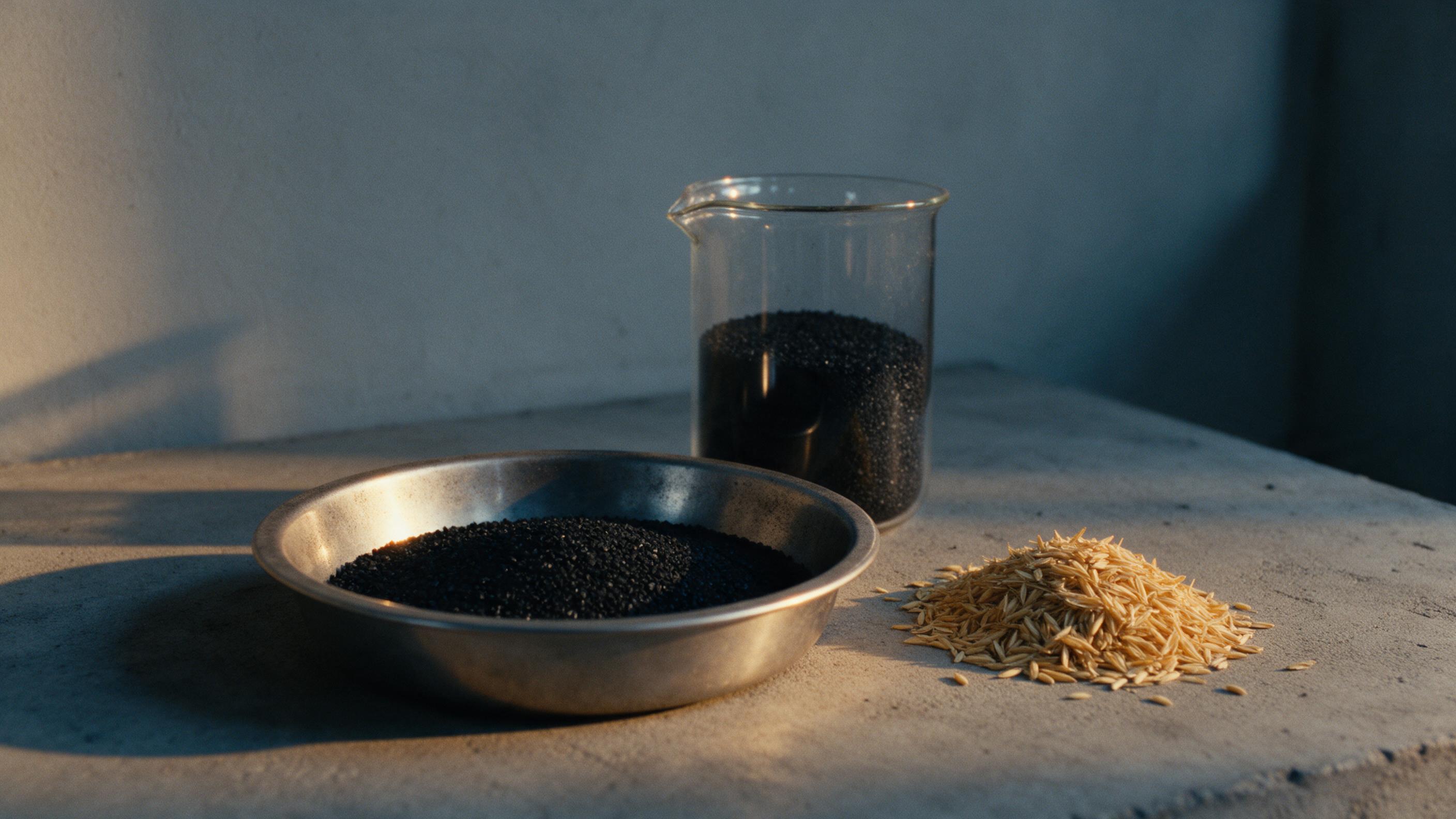
The Surface Area You Can Afford
Activated carbon trades at 1,543 to 2,645 dollars a tonne from fossil feedstock. Steam activation of biochar reaches 400 to 1,200 square metres per gram and potassium hydroxide activation reaches 2,635 from rice husk, so the porosity is a procurement decision before it is a chemistry problem.
Two Thousand Square Metres Of Nothing
Activated carbon is a sponge measured in football fields. One gram of it can carry 2,635 square metres of internal surface. A kilogram of the good stuff holds roughly a third of a hectare of pores. That surface is the product. Every gram of it is a place for a molecule to sit, and the market pays for places to sit: water treatment, air filtration, gas storage, catalyst supports. The raw material is biochar, which comes out of pyrolysis with almost none of that. Biochar is charcoal with ambition and no porosity worth the name. Activation is the step that turns one into the other. Two routes do it. They cost differently and they deliver differently, and the choice is made long before anyone runs a kiln. Everything else in this field is a consequence of that paragraph.
Steam Or Chemistry
Physical activation uses gas. Steam at 700 to 1,000 degrees Celsius drives carbon plus water to carbon monoxide plus hydrogen, an endothermic reaction that eats the carbon skeleton from the inside and leaves a pore behind. Carbon dioxide does the same by the Boudouard reaction, and it favours micropores, which is what gas adsorption wants. Steam activation lands at 400 to 1,200 square metres per gram depending on feedstock and conditions. Cheaper, simpler, lower ceiling. Chemical activation uses impregnation instead of heat alone. Potassium hydroxide reacts with carbon in a sequence that stops at potassium carbonate, and the washing step afterwards is not optional. Hydrochloric acid residuals and potassium salts have to come out. What you get for that trouble is up to 2,635 square metres per gram. Phosphoric acid sits between the two, adding oxygen functional groups at 800 to 1,500 square metres per gram. Four hundred against two thousand six hundred. That is the whole argument, and it is a cost argument, not a chemistry one.
The Price Already Exists
Commercial activated carbon trades at 1,543 to 2,645 US dollars a tonne. That price is set by coal and coconut shell, the two feedstocks that have supplied the category for decades, and it is quoted to you by suppliers who never wondered what your waste stream could do. Wood biochar holds more than 60 percent of the biochar market. Bamboo and manure follow. All three are cheaper inputs than coal, and none of them is priced into that 1,543 to 2,645 band. The published feasibility work on algal biochar found a minimum selling price near 2,200 dollars a tonne at a 10,000 acre footprint, with breakeven in 3.5 years. That is a peer-reviewed number in Fuel Communications, volume 19, article 100115, from Tsarpali, Kuhn and Philippidis in June 2024. Read that number again against the market. The algae route clears the commercial price. It does not beat it. Beating it is the only interesting outcome, and it comes from the feedstock, not the reactor.
The Rice Husk Result
In 2025 a group published a potassium hydroxide activation of rice husk biochar in RSC Catalysis Science and Technology, DOI 10.1039/D5CY00242G. Rice husk is agricultural residue. It is burned, ploughed back or dumped, and it costs nothing near what coal costs. Their material reached 2,635 square metres per gram with 0.15 percent oxygen content. That is not a laboratory curiosity. It is competitive with the best commercial activated carbons on the market today. Then they did the part that matters commercially. They used it as a palladium catalyst support for hydrogenation and measured a turnover frequency of 3.22 per second, the highest among every sample they tested, including the commercial reference. A waste residue, activated to world-class porosity, outperforming the incumbent as a catalyst support. That is the shape of the whole opportunity. The feedstock was free before anyone called it a feedstock.
The porosity is a procurement decision. The chemistry only decides which porosity you can afford.
Yield Buys Surface Area
Activation runs between 400 and 1,000 degrees Celsius, with residence times from 30 to 120 minutes. Higher temperature gives higher surface area and lower yield. The carbon you burn to make pores is carbon you cannot sell. So the operating point is a negotiation, and it is usually settled by an engineer optimising surface area and a finance person optimising tonnes. Neither of them is wrong. They are optimising different products. One more line item nobody prices at the design stage: the washing train for chemical activation. Potassium residues have to be removed, and the effluent has to be handled under a permit. The steam route skips that, which is exactly why it survives at a lower ceiling. Biochar carbon credits are supposed to close the gap. They do not yet, because the registries have not agreed on a methodology. Regulatory inconsistency is the barrier, not the physics. Do not put a credit line in a model you have not seen paid.
Where The File Is Decided
The framing that decides this project is not technical. It is a procurement question: what does the market already pay for activated carbon, and what does your waste stream cost to collect? If the answer leaves a margin, the engineering is well understood and the literature is deep. Physical activation at 400 to 1,200 square metres per gram is commodity art. Chemical activation at 2,635 is published and reproducible. So the file to write is a feedstock and cost case, with a target surface area and a target cost per tonne, tested against 1,543 to 2,645 dollars. Grants in this space respond to waste-to-product economics, and the honest version of that case is stronger than the optimistic one. I have built companies across twelve countries and deployed 210 energy systems. I restructured a EUR 75 million industrial group and signed a EUR 20 million personal guarantee. The pattern I have watched fail most often is not a bad process. It is a good process with an input that never arrived at the price the model assumed. The probability that a biochar project dies on collection logistics rather than on activation chemistry is not zero. Most spreadsheets price it at zero. Fix the feedstock price first. Then choose between steam and potassium hydroxide.
Higher activation temperature buys surface area and spends yield. Nobody gets both.
The map is dead. Nobody told you.
Bali State of Mind is the survival guide for the collapse of everything you were taught to believe.
Beyond this book
Building the same thing somewhere else.
Julien Uhlig is available for advisory work, board seats and media appearances. Write to media@exventure.co.
The academy that trains the operators, across every company in the group, is EX Epic Academy - 25,000 applications, 25 seats per cohort, 210 alumni across 19 countries. academy.epicsolutiongroup.com
18-20 November. Online, Las Palmas, Bali.
Three days on what happens to work, capital and institutions when the map stops matching the ground. Seats are limited by cohort.
ex-aisummit.com →