The Sunlit Register
The studio runs 2 registers and they are different temperatures of 1 craft. Pick the register before the first line is written, or spend 3 rewrites discovering that 2 films were fighting inside 1 file.
Two Registers, One Craft
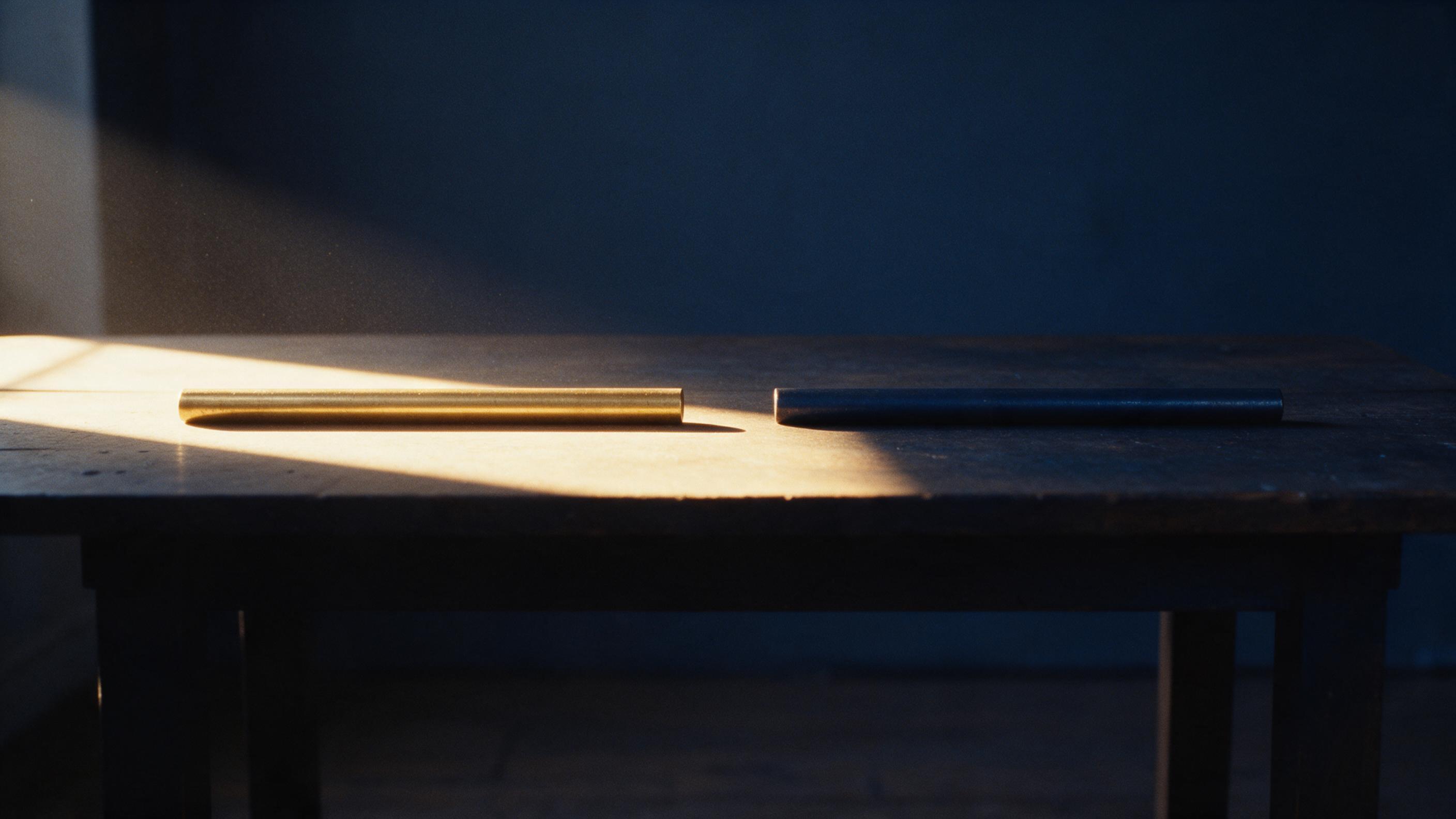
Most studios run 1 voice, and it drifts without anyone deciding it should. Ours runs 2 registers, and they are 2 different temperatures of the same craft. Register 1 is muted and editorial. Navy and gold, long holds, a contemplative figure, a read that stays level all the way down. Register 2 is its opposite at the same standard: upbeat, warm, young, alive. Bright high key grade, motion in every frame, a person doing something rather than a person thinking about it, music between 110 and 128 beats per minute. Both registers answer to the same 5 decisions. The hook, the cut grammar, the framing, the voice, and the file that ships. 5 decisions, 2 temperatures, 1 standard. The reason to write down the choice is that drift is invisible while it happens. A piece that opens muted, lifts into bright and warm at the midpoint and closes quiet is not 2 registers. It is 2 films fighting inside 1 file, and the viewer feels the fight as restlessness long before anyone can name it. So the register is decided in the same place the hook is decided: in writing, before the first line, on the same page. 1 page, 2 options, 1 circle around the choice. A 30 second piece in register 2 and a 12 minute piece in register 1 can be shot on the same afternoon with the same crew. What changes is the temperature, and the temperature is the variable worth controlling. The craft underneath does not move.
Seven Requirements, And They Are Checkable
Register 2 carries 7 requirements, and the reason they are written down is that every 1 of them can be checked against the edit rather than argued about in a review. Upbeat first. Rising energy, forward motion, cuts landing on the upbeat, a camera that tends upward and toward the light. Music between 110 and 128 beats per minute sets the rate the whole piece is cut to. Positive second. Orientation toward possibility, with the shift placed after the honest hard part rather than instead of it. Positivity is the resolution of a struggle. It is never the denial of 1. Young third. Platform native, quick, self aware, fluent in the way the platform is actually read. Sharp ideas at speed. Young is not the same as childish, and 1 clip can carry the difference or lose it. Motivational without cringy fourth, and that 1 is the hard requirement. It has its own list, and the list is long enough to need its own section. Personal fifth. First person, 1 real morning, 1 real number, 1 real place, 1 real failure. Story over statement, and point of view over summary. Honest sixth. Show the mess. 3 years and 40 versions rather than 3 smooth weeks. No fabricated results, setbacks included, nothing oversold. Alive seventh. Motion, gesture, energy shifts, breath audible in the read, imperfection kept where it carries feeling. Immediacy in the present tense does more work than 10 adjectives. 7 requirements, and each 1 has a setting attached: grade, music, cut rate, voice rate, camera behaviour, and ending. A requirement without a setting is a wish.
The Anti Cringe List
The hard requirement inside register 2 is the anti cringe list, and it exists for 1 reason. The words that were fine 5 years ago are instant shield triggers now, and 1 of them in the first 3 seconds loses the viewer before the content arrives. 11 of them are banned outright: grind, hustle, level up, boss energy, manifest, destroy your excuses, no excuses, 4am club, beast mode, king or queen of anything, and CEO of your life. 11 phrases, and not 1 of them is a message. They are the sound of 1 account performing at another account. The replacements are specific at every line. I stopped negotiating with my 6am self replaces discipline is freedom. A phone and a window replaces chase your dreams. 1 sentence is a scene. The other is a poster. Earn the motivation before handing it over. Show the mechanism and the cost first, then let the shift land, because a shift with no cost attached reads as a slogan and a slogan is the thing the audience came to avoid. Peer register, not preacher. An equal a few steps ahead, never a person standing above the room. Self aware, small-h funny, and the humour aimed at the author rather than the viewer. That is the vaccine against 90 per cent of the cringe in the category. Do not perform certainty either. I think, what worked for me, try this and see. 3 ways of holding a claim that keep the door open. Real stakes, real failure, no overselling, and energy carried in the delivery rather than the volume. No yelling, no fake excitement, no 4 exclamation marks standing in for 1 honest sentence. Then end on the viewer. Hand over 1 small step they can take today, and make the closing line serve them rather than the account. That is the whole list, and every item on it is a decision taken at the writing stage rather than the edit.
Specific Beats Generic On Every Line
Register 2 fails in 1 predictable way. It reaches for the generic version of a true sentence, because the generic version is faster to write and 2 syllables shorter. The fix is 1 rule applied to every line without exception: replace the abstraction with the object. Not chasing the dream, but a phone and a window. Not discipline, but the 6am negotiation I kept losing and then stopped having. The example script that came out of the source is built this way. I spent three years waiting to feel ready. Then I made my first film with a phone, a window and zero permission. Was it perfect? No. It was alive. Ready is not a feeling, it is a first draft. 5 beats, 4 hard specifics, and not 1 adjective doing the work of a noun. Note what the 3 years buys. It is not decoration. It is the proof that the writer paid something before giving advice, and it converts a claim into a report. Register 1 works the same way, which is the reason both registers share a backbone. Specificity is not a stylistic choice in either temperature. It is the difference between a piece that is remembered and a piece that is nodded at. The mechanism is mechanical rather than mysterious. Every abstract noun in a draft gets 1 question: what object, what number, what morning, what room. If there is no answer, the sentence is either cut or repaired. 1 rule, applied everywhere, and the difference between the 2 registers stops being a difference in quality.
2 registers, 1 craft. The temperature is the variable, never the standard.
Six Beats, Structure Rather Than Mood
The beat arc is 6 steps, and the arc is the structure rather than the mood. A piece can feel bright in every frame and still fail on the order of its 6 beats. 1: the hook, inside 1.5 seconds, carried across 3 channels at once. Visual, spoken and text. The quote on screen, the first spoken line and the movement in the frame say the same thing in 3 ways so 1 of them lands even on a muted autoplay. 2: the honest admission. The struggle named plainly, before any resolution, because that is what buys the viewer trust for the next 20 seconds. 3: the shift. It has to name the mechanism rather than the feeling, since a feeling cannot be repeated by the person watching. 4: the proof or the moment. A real scene, a real number, a real before and after. 1 verified detail outperforms 5 confident sentences. 5: the hand off. 1 small step the viewer can take today, sized so it can actually be taken today rather than after 1 course and 1 purchase. 6: the closing call to action, and it serves them rather than the account. Community rather than vanity. A question they can answer rather than a plea for a follow. Run the 6 beats against 3 failure modes and the value shows. A bright piece with no honest admission is 1 long advertisement. An honest admission with no shift is a complaint. A shift with no hand off serves the account and informs nobody. 6 beats, and the order is the difference between a piece that moves somebody and a piece that merely looks like it might.
The Table Underneath It
Underneath the register sits a table of settings, and the table is what makes the temperature reproducible rather than accidental. Grade: bright, warm and high key on 1 side, muted navy and gold on the other. Music: 110 to 128 beats per minute against sparse and slow. Cuts: every 0.5 to 1.5 seconds on the upbeat against long holds with velocity ramps. Voice: a brighter read at 1.05 to 1.1 rate against 1.0 level and slow. Camera: movement and gesture and handheld liveliness against static or a slow push in. Captions: bold on a bright image and dynamic against white on a dark bar. Subject: a person in motion, smiling, doing something, against a contemplative figure at rest. 7 rows, 2 columns, and a piece that pulls its settings from both columns at once reads as a mistake at every cut. That is the drift the register decision prevents, and it is why the table is written down next to the requirements instead of remembered. Bright grade, 110 to 128 on the music, 0.5 to 1.5 second cuts, a faster read, a moving camera, captions built for a bright frame, and a subject doing something. 7 settings, 1 temperature, and every 1 of them lands in the first 3 seconds whether it was chosen or not. Then 1 test closes the whole method. Read it aloud. If it sounds like a corporate keynote, it is rewritten before it is filmed, and the rewrite happens at the writing desk rather than in the edit bay where it costs 4 times as much. 30 years of building, in 12 countries, under 2 rules: work with what the constraint allows, and refuse the version that looks better on paper than it can look in the room. Built companies across twelve countries. Restructured an industrial group. Deployed 210 energy systems. Took a company through a Frankfurt IPO. Built 200 wood gasification machines at Entrade. Signed a personal guarantee on a company that folded on Christmas Day 2008. In the building for the 2003 blackout. 393 pages in paperback, published 8 April 2026. Not 1 of those was carried by finding the register late. The probability that a studio which picks its temperature before the first line reaches a finished piece is high. The probability that a piece written in 2 registers at once lands is close to 0, and it spends 3 rewrites and 40 versions finding out.
7 requirements, and every 1 of them is checkable in the edit.
The map is dead. Nobody told you.
Bali State of Mind is the survival guide for the collapse of everything you were taught to believe.
Beyond this book
Building the same thing somewhere else.
Julien Uhlig is available for advisory work, board seats and media appearances. Write to media@exventure.co.
The academy that trains the operators, across every company in the group, is EX Epic Academy - 25,000 applications, 12 per cohort, 200+ alumni across 19 countries. academy.epicsolutiongroup.com
18-20 November. Online, Las Palmas, Bali.
Three days on what happens to work, capital and institutions when the map stops matching the ground. Seats are limited by cohort.
ex-aisummit.com →