The Style Block Is A Contract
1 paragraph of prompt language, pasted into all 40 renders, is what makes 40 shots read as 1 film. Leave it out and the same 40 shots read as 40 unrelated images, each 1 defensible and none of them related.
One Block, Forty Renders
Every render the studio makes carries the same block of prompt language, copied and pasted rather than remembered. Not a mood, not a note in a folder that 3 people read and then abandon. 1 paragraph, fixed, identical down to the comma, in every still and every clip. The arithmetic is the argument. 40 shots that each carry the same 1 paragraph read as 40 frames of 1 film. The same 40 shots, each improvised fresh, read as 40 unrelated images. Both sets can be beautiful. Only 1 of them is a film. So the block is a contract rather than a suggestion. It is written down once and reused 40 times rather than re-imagined 40 times, because the re-imagining is where the drift lives. Render 1 and render 40 answer to the same paragraph, and the test is whether they sit beside each other in an edit without a seam showing. That is the whole job of it. 1 decision is taken out of 40 places and put in 1 place, over 1 afternoon, by 1 person writing 1 paragraph. A block pasted 39 times out of 40 is not a block. The probability that 40 independently prompted shots land as 1 film is close to 0. The probability that 40 shots carrying 1 written block do is high, and it costs 1 paste each. It also settles arguments before they happen. When the light is questioned at review, the answer is not an opinion. It is 4 lines of text that were agreed 40 frames ago, and the same contract rebuilt an industrial group and deployed 210 energy systems, which is 2 more places than a film set.
What Is Inside The Paragraph
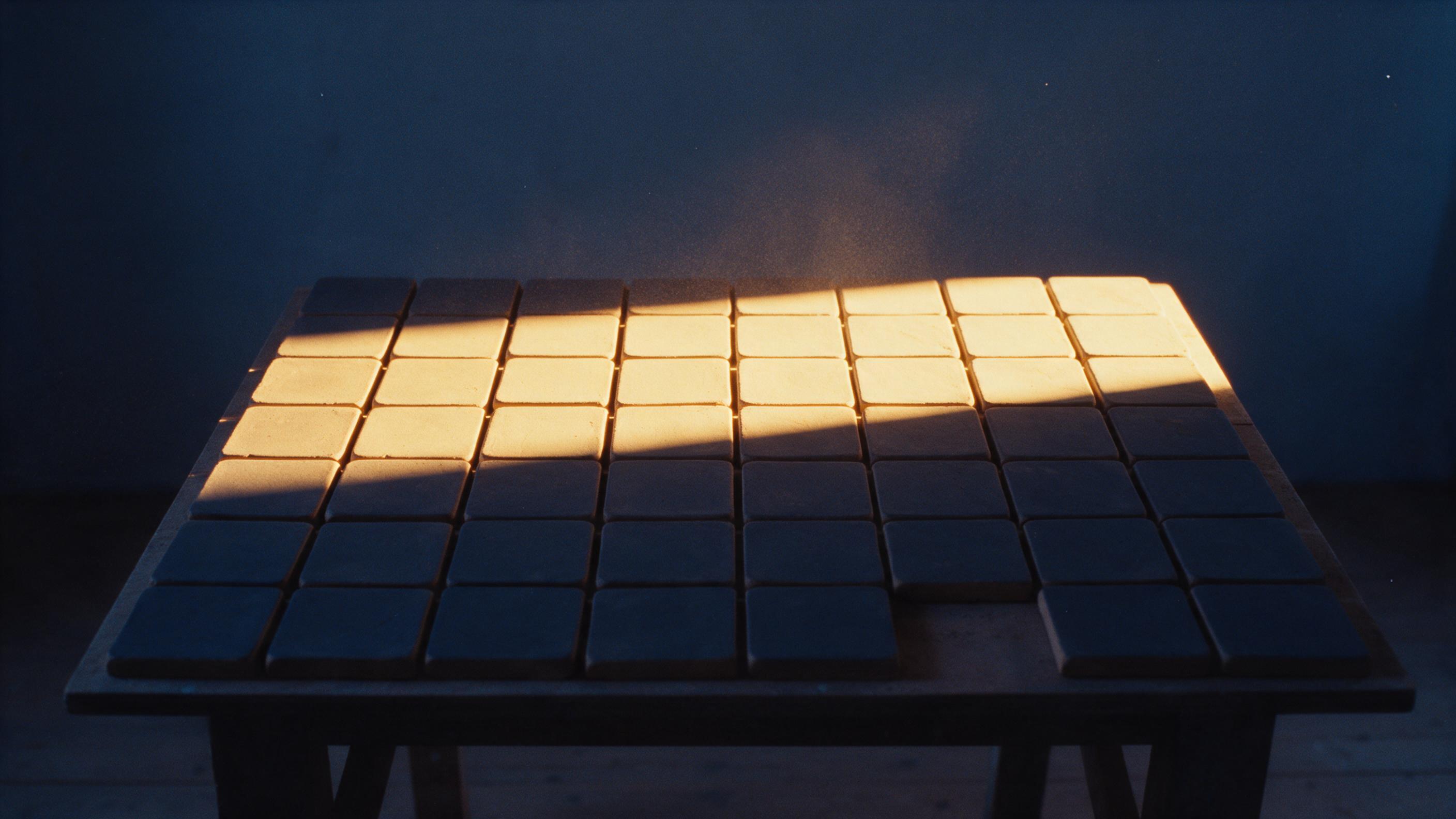
The paragraph carries 5 things in 1 breath. The light, the palette, the texture, the depth and the mood, stated in 1 block rather than in 12 separate rules that nobody reads twice. Muted desaturated cinematic film still. Golden hour light. Warm amber against deep navy. 35 mm film grain. Long soft shadows. Gentle atmospheric haze. Shallow depth of field. 1 quiet and slightly disquieting editorial temperature. Photoreal, documentary, natural skin texture, visible pores, unretouched, natural light, negative fill, 1 slow deliberate movement, 1 subject. The block then ends by naming what is never allowed in. No text, no watermark, no caption, no logo. 4 exclusions, inside the same paragraph, because a model that is not told what to refuse will render a signature into the corner of the 40th frame and be perfectly pleased with itself. There is a second block for what a render must avoid, and it runs after every still and every clip. The 2 travel together. 1 describes the room. The other lists the furniture that may never be moved into it. Vagueness is the expensive half. Warm light is 2 words that 10 models read 10 different ways. Golden hour at 2800 Kelvin is 1 instruction that reads 1 way, and it costs 3 more words to write. The 3 words are cheaper than the 10 re-rolls.
Identity Is The Half That Repeats
A character who is not described in the prompt re-rolls as a generic stranger. That is not a risk, it is the default behaviour of every model on the market, and it fires on the 2nd shot rather than the 1st, which is why the problem is always noticed late. So identity splits into 2 halves. The frontal half describes the face, and it is used only when the face is visible. The angle-agnostic half describes hair colour, shirt, build and age, and it goes into every single shot where the character appears, whether or not there is a face in the frame. A young woman in her early twenties, sun-kissed tan, dark wavy hair, a loose cream linen shirt, barefoot, calm and quiet. 1 sentence, 6 anchors, repeated verbatim in all 12 shots she appears in. Verbatim is not a stylistic preference. 1 reworded adjective is 1 new person, and the audience reads the new person immediately even when nobody can name what changed. The from-behind frame is the safest frame in the whole set, because a face that is not visible cannot drift. It still names its back-visible features explicitly. Seen from behind, dark wavy hair, cream linen shirt. The camera gets a back, and the viewer gets the same person who walked through the previous 11 frames. Split the halves and the count drops. 1 character, 2 descriptions, 1 of them conditional and 1 of them not.
The Lens Table Is A Decision
Framing is a table rather than a preference, and the table has 5 rows. Each row is a decision that is made once, in writing, so that it is not re-litigated on location at 6 in the morning. The hook face is 85 mm with shallow depth of field, medium framed, never an extreme close up, running 3 seconds or less. 1 row, 3 constraints, and all 3 are checkable in the edit rather than arguable in a review. The over-shoulder frame is 32 to 35 mm. The mid and walking frame is 35 to 40 mm, and the hands at the sides are stated in the prompt rather than hoped for, because 2 unattended hands are where a render starts improvising and inventing pockets. The wide establishing frame is 24 mm with deep focus. The from-behind frame takes any lens at all, since the face is not in the frame to be judged. The table exists so that 24 shots cut together as 24 views of 1 place rather than 24 separate trips to 24 similar places. A studio that leaves the lens to the model gets 5 different films in 1 edit and spends 4 hours in conform trying to hide the joins. Write the table down once and the only question on the day is which of the 5 rows this shot is. 5 possible answers rather than 100, and the 100 is where the time used to go.
40 shots carrying 1 paragraph read as 1 film. 40 improvised shots read as 40 images.
Name The Move And The Speed
Every camera fragment names the move and its speed in the same sentence. Locked off tripod, static, composed. Slow dolly in, pushing closer, intimate. Slow pull back, revealing. Tracking shot, moving alongside. Smooth gimbal glide, floating. Aerial drift, drifting over. Whip pan, rapid blur. A move without a speed comes back as a generic slow drift. Every time, on every model. There is 1 default motion in the weights and it is applied to anything that is not specific, which is why 8 clips shot 8 different ways arrive looking like 8 versions of the same drift. Speed is the half that gets dropped, because naming a move feels like the work and naming its rate feels like detail. Slow means slow. Rapid means rapid. A dolly in and a dolly in at 1 deliberate pace are 2 different shots, and only 1 of them can be cut against a 3 second hook. 1 line per shot does it. The move, the speed, and the frame it happens in. 3 facts, 12 words, and it is the difference between 40 clips and 40 shots.
The Temperature Anchor Fixes The Rest
The last block is the 1 that decides whether the other 3 work. A humid tropical golden hour at 2800 Kelvin, warm light diffused by milky haze, sweat sheen on the skin, linen clothes, long shadows, atmospheric perspective. Light, air, skin and wardrobe have to agree on the temperature. When 3 of the 4 agree and 1 does not, the frame reads fake no matter how good any 1 of them is. Warm light on cold air reads like a composite. Correct sweat on flat light reads like a filter dropped over a sharp frame. 2800 Kelvin is not decoration. It is the anchor the other 3 blocks are judged against, and it is the reason the style block opens with light rather than leading with it. Sixteen years of field work in rural Nigeria, post-conflict Serbia, Kazan, Fukushima and Silicon Valley taught the same lesson in 5 countries and 5 climates. The frame that reads as true is the 1 where every visible element agreed on the same afternoon, and the frame that reads as assembled is the 1 where 3 of the 4 agreed and the 4th was added later. The straight version of this is a contract, and it holds across more than a film set. Write the block once. Paste it 40 times. Split identity into the half that is conditional and the half that is not. Take the lens from the table and the speed from the line. Anchor the whole thing at 2800 Kelvin, because the block is not a suggestion and the film is what happens when 40 renders obey 1 paragraph. The book is 393 pages and it went to press in April 2026. The 4 blocks in it are the 4 described here, unchanged, because a contract that is rewritten per shot is not a contract. The probability that a studio holding 4 fixed blocks ships a coherent 40 shot film is high. The probability that a studio improvising 40 separate prompts does is close to 0, and it discovers that in the edit, 1 seam at a time, with the light from 40 different afternoons.
A block pasted 39 times out of 40 is not a block.
The map is dead. Nobody told you.
Bali State of Mind is the survival guide for the collapse of everything you were taught to believe.
Beyond this book
Building the same thing somewhere else.
Julien Uhlig is available for advisory work, board seats and media appearances. Write to media@exventure.co.
The academy that trains the operators, across every company in the group, is EX Epic Academy - 25,000 applications, 12 per cohort, 200+ alumni across 19 countries. academy.epicsolutiongroup.com
18-20 November. Online, Las Palmas, Bali.
Three days on what happens to work, capital and institutions when the map stops matching the ground. Seats are limited by cohort.
ex-aisummit.com →