The Strain Lives In The Geometry
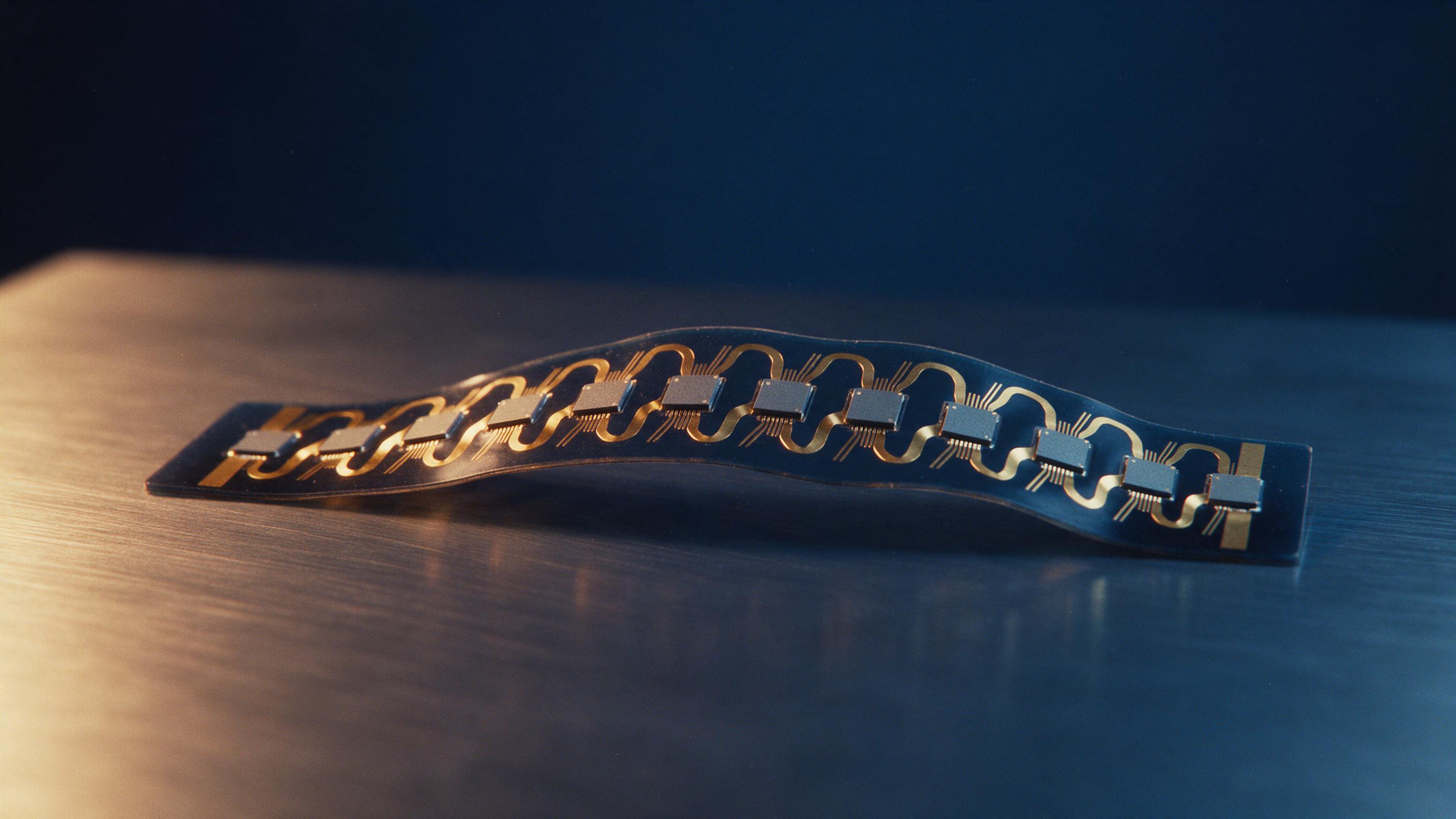
Stretchable electronics keeps the chip rigid and puts the strain into the wiring. A serpentine copper trace on polyimide opens like an accordion, so the metal sees under 0.5 per cent local strain at 30 per cent global stretch while the silicon island sees under 0.01 per cent. Geometry sets the ceiling: 30 to 50 per cent stretch at 1,000 cycles for a simple arc, 100 to 200 per cent at 100,000 cycles for a fractal, past 400 per cent for kirigami in one direction only. Islands cover 10 to 50 per cent of the area, so sensing happens between islands rather than at maximum density.
The Strain Lives In The Geometry
Stretchable electronics has a dominant answer and it is not a stretchy material. It is a rigid chip on a spring. A serpentine copper or gold trace on polyimide behaves as a mechanical spring. Under tension the serpentine opens like an accordion: its arc length stays constant while the end-to-end distance grows. The metal sees under 0.5 per cent local strain while the structure around it is stretched 30 per cent, and the silicon island sitting on top sees under 0.01 per cent. That is the entire trick. The strain is absorbed by the shape of the wiring rather than by the chemistry of the conductor, which means the electronics can be ordinary silicon, at ordinary performance, on a surface that moves. Mechanically the system is modelled as a spring-mass pair, where the interconnects are the springs and the islands are the rigid masses. It is old engineering applied to a new substrate, and it is the reason the architecture has held the field for more than 15 years.
The Island Stays Rigid
The island is where the performance comes from, so the design goal is to keep it perfectly still. Active silicon is thinned to 10 to 50 micrometres for the process, and can go to 100 micrometres. At 50 micrometres the minimum bend radius of the finished stack is about 1 millimetre, which is the number that decides whether a patch conforms to a knuckle or fights it. The island sits at under 0.01 per cent local strain. Its neighbours in the wiring sit at under 0.5 per cent at 30 per cent global stretch. The gap between those two figures is the whole design, and everything else is a consequence of it. Materials are chosen around that requirement. Substrate and encapsulation are PDMS, with polyimide available as the stiffer encapsulant. Conductors are copper at 1 to 5 micrometres or gold at 0.1 to 1 micrometre, bonded through a chromium or titanium adhesion layer of 5 to 50 nanometres. The adhesion layer is thin because it carries no current. It is there to stop the metal lifting off the polymer the first time the part bends.
The Cost Curve Runs Through The Geometry
The stretch a part can survive is set by the shape of the interconnect, and the shapes are ranked. A simple serpentine arc gives 30 to 50 per cent stretch at moderate anisotropy, with roughly 1,000 cycles to failure. A horseshoe gives 50 to 80 per cent with lower anisotropy and roughly 10,000 cycles. A fractal trace, Peano or Vicsek or Moore, reaches 100 to 200 per cent and roughly 100,000 cycles, paid for with a harder mask. A self-similar nested fractal reaches 200 to 400 per cent and drops back to 10,000 cycles. Kirigami, which is cut rather than drawn, exceeds 400 per cent, is directional, and returns to 1,000 cycles. Read that as a purchasing table and the shape of the decision appears. Every step up in stretch is either paid for in fabrication complexity or refunded in fatigue life. Kirigami is the only entry that is simple to make and reaches past 400 per cent, and it does so in one direction, which rules it out of any surface that bends in two. The maximum stretch of the family is 50 to 200 per cent. Below the top fractal, the wrist and the elbow are comfortably inside the envelope.
What The Architecture Buys
The advantages are specific and worth stating without decoration. Because the island is conventional silicon, the electronics on it are conventional too: amplifiers, analogue-to-digital converters and wireless transmitters at commercial performance, none of which a stretchable polymer matches on its own. Copper traces carry current at under 0.1 ohm per square. The mechanics are finite-element validated spring behaviour rather than a materials gamble. Fabrication inherits existing semiconductor processes with transfer printing as the added step. And the reliability record is the longest in the field, with more than 15 years of demonstrations behind it. The typical flow is five steps. Fabricate the chips on a silicon-on-insulator wafer and thin to 10 to 50 micrometres. Draw the serpentine interconnects on a glass carrier over a sacrificial layer. Transfer-print the islands onto the interconnect array with an elastomeric stamp. Encapsulate in PDMS. Dissolve the sacrificial layer and release the finished part. None of those steps is exotic. All of them must land within microns of each other.
The strain is absorbed by the shape of the wiring, not by the chemistry of the conductor.
Where It Breaks
There are four failure modes and all four are designed in. The first is the vertex. Every serpentine bend is a stress concentration, and the part fails at the tightest radius it contains. Fatigue life runs from 1,000 cycles to 100,000 depending on the geometry, and the failure always arrives in the same place. The second is the island edge. The interface between a rigid chip and a soft substrate is a stiffness discontinuity, and it can delaminate. The third is coverage. Islands occupy 10 to 50 per cent of the area, so sensing happens between islands rather than at maximum density. That puts a ceiling on sensor pitch which no amount of electrical performance removes, and it is the single most important constraint for anyone specifying a skin. The fourth is the ceiling itself. Even fractal interconnects stop around 400 per cent, and an application that needs more has to leave this architecture entirely and take on the materials problem it was avoiding.
The Specification A Buyer Writes
A program buying a robot skin patch is choosing between five geometries, and the choice is made before any supplier is contacted. Four fields decide it. Stretch required, as a range in per cent. The bend direction, one axis or two. Cycles to failure over the life of the product. And sensor pitch, which is capped by the coverage fraction whatever the rest of the design says. Put those four on one page and the geometry selects itself: a knuckle crossing in one axis lands on a horseshoe, a full glove lands on a fractal, and a two-axis conformable patch rules kirigami out on the first line. The probability that a program reaching for maximum sensor density gets there through this architecture is close to zero, because the coverage fraction sets the limit before the first chip is placed. The probability that it gets a reliable island field at 30 to 50 per cent stretch, this quarter, from a supply chain that already exists, is very high. I have built companies across twelve countries and restructured a 75 million euro industrial group. The pattern does not change. Numbers get bought. Adjectives do not.
The gap between 0.01 per cent and 0.5 per cent is the whole design.
The map is dead. Nobody told you.
Bali State of Mind is the survival guide for the collapse of everything you were taught to believe.
Beyond this book
Building the same thing somewhere else.
Julien Uhlig is available for advisory work, board seats and media appearances. Write to media@exventure.co.
The academy that trains the operators, across every company in the group, is EX Epic Academy - 25,000 applications, 25 seats per cohort, 210 alumni across 19 countries. academy.epicsolutiongroup.com
18-20 November. Online, Las Palmas, Bali.
Three days on what happens to work, capital and institutions when the map stops matching the ground. Seats are limited by cohort.
ex-aisummit.com →