The Strain Goes Into The Shape
Silicon fractures at about one per cent strain. Skin, cloth and the inside of a moving joint deform by tens of per cent. The most cited answer to that gap does not soften anything: it changes the shape of the wire until the geometry absorbs the movement and the chip stays as brittle as it was.
The Rigid Island In A Soft Sea
The mismatch is two orders of magnitude wide. A silicon die is a brittle plate that fractures at roughly one per cent strain. The surfaces these devices have to sit on are not: skin, cloth and the inside of a moving joint deform by tens of per cent, and they do it thousands of times a day.\n\nMost of the first decade of the field tried to fix the material. Soften the substrate, thin the die, add a compliant encapsulation. Every version of that approach met the same wall, because the electrical performance of a polymer is not the electrical performance of silicon.\n\nThe published answer went the other way. Keep the silicon rigid and keep it small, and let the wiring absorb the movement. The chips become islands. The interconnect becomes a spring. What the group at Northwestern built between 2008 and 2010 was a geometry, published under a name that is unusually literal for the literature: deterministically deformable interconnects.\n\nA mechanical problem, answered geometrically. Strain never reaches the silicon, because the structure changed shape before it had to.
The Serpentine Is A Spring
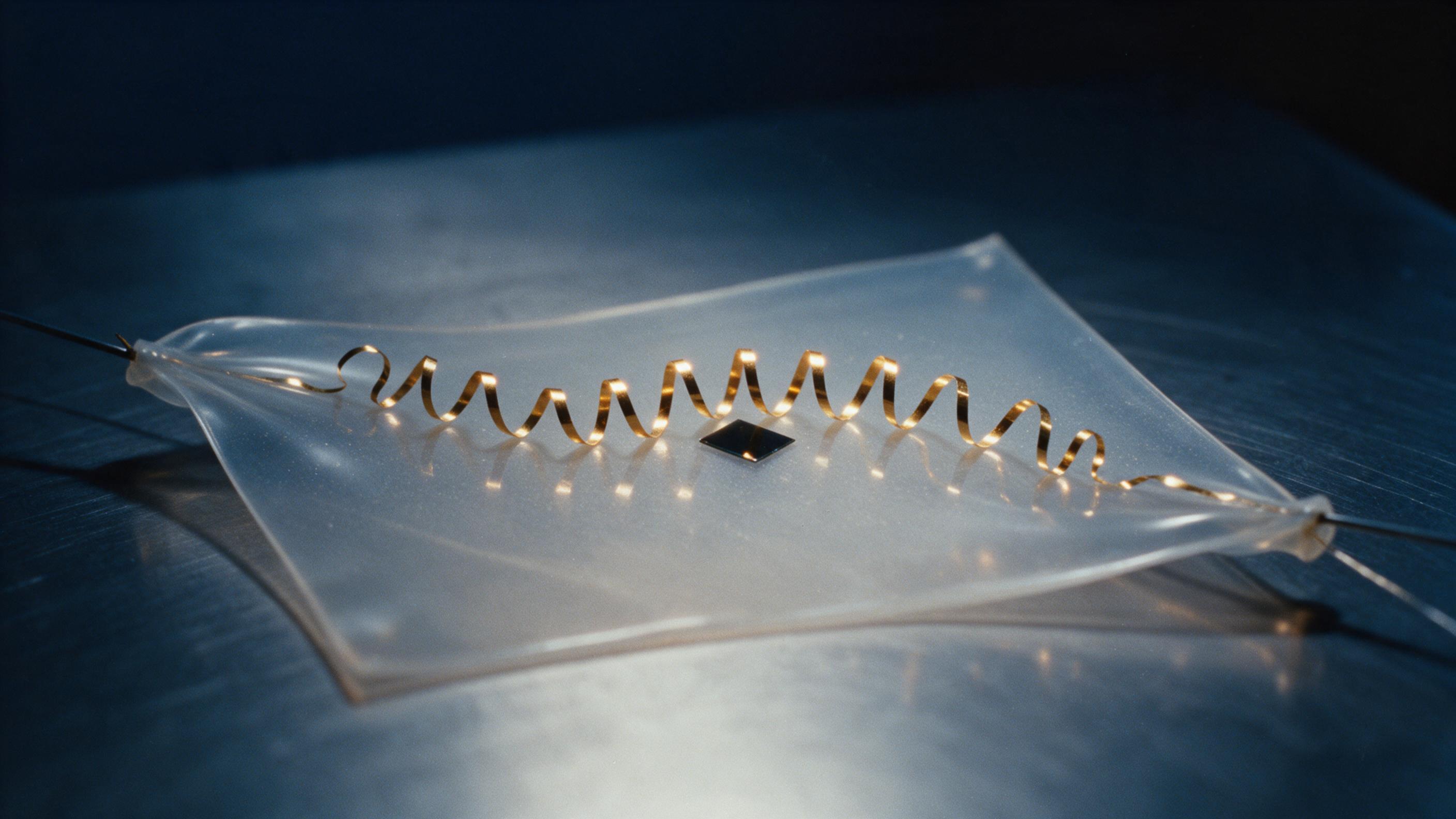
A serpentine trace is a metal ribbon on a polyimide substrate that turns back on itself. Pull the two ends apart and the arcs open like an accordion: the arc length stays constant while the end-to-end distance grows. The copper is 1 to 5 micrometres thick, or the gold 0.1 to 1 micrometre, bonded to the polymer through a chromium or titanium adhesion layer of 5 to 50 nanometres.\n\nThe numbers are what make it credible. At 30 per cent global stretch the local strain in the interconnect stays below 0.5 per cent, and the strain in the island stays below 0.01 per cent. The traces measure under 0.1 ohms per square, which is a commercial interconnect rather than a compromise one.\n\nThe mechanics are modelled as a spring-mass system: the interconnects are the springs, the islands are the masses, and the array is validated in finite-element simulation before anything is fabricated. That is the word deterministic doing real work. Nothing about the deformation is accidental, and nothing about it depends on a new material.\n\nA rigid chip on a soft body is not a paradox. It is a spring placed where the movement is, and it happens to be a spring made of copper.
Five Geometries And Five Fatigue Lives
Stretch ratio is bought with geometry, and the geometry has a price list. A simple serpentine arc reaches 30 to 50 per cent elongation and survives about 1,000 cycles. A horseshoe reaches 50 to 80 per cent and lasts about 10,000. A fractal trace, drawn as Peano, Vicsek or Moore order, reaches 100 to 200 per cent and lasts about 100,000. Nested self-similar fractals push to 200 to 400 per cent and fall back to 10,000. Kirigami, which cuts the pattern instead of drawing it, passes 400 per cent at about 1,000 cycles.\n\nRead the second column and the real constraint appears. Every extra per cent of stretch is paid for in fatigue life, and the bill lands at the tightest radius, where the bends concentrate stress until a vertex cracks. The minimum bend radius of the whole stack is about one millimetre.\n\nThe honest ceiling is about 400 per cent. The honest coverage is 10 to 50 per cent of the area occupied by islands, which means sensing happens between the islands rather than at maximum density. Those two numbers are the part of the specification nobody puts on the front page.\n\nFabrication is where the cost lands. Transfer printing, wafer thinning to 10 to 100 micrometres and multi-layer alignment mean this approach borrows a semiconductor line rather than avoiding one.
Fifty Micrometres Of Skin, 2011
In 2011 the same group published the system that left the laboratory. Epidermal electronics: a sheet with the thickness, mass and modulus of the epidermis itself, applied like a temporary tattoo. The film is 10 to 50 micrometres thick, thinner than a human hair, with a modulus of about 50 kilopascals matched to skin. It stretches 30 to 50 per cent with the body underneath it.\n\nThe demonstration set was ECG, EMG, EEG, temperature and hydration, and the accuracies were not novelty grade. Heart rate within 2 beats per minute. Temperature within 0.1 degrees Celsius. Body water within 2 per cent. Respiration within 1 breath per minute. The paper has been cited more than 3,000 times, which is unusual for a fabrication method.\n\nIt worked for a mechanical reason rather than an electronic one. A rigid electrode on moving skin measures motion as well as it measures biopotential, and the artifact lands in the same band as the signal. When the sensor has the modulus of the surface it sits on, the two move together and the artifact has nowhere to come from.\n\nCoupling is a design parameter. It belongs in the sensor specification, on the line under sensitivity.
Silicon breaks at about one per cent strain. The answer was never a softer chip.
Wireless, Then Cleared
The next thing to remove was the battery. A cell adds thickness, mass and a rigid can to a film whose entire argument is that it has none of those. By 2015 the group had published battery-free versions powered by near-field coupling, read passively and needing no charge at all. Battery life went from days to irrelevant.\n\nThen the products arrived. Wireless neonatal monitoring patches and cardiac monitors reached FDA clearance from 2020 onwards, the first stretchable electronics to hold regulatory approval, and the first to reach a market instead of a demonstration. Three spinouts carry the route: MC10, Avalon Medical Devices, and Epitel, whose EEG patches watch for seizures.\n\nThe commercial frame is not marginal. Cardiac arrhythmia monitoring runs to roughly 3 billion dollars a year worldwide, continuous glucose to about 15 billion, and neonatal monitoring to about 500 million. A patch that needs no tape has a market reason to exist before it has a research reason.\n\nThe same architecture is now going inward. Stretchable electrode arrays published from 2021 conform to the brain and the spinal cord at sub-millimetre scale, carrying thousands of channels on one soft substrate. The rigid island survived the trip.
Put The Fix In The Shape
The transferable lesson is narrow and worth stating plainly. When a mechanical limit blocks a system, the first question is whether the fix belongs in the shape rather than in the chemistry. In this case the material was never the mechanism. The wire was.\n\nThe evidence sits in what did not happen. The stretched-silicon route never reached commercial silicon performance, and the probability that a material-level approach closes that gap in the same footprint is low, well under 20 per cent, because altering the substrate changes the electrical behaviour while altering the geometry leaves it untouched.\n\nFifteen years of devices make the argument on the record. The silicon stayed exactly as brittle as it was in 2008 and shipped anyway, across medical monitoring, prosthetics and soft neural interfaces, on the strength of a shape drawn in a mask layout.\n\nThe constraint you cannot remove is usually the one you route around. The teams that win do it in geometry, early, before the material budget is spent.
The metal never stretches. The arc opens, and the ends move apart.
The map is dead. Nobody told you.
Bali State of Mind is the survival guide for the collapse of everything you were taught to believe.
Beyond this book
Building the same thing somewhere else.
Julien Uhlig is available for advisory work, board seats and media appearances. Write to media@exventure.co.
The academy that trains the operators, across every company in the group, is EX Epic Academy - 25,000 applications, 12 per cohort, 200+ alumni across 19 countries. academy.epicsolutiongroup.com
18-20 November. Online, Las Palmas, Bali.
Three days on what happens to work, capital and institutions when the map stops matching the ground. Seats are limited by cohort.
ex-aisummit.com →