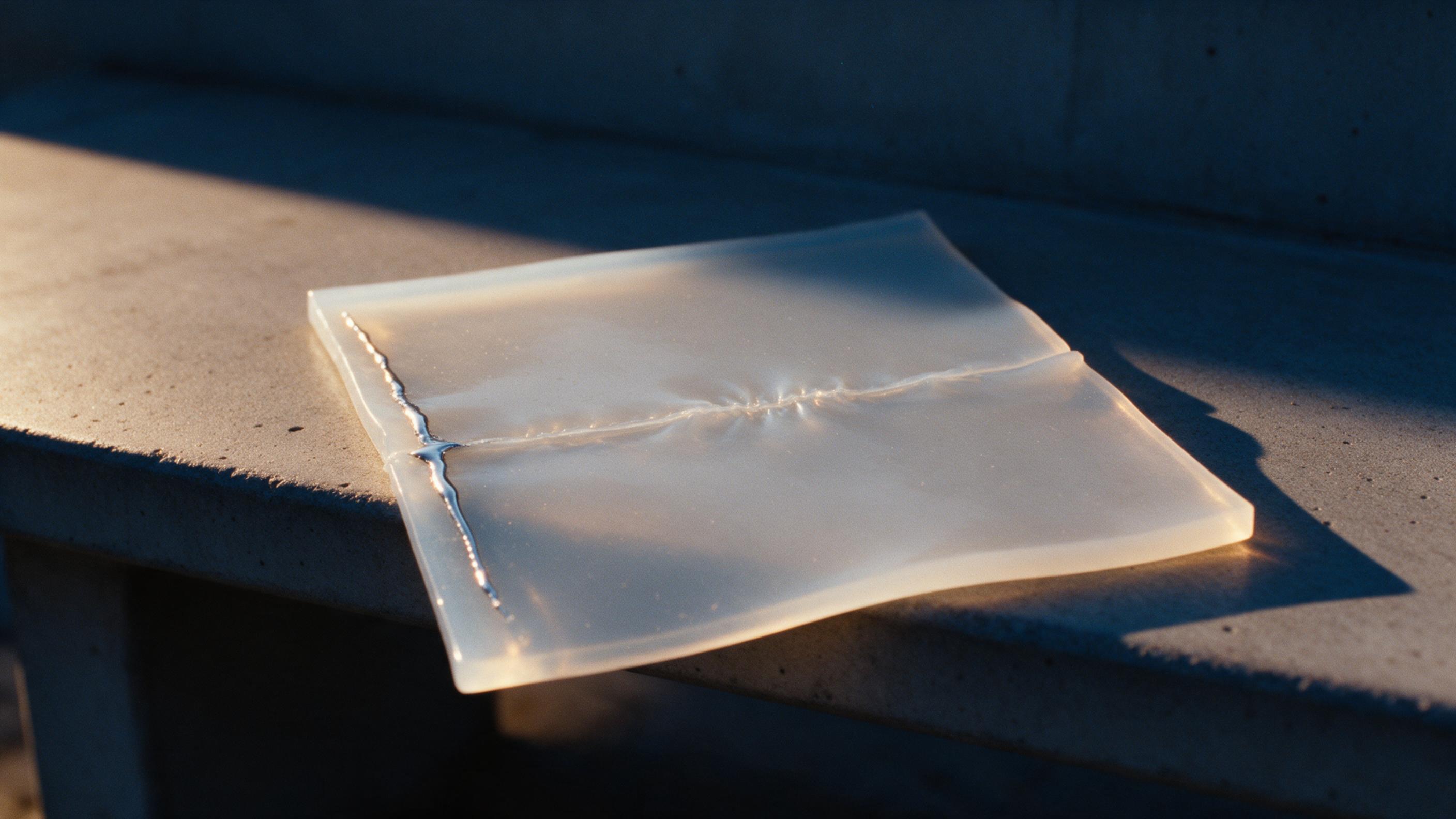
The Skin That Repairs Itself
Self-healing chemistry gives electronic skin biology's own trick: a cut that re-knits. Hydrogen-bonding networks close at room temperature in seconds and recover 50 to 80 per cent of mechanical strength across 50 to 100 cycles. Diels-Alder pairs reach 80 to 95 per cent, but need 60 to 120 degrees Celsius and give up after 5 to 20 cycles. Demonstrations run 5 to 50 cycles. A working skin needs 1,000.
The Most Fragile Part Is The Surface
The sensor is the contact surface. That one sentence is the whole durability problem in this field, and nobody designed it in. It is what touching things does. The part that reads the world is the part that gets scraped, punctured, soaked and flexed. Every hour of use is an hour of wear on the component that has to stay calibrated. In an electrical array the same damage also breaks the conductive path, so one scratch costs the signal and the structure together. The published heal numbers are strong. An electro-optical self-healing skin reported in 2025 held 93 per cent mechanical healing efficiency. A hydrogel-carbon-nanotube capacitive skin recovered 85 per cent of its capacitance after 100 cuts. Those are the right experiments. They are also the easy version.
Four Ways To Re-Knit A Cut
Diels-Alder chemistry pairs furan with maleimide into covalent bonds that break and reform. Healing takes 5 to 60 minutes at 60 to 120 degrees Celsius, restores 80 to 95 per cent of mechanical strength, and survives 5 to 20 cycles before the bonds degrade. Hydrogen-bonding networks use many weak bonds instead of a few strong ones. They heal at room temperature with no stimulus at all, in seconds to minutes. Recovery is 50 to 80 per cent. The cycle count is the best of the four, at 50 to 100 or more. Disulfide exchange swaps S-S partners under mild conditions: minutes to hours, 60 to 90 per cent recovery, 10 to 50 cycles. Boronic ester bonds exchange in water, in seconds to minutes, at 70 to 95 per cent recovery, 50 cycles and up. Four mechanisms. Two of them need a stimulus the machine may not have.
Heat Is A Dependency, Not A Feature
A range of 60 to 120 degrees Celsius is nothing in a factory. On a machine that walks, it is a heater layer, a control loop and a power budget. A skin that only heals when you plug it in is a maintenance interval with a nicer name. The mechanisms that heal with no prompt are the ones that survive an ordinary operating day: hydrogen bonding at room temperature, boronic ester in the presence of water, liquid metal inside a conductive trace. So the preference list does not follow the ranking by recovery percentage. Autonomy beats efficiency, and 50 to 80 per cent recovered without being asked is worth more than 95 per cent recovered in an oven. That inversion is the first place a specification sheet misleads a buyer.
Electricity Heals Worse Than Rubber
Mechanical healing and electrical healing are separate problems, and the second one is harder. A cut through a conductive path has to restore percolation, not just close a gap. A percolation composite reconnects its filler particles, but the alignment is not the same, so resistance comes back higher than it started. Liquid metal such as EGaIn simply flows back together and reforms its oxide skin, which is close to perfect. Conductive polymer chains re-entangle and rebuild the path, with good recovery. A capacitive dielectric layer returns to within 5 per cent of its original value. The pairing decides the outcome. Liquid metal or a capacitive layer inside a self-healing matrix is where the two halves of the problem are solved together. A self-healing rubber wrapped around a brittle conductor only heals the easy half. Most of the field's demonstrations are still the easy half.
The part that reads the world is the part that gets scraped.
The Number Nobody Puts In The Abstract
Recovery efficiency is what every paper leads with. It is not the number that decides whether a skin lasts. Ninety-five per cent of strength after a cut is not the same as never being cut. Strength is a curve, and the curve steps down each time. The count that matters is cycles. Most demonstrations land between 5 and 50. A skin in daily use needs 1,000 or more. That is a gap of 20 times at the optimistic end, and it is not closed by a better percentage. Speed is the second number. A cut that takes an hour to heal leaves the machine out of service for an hour. Sub-minute healing is the working target, and only the room-temperature mechanisms reach it. So the honest reading of a 93 per cent healing efficiency is: 93 per cent of the original strength, on a sample that had been cut once, on a bench.
Recovery Is Not Toughness
Self-healing and toughness are complementary and constantly confused. One resists the damage. The other undoes it afterwards. A part that heals perfectly but deforms permanently has still lost its calibration, and gel surfaces take scratches and permanent deformation that shift calibration over weeks of normal use. There is a real probability that the first commercially useful self-healing skin is not the one holding the highest healing efficiency. It is the one whose cycle count survives the field. I signed a personal guarantee and watched the company fold on Christmas Day 2008. What I took from that was not that risk is bad. It is that any plan which depends on recovery after the fact carries a schedule, and the schedule is not yours. A skin that repairs itself is a good answer to damage. It is not an answer to being damaged. Put the sensor where it cannot be hit as often, and the chemistry stops being the headline.
A skin that only heals when you plug it in is a maintenance interval with a nicer name.
The map is dead. Nobody told you.
Bali State of Mind is the survival guide for the collapse of everything you were taught to believe.
Beyond this book
Building the same thing somewhere else.
Julien Uhlig is available for advisory work, board seats and media appearances. Write to media@exventure.co.
The academy that trains the operators, across every company in the group, is EX Epic Academy - 25,000 applications, 12 per cohort, 200+ alumni across 19 countries. academy.epicsolutiongroup.com
18-20 November. Online, Las Palmas, Bali.
Three days on what happens to work, capital and institutions when the map stops matching the ground. Seats are limited by cohort.
ex-aisummit.com →