The Skin That Dries Out
The substrate that matches living tissue more closely than anything else on the materials shelf is 70 to 99 per cent water, and water leaves. Ionic skin carries charge with ions instead of electrons at 10 to the minus 3 to 10 to the minus 2 siemens per centimetre, with a modulus of 1 to 100 kilopascals, better than 95 per cent transparency and stretch past 2000 per cent in a double network. Then it shrinks, stiffens and stops conducting, over hours to days. Encapsulation is mandatory. Encapsulation costs the compliance you picked the material for.
Ninety-Seven Per Cent Water
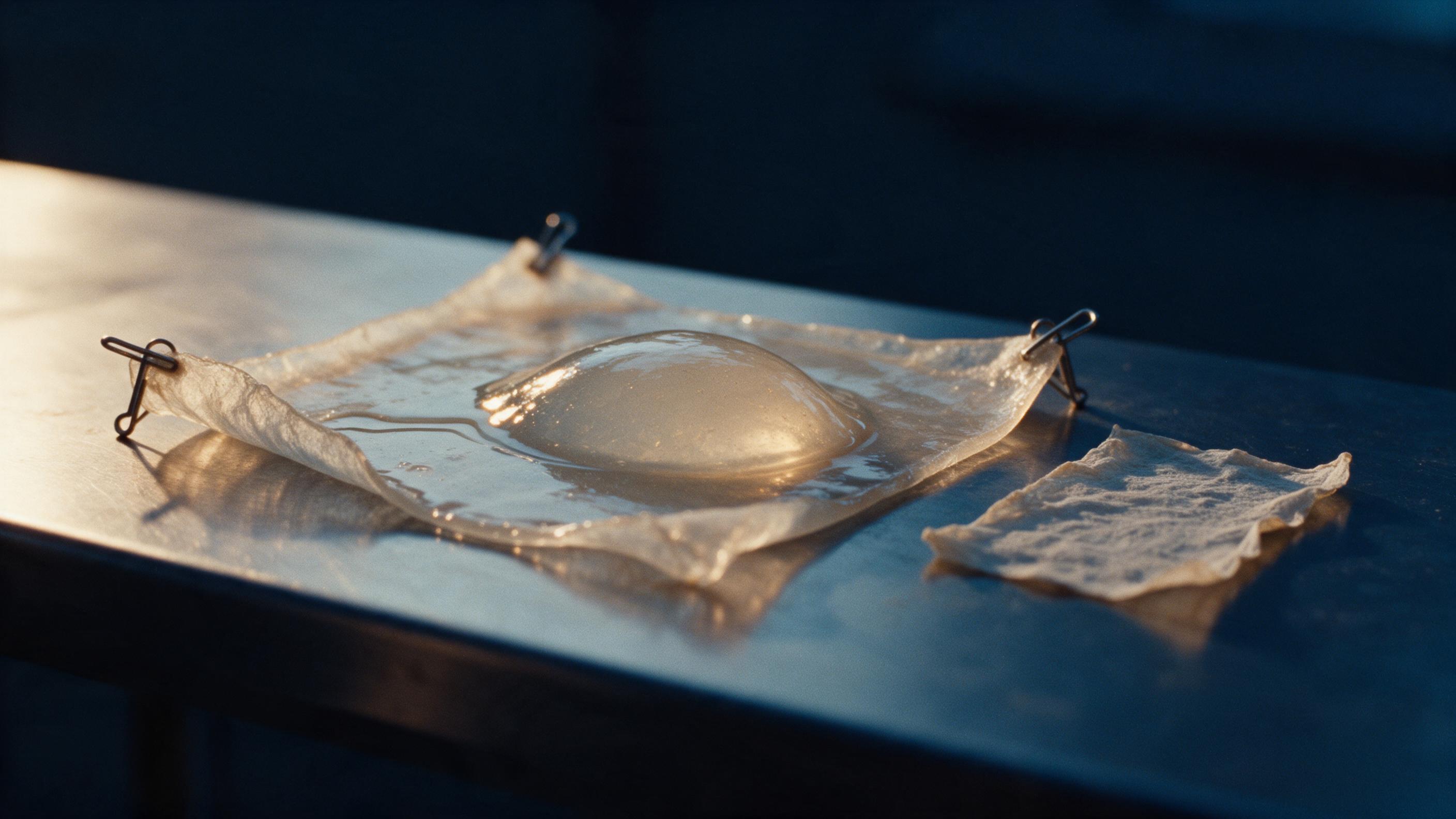
There is a sheet of it on the steel bench that you would walk past. About a millimetre thick, clear, faintly damp, resting under an upturned beaker because the last person in the room stopped trusting it near moving air. A hydrogel is a crosslinked polymer network swollen with water. That is the whole invention. Between 70 and 99 per cent of its mass is water held inside a mesh of polymer chains, with lithium chloride or sodium chloride or potassium chloride dissolved in it to carry charge. The datasheet taped to the bench says it matches living tissue more closely than anything else on the shelf. The datasheet is right. Modulus of 1 to 100 kilopascals. Human skin sits inside that band. No metal, no elastomer and no rigid semiconductor gets there without being engineered toward it, and most never do. The same sheet will be useless by Friday. Both statements are true at once, and almost every argument about this material is one side reading the first one and the other side reading the second.
Charge Carried By Water
An electronic conductor moves electrons and holes. A hydrogel moves ions. Lithium, sodium, chloride, drifting through a water swollen mesh when a voltage is applied across it. That one substitution rewrites every number downstream. Conductivity lands between 10 to the minus 3 and 10 to the minus 2 siemens per centimetre. A metal runs around 10 to the 4. Ion mobility is 10 to the 6 times lower than electron mobility, so the frequency response flattens out somewhere between 1 and 10 kilohertz. Above that you are not reading a sensor any more. The junction is the second bill. A copper wire meets an ionic gel through an electrochemical double layer, which means the place where you read the signal generates its own capacitance and its own side reactions. The electrode is part of the measurement. Ionic conduction is not worse conduction. It is a different promise with a different clock.
The Only Substrate That Needs No Engineering
Understand why anyone put up with the slow part. The rest of the list is remarkable. Transparency above 95 per cent, so a camera can look through the sensor. Stretch of 200 to 500 per cent in a standard gel and 500 to 2000 per cent in a double network. Toughness of 10 to 100 joules per square metre, and 1000 to 10000 once the double network is in place. Self healing in the gels built on dynamic crosslinks, which re-knit after a cut. Then the recipes, each cheap enough to mix on a bench. Polyacrylamide with 4 to 8 molar lithium chloride holds 10 to the minus 2 siemens per centimetre and stretches past 500 per cent. Polyvinyl alcohol with phosphoric acid is cheaper, self healing and stretches 200 per cent. Calcium alginate, out of seaweed, is biodegradable at 10 to the minus 3. Gelatin with salt is edible and stretches 50 per cent. Water based, salt based, non toxic. You can put it on skin. In a few cases you can put it inside a body. Read as a materials review, this is the solved case. It is the specification that kills it.
Then The Water Leaves
Drying sits at the top of every disadvantage list and it is not a footnote. Water evaporates. Over hours to days the gel shrinks, stiffens and loses conductivity, and it does not announce which hour it starts. Freezing is the second. Water freezes at 0 degrees Celsius, and below that the material is rigid and non conductive. Glycerol or ethylene glycol in the mixture holds the working range to minus 20 degrees, at a cost in viscosity, in conductivity and in the biocompatibility that justified the material. Salting past 8 molar lithium chloride pushes the freezing point down and starts crystallising the salt instead. Third, a cut in a standard hydrogel grows. Toughness of 10 to 100 joules per square metre means a small defect propagates, and the sheet you were testing is two sheets. The double network fixes that number by an order of magnitude, and moves the manufacturing into a different category. None of this shows up in the first hour. All of it decides the deployment.
The best tissue match in the room is also the shortest lived.
Every Fix Costs The Property You Chose
Here is the framework, and it is the part that never reaches the abstract. Oil encapsulation stops the evaporation and gives the surface a lubricious feel. The material becomes 50 to 100 times stiffer and stops being transparent. An elastomer laminate seals the gel and closes the water loss. Stiffness rises and the transparency is gone, so the optical readout you wanted is gone with it. An antifreeze mixture widens the temperature range and narrows the biology. Every one of those moves protects the conductivity by spending the compliance. Spend enough of it and you are holding a stiff, opaque, durable device with a wet core inside that you can no longer put on skin. Encapsulation is mandatory. That is the sentence. Encapsulation is mandatory, and encapsulation costs the compliance you chose the material for.
Read The Lifetime, Not The Sensor
The figures are honest. They were measured on day one. How small a pressure can it feel, how fast can it sample, how far can it bend before it breaks. Those questions are answered, in tables, in papers, with enough repetition that the material looks finished. How many hours until the reading drifts, and what a drifted reading looks like to the software on the other end, is the question the tables skip. I have built companies across 12 countries and restructured a industrial group. The pattern in hardware is always the same. The half that demos in the first hour gets funded, because a visitor can touch it. The half that has to survive a thousand hours gets deferred, because in a slide deck it looks like packaging. So read it in the other order. Start from the number of hours the device has to work, whether that is a 14 day ECG patch on a chest or a sensor laid on a wound. Then walk backwards and take whatever modulus, stretch and transparency the encapsulation leaves you, and only then check whether the sensor you wanted still exists inside that envelope. The probability that an ionic skin survives a fortnight on a moving body is not zero. Most product road maps price it at zero, then meet the drying curve in month nine, on a customer, with the warranty already signed.
It is 97 per cent water, and water leaves.
The map is dead. Nobody told you.
Bali State of Mind is the survival guide for the collapse of everything you were taught to believe.
Beyond this book
Building the same thing somewhere else.
Julien Uhlig is available for advisory work, board seats and media appearances. Write to media@exventure.co.
The academy that trains the operators, across every company in the group, is EX Epic Academy - 25,000 applications, 12 per cohort, 200+ alumni across 19 countries. academy.epicsolutiongroup.com
18-20 November. Online, Las Palmas, Bali.
Three days on what happens to work, capital and institutions when the map stops matching the ground. Seats are limited by cohort.
ex-aisummit.com →