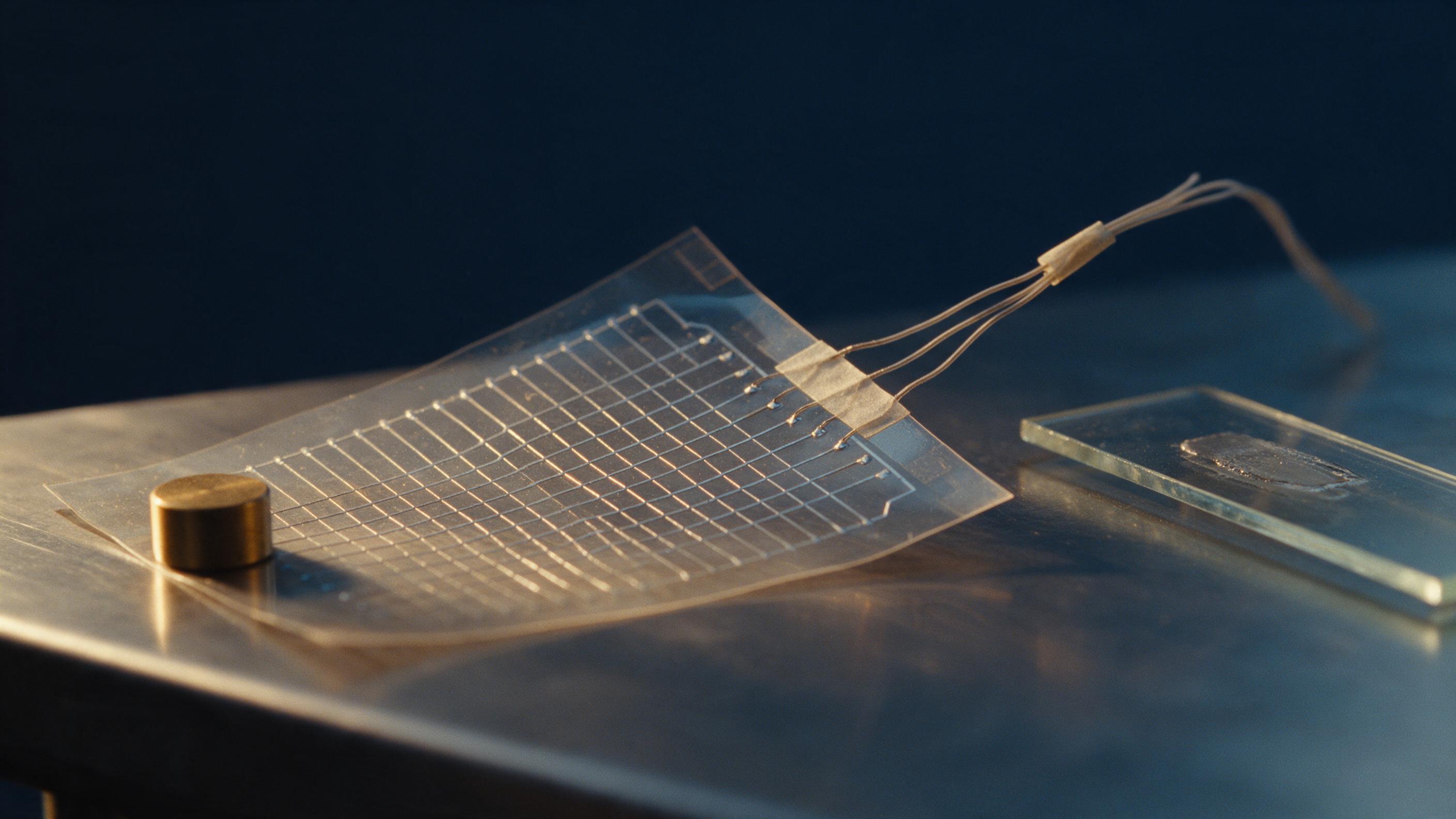
The Signal That Decays To Zero
Piezoelectric sensing is the fastest and most sensitive touch transducer in the catalogue, and the only one that cannot hold a reading. Deform the film and charge appears proportional to the force; hold the deformation and the charge drains away through the material's own resistance and the reader's input impedance, on a time constant of resistance times capacitance. The device is AC-coupled by physics. It reports events, never states.
Press It And It Answers Once
Press a piezoelectric film and it answers immediately. Hold the press and it goes quiet. That is not bad electronics. It is the material obeying the crystal physics it was chosen for, and it is the one fact that decides where this sensor belongs in a robot hand. Strain the material and its internal polarisation shifts, so charge appears on the two surfaces in proportion to the force applied. The relation is one multiplication: charge equals the charge coefficient times the force, where the coefficient is measured in picocoulombs per newton. A film of polyvinylidene fluoride, the workhorse of electronic skin, carries a charge coefficient of minus 33 picocoulombs per newton and a dielectric constant of 12. Then the charge drains. Through the material's own internal resistance, through the input impedance of whatever is reading it, through every external load in the path. The drain follows a time constant equal to resistance times capacitance, and under a constant load the output decays to zero. The sensor reports the moment. It never reports the state.
AC-Coupled By Physics
There is no bias voltage to hold across this device and no steady-state reading to wait for. The honest description is that it is AC-coupled by physics, in the same way an audio transformer is AC-coupled by design. Only here nobody chose it. What that buys, in exchange, is bandwidth and sensitivity that no competing transducer matches. PVDF runs from 0.1 hertz at the bottom to 1 gigahertz at the top, five orders of magnitude wider than the mechanical world it is listening to. Its detection threshold sits below 1 millinewton, which is lighter than a housefly landing. Dynamic range runs 60 to 80 decibels. It works from minus 40 to 100 degrees Celsius. It also has no hysteresis, and that is a structural gift rather than a tuning result. The effect is mediated by crystal structure, not by a percolation network of conductive filler squeezed inside an elastomer. There is nothing in the material to fatigue, no network to re-form, no creep to re-zero between cycles. The output for a given deformation is the same on the first press and the millionth. The catch is at the wire, not in the film. A charge source with a very high internal impedance has to be buffered where it sits. That means a high-impedance stage at the sensor, built on a JFET or a CMOS input, with the capacitance of the cable sitting in parallel with the signal path and eating it. The amplifier is part of the sensor, or the sensor is noise.
The Reading Under The Stone
Put a stone on a piezoelectric pad. You get one clean spike at contact, then silence while the stone sits there, and a spike of the opposite sign when you lift it off. Put the same stone on a capacitive pad and the reading holds steady for an hour, because a capacitor measures a gap and the gap is still open the same amount. The pad did not fail. It answered the only question it can answer, which is what changed. That single restriction removes whole product categories from the list. Weighing anything is out. Holding a grip force constant is out. Measuring resting contact pressure, which is most of what a hand does when it is simply carrying something, is out. It also adds a category that no other transducer in the stack can serve. Tapping, impact, contact timing, texture, the onset of a slip: these are all events, and events are exactly what a decaying signal is built to catch. The sensor that cannot hold a reading is the sensor that is never late. The mistake is treating that as a flaw to engineer around with a longer time constant. Hold the charge longer with a bigger capacitor or a leakier amplifier and you do not get static pressure. You get a slower, dirtier version of the same dynamic signal, with the bandwidth that justified the material thrown away.
Five Materials, One Column Of Compromise
Lead zirconate titanate ceramic carries a charge coefficient of 200 to 600 picocoulombs per newton, six to eighteen times PVDF, with a detection threshold under 0.1 millinewton and 80 to 120 decibels of dynamic range. It is also rigid, brittle, contains lead, and cannot be mounted on a surface that moves. Its dielectric constant runs 1200 to 3000 and its Curie temperature sits near 350 degrees Celsius. PVDF trades that sensitivity for a film that bends, and the film gets thin: 9 micrometres is a production number, thin enough to laminate into a stack between other layers without changing the stack's mechanics. Its copolymer P(VDF-TrFE) buys more crystallinity at minus 38 picocoulombs per newton and a Curie temperature near 120 degrees. Zinc oxide is biocompatible and thin-film compatible at 12 picocoulombs per newton, annealing near 500 degrees. Aluminium nitride is CMOS-compatible and survives past 1000 degrees, at 5 picocoulombs per newton, which is quiet enough to be the wrong choice for touch and the right choice for process integration. Every material in the column pays for its position. Whichever one you pick, the material arrives unpolarised and has to be poled under a strong DC field to align its domains before it will produce charge at all. That is a manufacturing step, not a trim.
Press it and it answers. Hold it and it goes quiet.
The Sensor That Also Measures Heat
PVDF is pyroelectric as well as piezoelectric. A temperature change of 0.1 degrees Celsius produces a signal comparable to a moderate touch, on the same electrodes, through the same amplifier, with the same sign of decay. The electronics cannot tell the two apart by shape alone, because there is no shape difference to find. Charge is charge. An environment that warms by half a degree while a hand approaches will hand you a touch reading that never happened, and it will look exactly like the one that did. This is why the useful implementations in wearable and field hardware are differential. Two matched elements, wired so the common thermal signal subtracts and the mechanical signal does not, or a thermal shield over the film, or compensation in the signal chain after the fact. All three are engineering, not calibration. The same physics that makes the material fast makes it credulous. Anything that changes the crystal's spacing talks to it, and temperature does.
A Pair, Not A Sensor
The most effective use of a piezoelectric layer is next to a static one. A dynamic channel to catch the event, and a capacitive or piezoresistive layer to measure the sustained force that follows it. That split maps onto the physics cleanly. The vibrations that precede a slipping object run at 5 to 50 hertz, and the dynamic channel is the one listening there. Scanning a surface produces a characteristic vibration signature that identifies fabrics, papers and finishes by feel alone, and that signature lives in the same band. Impact timing and contact events are transients by definition. The static layer answers the question the dynamic layer physically cannot: how hard, right now, and still. I have built companies across twelve countries and restructured a industrial group, and the pattern with sensor choices has not moved in 30 years. The part that answers one question extremely well tends to survive in production. The part asked to answer two usually fails the second one at temperature, or on the line, or in the field. The probability that a robot hand in volume production carries a piezoelectric layer is not zero. Most road maps price it at zero, because a sensor that cannot weigh a stone is easy to mark down in a spreadsheet and hard to appreciate in a demo. The pulse is the event. The plateau is the force. Neither sensor reports both, and the hand that feels like a hand will carry one of each.
There is no bias to hold. The charge is leaving the moment it arrives.
The map is dead. Nobody told you.
Bali State of Mind is the survival guide for the collapse of everything you were taught to believe.
Beyond this book
Building the same thing somewhere else.
Julien Uhlig is available for advisory work, board seats and media appearances. Write to media@exventure.co.
The academy that trains the operators, across every company in the group, is EX Epic Academy - 25,000 applications, 12 per cohort, 200+ alumni across 19 countries. academy.epicsolutiongroup.com
18-20 November. Online, Las Palmas, Bali.
Three days on what happens to work, capital and institutions when the map stops matching the ground. Seats are limited by cohort.
ex-aisummit.com →