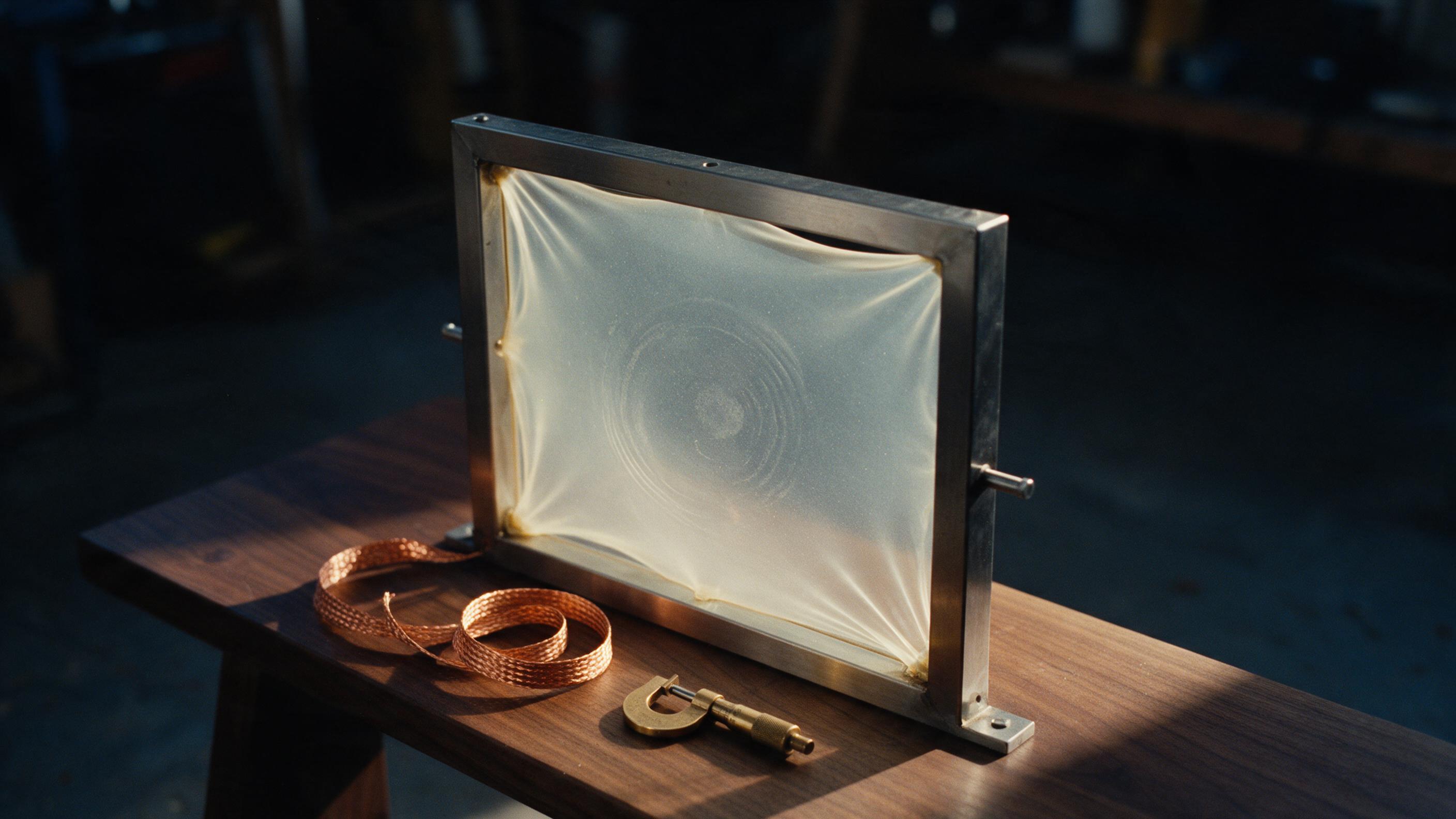
The Sense That Has To Touch The World
Vision and hearing are remote senses. They sample energy that is already on its way in, which is why a camera can work from behind glass and never touch anything. Touch is the only contact sense. It cannot be moved off the boundary and it cannot be treated as a channel that happens to be mounted on a body, because the surface that senses is the same surface that manipulates, deforms, wears and repairs. That single difference is what makes the engineering unusual, and it is the difference that most of the field quietly designs away.
The Sense That Cannot Be Moved Off The Boundary
Vision is a remote sense. A camera can be sealed behind glass, because light arrives at the lens whether or not the lens participates in anything. A microphone works through a membrane. Both senses sample energy that is already travelling, which means the sensor can sit back from the world and still be correct.\n\nTouch does not work that way. The tactile sensor has to be the surface that makes contact. There is no gap to exploit and no sealed enclosure to hide behind. The sensing surface is the touching surface, and it has to survive the thing it is measuring.\n\nThe mismatch shows up immediately in the numbers. Human skin runs at 10 to 100 kilopascals of stiffness. Silicon runs at about 150 gigapascals. That is six orders of magnitude between the material a sensor is built from and the material it has to imitate, and every design in the field is an argument with that gap.\n\nSkin also stretches 30 to 70 per cent before it breaks, holds a coefficient of friction between 0.4 and 0.8, and passes 200 to 400 grams of water vapour per square metre per day so it can breathe. None of those are sensing requirements. All of them are requirements on whatever the sensor is attached to.
The Sensor Is Also The Surface That Wears
The second consequence follows from the first one. Because the sensor is the contact surface, it is also the surface that grips, that deforms under load, that abrades and that has to repair itself. Sensing and manipulating are not two functions sharing a housing. They are one surface doing both at once.\n\nFingertip compliance is the clearest case. A human fingertip indents 1 to 2 millimetres under firm contact, and that lets it conform to a rough surface without any active force control. The softness is doing the gripping. A rigid sensor pad has to solve the same problem with a controller, and it is worse at it.\n\nThis is the half that gets under-designed. A taxel can be characterised in a lab in an afternoon. A wiring harness that crosses a knuckle 500,000 times a day cannot be characterised in an afternoon, and it is the part that fails. Sixteen years of field work, from rural Nigeria to post-conflict Serbia to Kazan to Fukushima, is long enough to learn which half of a system actually breaks. It is almost never the clever part.
The Mechanics Are The First Stage Of The Computation
Before any signal leaves the fingertip, the tissue has already done work on it. The stratum corneum is 10 to 20 micrometres of dead keratinised cells, and its ridges sit at a periodic 200 to 400 micrometre pitch. Those ridges act as a mechanical bandpass filter. They amplify texture vibration in the 50 to 500 hertz band that matters for slip and attenuate slow drift.\n\nBelow that, the viscoelastic layering separates channels by frequency before a single nerve fires. Fast events reach the deep Pacinian corpuscles. Slower, sustained pressure reaches the Merkel cells near the surface. The separation is mechanical, and it costs the nervous system nothing.\n\nThat is the design lesson and it is the one most easily missed. Morphology can do work that no algorithm has to repeat. A gel that conforms to an object has already computed the contact geometry. A soft body that spreads load has already filtered the force. The mechanics are not packaging sitting in front of the sensor. They are the first stage of the computation.
Two Systems, And The Field Only Builds One
Human glabrous skin carries four classes of mechanoreceptor. The Merkel cells report shape with receptive fields of 2 to 5 millimetres, sit at roughly 100 per square centimetre in the fingertip against 10 per square centimetre on the palm, and set a two-point discrimination limit of 1 to 2 millimetres. Meissner corpuscles answer change. Ruffini endings read stretch. Pacinian corpuscles follow vibration into the hundreds of hertz.\n\nThat system is the one every artificial skin imitates, and it is only half the organ. A second class of unmyelinated afferents runs in hairy skin, conducting at 0.5 to 2 metres per second against the 35 to 75 metres per second of the fast fibres. It does not report position at all. Its peak response is a stroke at 1 to 10 centimetres per second at roughly skin temperature, near 32 degrees Celsius, and it projects to the insula and the orbitofrontal cortex rather than to the somatosensory map.\n\nThe two channels do different jobs. One answers what, where and how hard. The other answers whether the contact is safe and wanted. Almost no tactile programme touches the second channel, which is why a machine with an excellent force resolution can still be informationally competent and emotionally mute.
A camera can work from behind glass. A touch sensor has to be the thing that touches.
The Wall Is In The Wiring
Human skin holds around 17,000 mechanoreceptors in a single hand, with roughly 38,000 nerves crossing the wrist. A typical robot hand in 2020 carried 10 to 50 taxels. The advanced research hands of 2025 carry 100 to 500, with some laboratory arrays past 1,000. The sensors are not the constraint.\n\nArithmetic makes the rest of it plain. A thousand taxels at 10-bit resolution sampled at 100 hertz is 1 megabit per second, which is manageable for one finger. Ten fingers plus a palm pushes past 10 megabits per second. A whole-hand array of 10,000 taxels needs more than 100 megabits per second, routed off a curved, moving surface, through joints that flex millions of cycles.\n\nThat is why the bottleneck has already moved twice: from the transducer, to the interconnect, and now to interpretation. It is also why the field's real trilemma is that you can have spatial resolution, large-area coverage or manageable wiring, and pick only two of the three. The third has to give, and which one you give up is the decision that defines the product.
A Boundary Is Not A Channel
An artificial skin is not a sensor array with a soft cover on it. It is a boundary, the surface where a system ends and the world begins, and the only surface where contact, force, damage and care all register in the same place at the same time.\n\nA robot with cameras and no touch is a disembodied eye. It can describe the world from a distance. It cannot tell you what it is like to be against it.\n\nThe probability that the load-bearing work in this field shifts from transduction to interpretation over the next ten years is not zero. Most roadmaps are pricing it at zero, which is why most tactile programmes spend everything at the sensor and leave the wiring, the safety layer and the affective channel unbuilt.\n\nThe channel is not the point. The boundary is. The surface that has to touch the world is the surface that has to survive it.
The surface that senses is the surface that deforms, wears and repairs.
The map is dead. Nobody told you.
Bali State of Mind is the survival guide for the collapse of everything you were taught to believe.
Beyond this book
Building the same thing somewhere else.
Julien Uhlig is available for advisory work, board seats and media appearances. Write to media@exventure.co.
The academy that trains the operators, across every company in the group, is EX Epic Academy - 25,000 applications, 12 per cohort, 200+ alumni across 19 countries. academy.epicsolutiongroup.com
18-20 November. Online, Las Palmas, Bali.
Three days on what happens to work, capital and institutions when the map stops matching the ground. Seats are limited by cohort.
ex-aisummit.com →