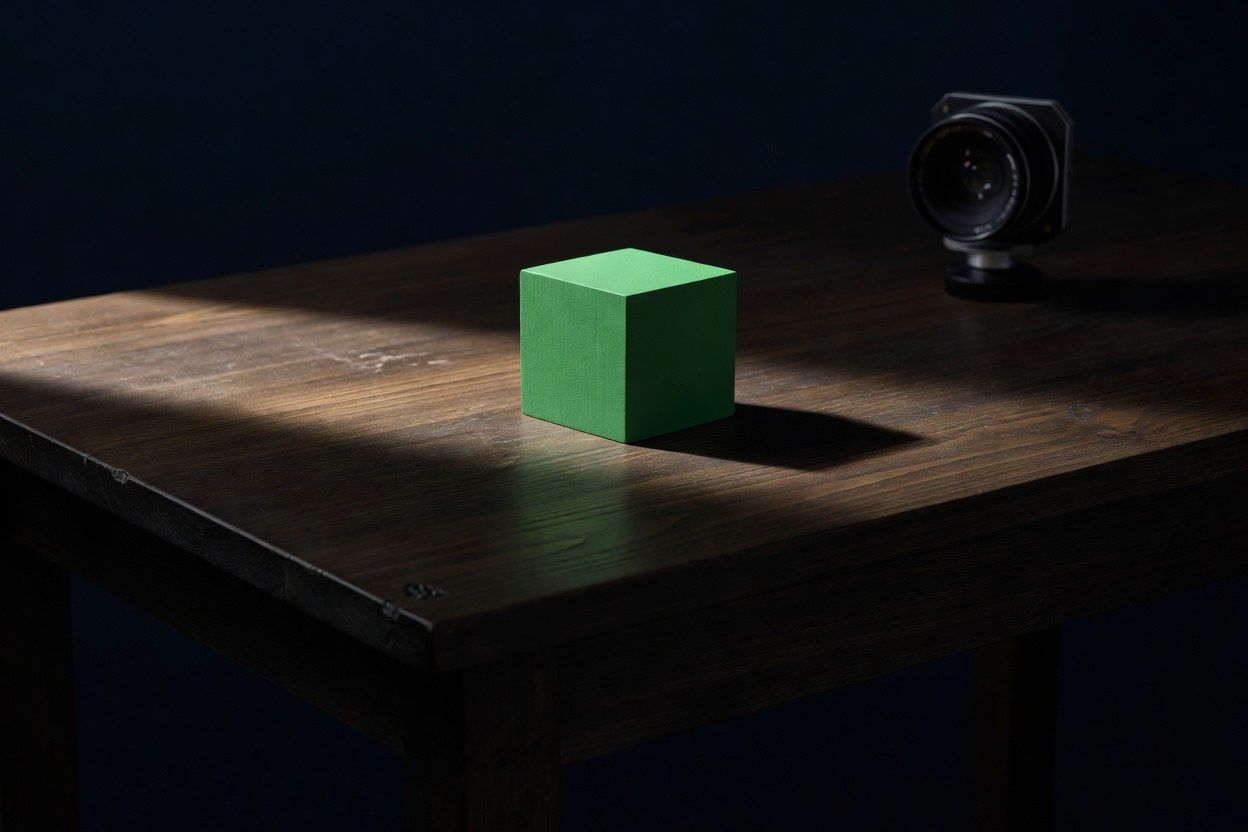
The Room Is The Green Screen
An LED volume is 1 way to build a virtual production stage, and it is the expensive way. The cheaper one is 6 principles: build the green into the room itself, let depth data place the subject in the scene, keep 1 calibrated rig with interchangeable lenses, and let every reusable asset live as a file. 0 renders required to make the case.
A Stage Priced Like A Room, Not Like An LED Volume
The note was captured in 258 words and it opens with a blunt phrase: a poor man's LED volume. That is the brief. A virtual production stage normally means an LED volume: a curved wall of panels wrapping the set, a room built around it, a calibration team on call, and a wall that can never be used for anything else. The alternative in those 258 words costs a fraction of it. Build the green into the space itself and let the room be the set. Same workflow, same output, different bill. I have taken that trade before and I know which side of it survives contact. In 2008 I signed a EUR 20 million personal guarantee against a plan that assumed the expensive version of everything, and the company folded on Christmas Day. The question is never whether the technology works. It is whether the same result can be reached without buying the room twice.
The Space Is The Green Screen, Not Something Hung In Front Of It
6 principles carry the concept, and the first one reorders everything under it. The space is the green screen. You build the green into the room itself, floor to ceiling and wall to wall, so there is nothing to hang in front of the subject and nothing to reposition between setups. 4 of the other 5 principles are consequences of that 1 decision: depth data does the positioning, the rig is calibrated once, the hardware stays off the shelf, and the background becomes a layer rather than a location. A screen on a frame is a wall you keep moving. The same green built into the space is a stage. I have watched that distinction decide a project before. 200 wood-gasification machines were built across the UK and Europe, and the plants that held were the ones designed around the process rather than the process fitted into a rented building afterwards. 11 countries, 1 lesson.
Depth Data Puts The Subject In The Scene At Millimetre Precision
The camera's depth reading is what places the subject inside the 3D scene, precisely enough that nobody eyeballs a position on a monitor. Depth data equals millimetre positioning. The rig is calibrated once, at 1080p and 24 fps or wherever the delivery sits, and the software carries the rest of it. That is the part that changes the economics: calibration stops being a session on the call sheet and becomes a number stored in a file. The 12 stages of a production pipeline all lean on that file, and 3 of them - framing, focus, composite - stop being guesswork once the position is a measurement instead of an opinion. I have spent 16 years in field work, from rural Nigeria to post-conflict Serbia to Kazan to Fukushima, and the arithmetic never moved. The setup you measure once is the setup that holds.
1 Rig, Interchangeable Lenses, 0 Recalibrations
A wide room shot and a tight close-up are normally 2 setups and 2 calibration passes. Here they are 1 rig and a lens swap. An 18 mm for the room, a 50 mm for the mid, an 85 mm for the face, and the calibration is untouched because it lives in the software rather than in the mount. That is the second principle doing real work: hardware off the shelf, intelligence in software. Nothing on the rig is bespoke, and the part that is expensive to change is a file. The same move restructured a EUR 75 million industrial group: we pulled the intelligence out of 12 departments and into 1 operating standard, and the plant stopped being a negotiation. The probability that a bespoke rig is the cheaper rig over 3 productions is not zero. Most people price it at zero, then buy the calibration team again.
A screen hung in front of a room is a wall. The same green built into the room is a stage.
Capture Clean, Fit Later, And Light It To Match
The workflow is 2 steps and the order is the point. Capture the subject clean in front of the green screen, then fit that capture into a scene whose background is a fully replaceable layer. On a 1080 by 1920 vertical delivery the subject never waits on the background and the background never dictates the shoot day. Then the part that decides whether any of it reads as real: lighting. A touch of light makes the subject pop and matches the background's own light, which is the difference between a key and a composite. Keying plus correct lighting is a believable shot. Keying on its own is a cutout, and an audience feels that in about 2 s without being able to name it. 210 energy systems were deployed across Africa and Asia on that logic: the unit was built to a standard, the site was fitted to the unit, and the 2 were never negotiated in the same meeting.
The Reusable Part Is The Files, Not The Room
Everything that can be used twice lives as a file in the media library: the studio, the backgrounds, the characters, all of it in one place. That is the compounding asset. The second film starts from the first film's assets instead of an empty room, and the third starts from 2 films' worth. The next steps on the list are a hardware spec, a lighting plan, a software chain that runs capture to key to composite to render, and budget tiers for a first build. 393 pages and 12 countries of building companies taught me one thing, which is that the value sits in what you keep. 250 operators trained through a programme with a 25 seat cohort learned it the same way, by reusing what the cohort before them built rather than starting from a blank page. The probability that every shoot should begin from an empty room is not zero. Most people price it at zero, and then pay for it shoot after shoot.
Depth data equals millimetre positioning, so nobody has to eyeball it on a monitor.
The map is dead. Nobody told you.
Bali State of Mind is the survival guide for the collapse of everything you were taught to believe.
Beyond this book
Building the same thing somewhere else.
Julien Uhlig is available for advisory work, board seats and media appearances. Write to media@exventure.co.
The academy that trains the operators, across every company in the group, is EX Epic Academy - 25,000 applications, 25 seats per cohort, 210 alumni across 19 countries. academy.epicsolutiongroup.com
18-20 November. Online, Las Palmas, Bali.
Three days on what happens to work, capital and institutions when the map stops matching the ground. Seats are limited by cohort.
ex-aisummit.com →