The Residue That Decides The Reactor
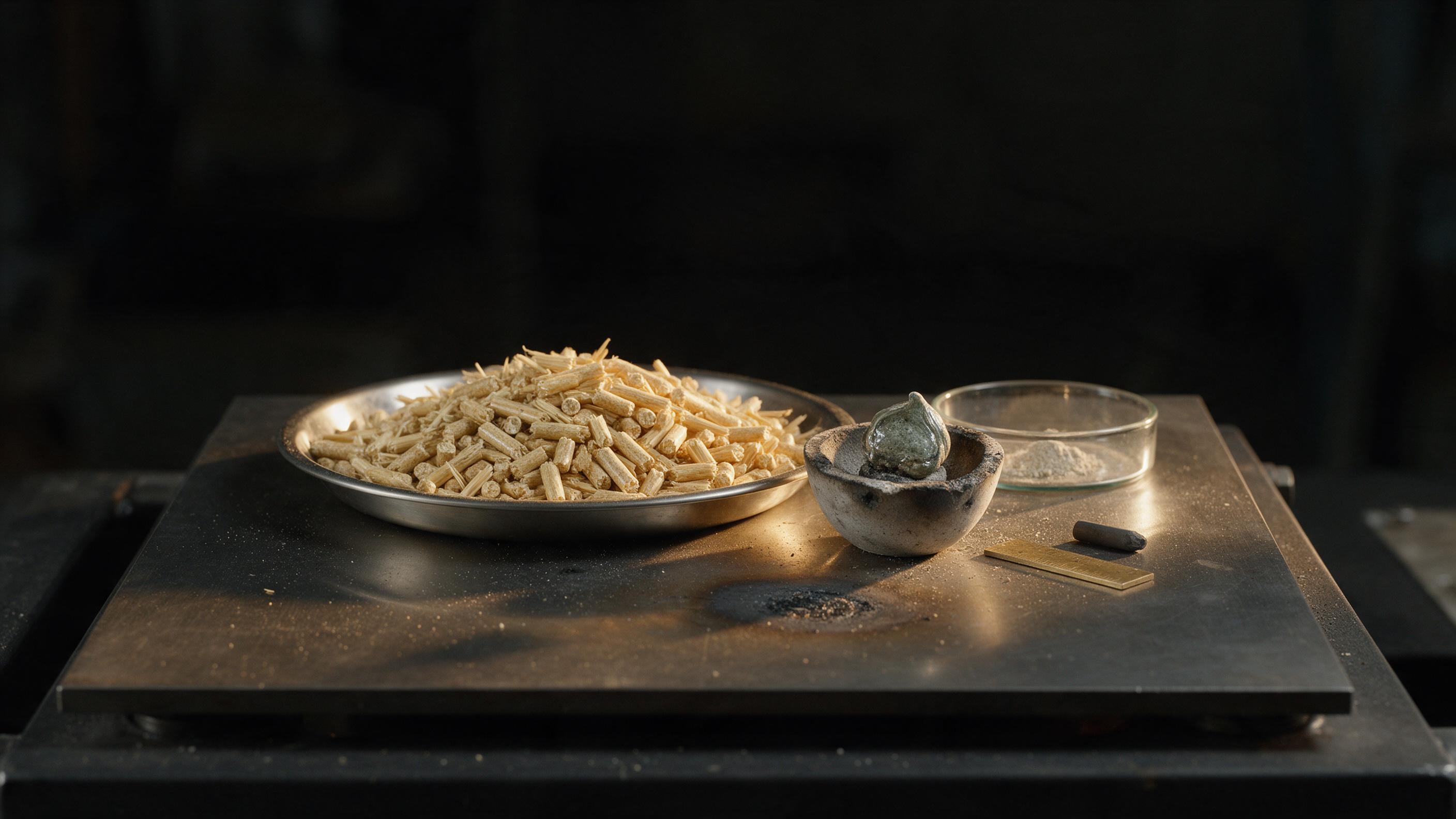
A straw pellet reports 17.2 megajoules per kilogram, which is close enough to wood that the fuel sheet looks unremarkable. What the sheet does not carry is the ash softening temperature, and that single number decides which reactor the pellet is allowed to enter. Nine runs and 75 hours on a German test stand show what the answer costs.
Seventeen Megajoules On Paper
Put the fuel analysis in front of an engineer and the case writes itself. Straw pellets measured in a German university laboratory came back at 17.21 megajoules per kilogram, and across nine separate runs the number never moved far: 17.13, 17.15, 17.21, 17.23, 17.24, 17.27, 17.29, 17.30, 17.44. Water content sat at 8.38 to 8.62 per cent. The dry matter carried 47.33 per cent carbon, 6.72 per cent hydrogen, 0.26 per cent nitrogen, 0.07 per cent sulphur and 4.52 per cent ash. Wood is right next door to all of it. This is why so many process chains get designed around a residue before anyone has burned a single tonne of it, and why so many of them stall at commissioning. The energy content is the easy column and it is the column everybody reads first.
One Thousand Against Thirteen Hundred
Now the column that decides. Wheat straw ash softens at roughly 1,000 degrees Celsius, which is not a high number in gasification terms. Local peak temperatures inside the fixed bed of a co-current gasifier have been measured above 1,300 degrees. The ash is therefore molten in the hottest part of the reactor while the fuel above it is still being dried and devolatilised. Melted ash runs down, bridges the gaps between the pellets and closes the bed, and once the bed stops passing gas the process stops. Nothing about that sequence is a defect in the straw. The straw is doing exactly what its chemistry says it will do at that temperature. This is the arithmetic that decides reactor type, reactor geometry and whether the project is worth starting, and it is routinely left out of the deck. The probability that a residue fails for the reason printed on the fuel sheet is low. It fails for the number that was never printed.
The Machine That Pierces The Bed
The answer taken at Zittau and Goerlitz was mechanical rather than chemical. The X5 gasifier designed by MFC is a fixed-bed co-current unit built around the assumption that slag will form and has to be broken. A fuel bunker holds just under 60 kilograms of pellets and feeds them with a discharge screw, with the fill level held by an optical laser system. A pressure blower pushes the gasification air in from above. A vertically movable poker drives down through the bed on a ring-shaped path and breaks the slag layers so the fuel and air keep talking to each other. A water-cooled finger grate at the bottom grinds the lumps that the poker pushes down and discharges them as grate ash. Gas leaves through a dry pulse filter with two cartridges, and the whole vessel is gas-tight against 135 millibar of overpressure with automatic shutdown on any fault. Nine measurement runs were carried out on straw pellets, over 75 hours in total, then a single continuous run past 25 hours. No plant failure was attributed to slagging. The design assumption was correct.
What It Actually Made
The long run settled on 5.89 kilograms of fuel per hour, 11.55 kilograms of air per hour, and an air number between 0.34 and 0.38, which is deliberately far below stoichiometric because the point is a lean gas and not heat. The product gas came out at 17.16 kilograms per hour with a dry composition of 19.82 per cent carbon monoxide, 14.90 per cent hydrogen, 11.68 per cent carbon dioxide, 2.55 per cent methane, 0.38 per cent ethylene, 0.10 per cent ethane, 50.38 per cent nitrogen and 0.20 per cent oxygen, with 12.66 per cent water. Calorific value: 4.20 megajoules per kilogram, 4.93 per megajoule per cubic metre at standard conditions. Cold gas efficiency reached 77 per cent, and fuel utilisation 84 per cent. Across the nine runs the range was 71 to 77 and 76 to 84, and the best run was the long one. Reactor wall temperatures ran from 638 to 835 degrees, gas left the reactor at 432 degrees and left the filter at 211. The report notes that these figures sit close to the empirical values for wood gas from the same class of gasifier, and calls 4.9 megajoules per cubic metre an excellent value for straw. Read that sentence twice, because it is the whole commercial argument for burning residues that have never been used as a mono-fuel.
The fuel sheet says seventeen megajoules. The ash says one thousand degrees. Only one of them decides.
The Residue Is The Receipt
Then the part that decides whether the plant makes money. Grate ash came off at 0.21 to 0.39 kilograms per hour, and filter dust barely moved at all: 0.04 to 0.06 kilograms per hour regardless of how the parameters were set. The interesting figure is what was inside them. Carbon in the grate ash started at 31.88 per cent in the first run, fell through 28.11, 23.54, 20.68, 10.85 and 9.48, and ended at 3.54 and 3.31 in the final two variation runs before reading 21.59 in the long run. Ash content in that same grate ash ranged from 63.65 to 92.23 per cent, and its calorific value from 2.22 to 12.45 megajoules per kilogram. Filter dust carried 21.59 to 49.01 per cent carbon. That spread is the process telling you what it failed to convert, weighed in kilograms rather than estimated in a model. The report is straight about what it does not know: the cause of the variation in grate ash quantity is recorded as unclear. The mass balance closed at zero per cent, the individual element balances landed between plus 4 and minus 5 per cent, and the energy balance came in at minus 13 per cent, 3.4 kilowatts of apparent surplus, with radiation and convection to the surroundings named as the main contributor. Every pilot report should carry that line, and almost none of them do.
The Date On The Test
The document is revision 3, issued 19 February 2021, 44 pages, out of the Institute of Process Engineering at the University of Applied Sciences Zittau and Goerlitz, part of the HORA project running from 1 May 2019 to 31 July 2021, funded by the European Union through EFRE. Nine runs. A long run of 25 hours 13 minutes with a stationary evaluation window of 21.72 hours. And then conclusion four: further extensive tests are necessary to develop the control system, because an operator is still required and not every parameter readjusts itself. That is what a trustworthy test looks like. It has a date, a revision number, an author list and a list of what it still cannot do. I have spent sixteen years in field work from rural Nigeria to Fukushima, built companies across twelve countries and restructured a industrial group, and the pattern never changes: the projects that get built are the ones carrying a dated test and a named limitation, and the projects that die carry a slide. Entrade built 200 wood-gasification machines across the UK and Europe on exactly this kind of evidence and no other. The residue was never asked whether it fits your process. It simply reports what it does at temperature, in a laboratory, on a date, in a document that either exists or does not.
Slag is not a fault in the fuel. It is a statement about the temperature you chose.
The map is dead. Nobody told you.
Bali State of Mind is the survival guide for the collapse of everything you were taught to believe.
Beyond this book
Building the same thing somewhere else.
Julien Uhlig is available for advisory work, board seats and media appearances. Write to media@exventure.co.
The academy that trains the operators, across every company in the group, is EX Epic Academy - 25,000 applications, 12 per cohort, 200+ alumni across 19 countries. academy.epicsolutiongroup.com
18-20 November. Online, Las Palmas, Bali.
Three days on what happens to work, capital and institutions when the map stops matching the ground. Seats are limited by cohort.
ex-aisummit.com →