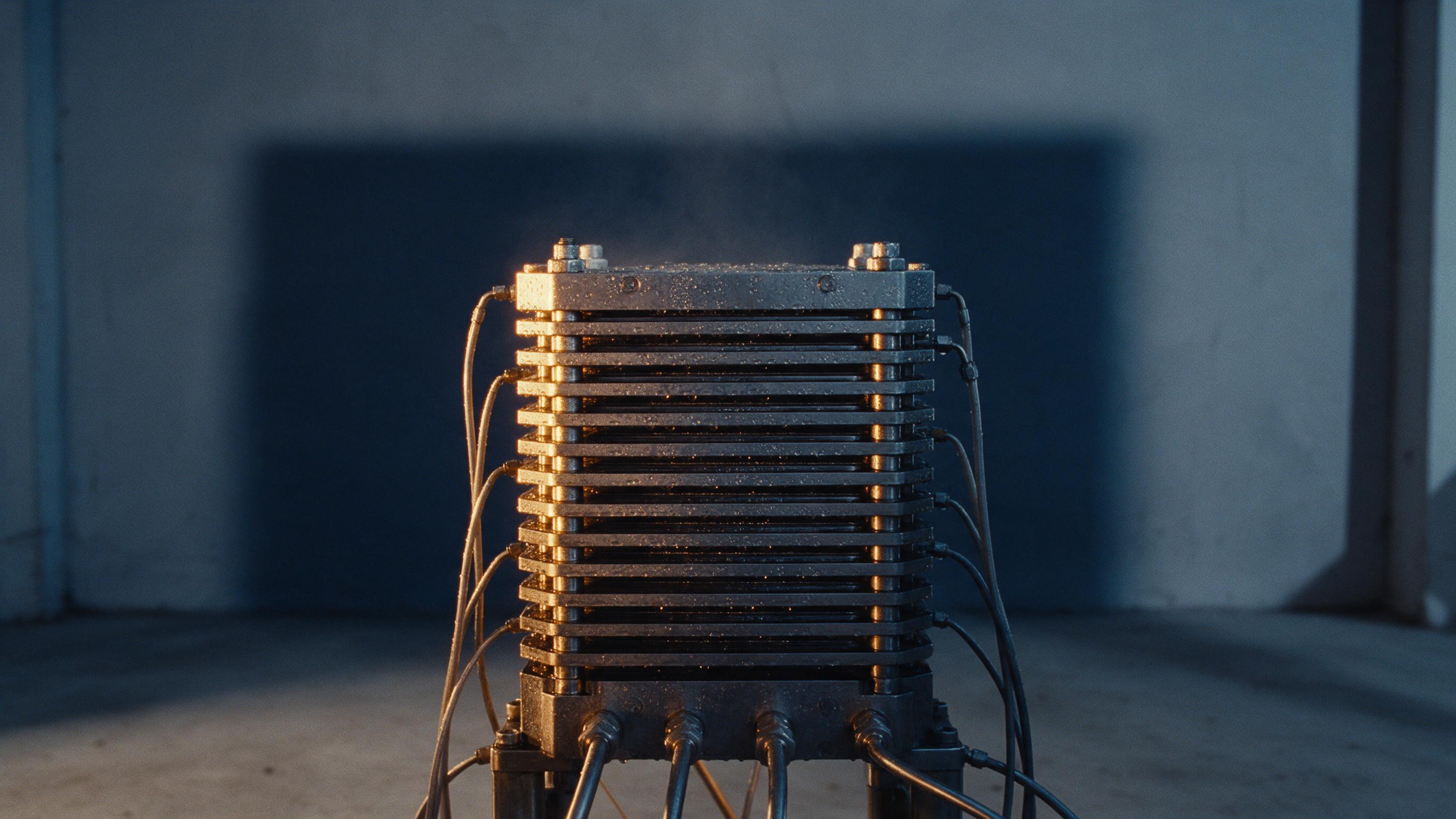
The Reactor That Is Not A Tower
Fischer-Tropsch runs at 200 to 350 degrees Celsius and gives off roughly 165 kilojoules per mole of carbon monoxide, which is why the classic answer was a very large reactor. Microchannel units do the same chemistry in 0.5 to 5 millimetre channels and fit the scale a real feedstock arrives in.
Two Hundred Degrees Of Waste Heat
Fischer-Tropsch takes carbon monoxide and hydrogen and hands back liquid hydrocarbons. Naphtha, diesel, wax. The reaction runs at 200 to 350 degrees Celsius and 20 to 30 bar. Every mole of carbon monoxide that converts releases about 165 kilojoules. Not a gentle reaction. A reactor that removes heat badly grows hot spots, and hot spots make methane instead of liquid. So the classic answer was size. Give the heat a very large surface and a very large volume to live in, and the temperature stays where the catalyst wants it. That answer worked. It also fixed the plant at a size where the only sensible location is a gas field with a pipeline already attached. Everything interesting in this field since has been an argument with that paragraph.
The Catalyst Picks The Gas
Cobalt or iron. That is the first decision, and the syngas makes it for you. Cobalt wants hydrogen-rich gas. High activity, strong paraffin selectivity, the choice for gas-to-liquids and biomass-to-liquids. Iron tolerates low hydrogen to carbon monoxide ratios and carries water-gas shift activity in the same bed, which is why coal-to-liquids runs on iron. The ratio is not a preference. Feed a cobalt bed gas that is short of hydrogen and it fouls. Feed an iron bed gas that is rich in hydrogen and you have paid for shift chemistry the process did not need. Most feasibility studies pick the catalyst before anyone has measured the gas. That single ordering mistake costs more than the catalyst.
The Plant Shrank Before It Got Cheaper
Microchannel reactors: channels 0.5 to 5 millimetres wide, arranged in cross-flow with dedicated cooling channels between them. Same chemistry, with the heat path measured in fractions of a millimetre instead of metres. Velocys is the commercial provider, targeting small-scale gas-to-liquids and biomass-to-liquids in the 1,000 to 15,000 barrels per day range. Published work in 2025 backs the direction. An RSC Advances CFD study of an iron-based microchannel reactor, inlet 340 degrees Celsius at 0.7 megapascals and a hydrogen to carbon monoxide ratio of 2 to 3, found that coating the catalyst on both sides of the channel lifted carbon monoxide conversion by 8.9 percent. Pressure drop across the channel: 3 to 5 pascals. Negligible. Two more results in the same family, both worth citing. A 4.5 nanometre cobalt film laid down by atomic layer deposition in a silicon microreactor reached 74 percent carbon monoxide conversion at 220 degrees Celsius on a 2 to 1 ratio, producing C1 to C4 hydrocarbons. A FeCo on SiO2-Al2O3 catalyst in a 3D-printed stainless steel microchannel reactor reached up to 80 percent conversion at 320 degrees Celsius and 20 bar, and held for 30 hours on stream. The engineering claim is narrow and it is real: the heat problem at small scale is solvable, and the numbers are published.
Alpha Is The Business Case
Chain growth probability. Alpha. One number decides what comes out of the reactor. High alpha gives long chains, wax and diesel-range molecules. Low alpha gives lighter fractions. Geometry, temperature and catalyst choice all move that number, which is why a reactor specification and a product specification are the same document. For aviation the shape matters more than the volume. Fischer-Tropsch makes linear paraffins and jet fuel is branched, so hydrocracking and isomerisation are not optional extras. They are the second plant. Two numbers a techno-economic assessment needs and the open literature does not hand over: catalyst cost per kilogram for microchannel systems, and the cost of the wax-to-jet upgrade. Leave either one out and the model is a wish. The pattern repeats across every distributed process. The pilot is affordable. The upgrade train is where the money goes.
The plant got smaller before the process got cheaper. Only the first of those two problems is solved.
Clean Gas Or No Reactor
Fischer-Tropsch catalyst does not forgive. Hydrogen sulphide below 0.1 parts per million, particulates removed. Cobalt and iron both poison, and the poisoning is permanent. That clean-up train carries real cost and real complexity, and it sits upstream of everything else. It is also the part most often priced from a supplier quote written for a different gas. There is a second route. Syngas fermentation tolerates impurities that kill a catalyst, and it runs at 30 to 40 degrees Celsius. Its output is ethanol, which then needs alcohol-to-jet to reach the same product. The trade is clean. A clean-up train plus a hydrocracker, against a fermentation step plus an ethanol-to-jet plant. Two chains, two cost structures, and the gas you actually hold decides which one you can afford. Neither route is better. One of them is better for your feedstock.
Where The File Is Decided
Distributed gasification in the 20 to 200 tonne per day band cannot feed a conventional Fischer-Tropsch plant. That plant wants more than ten times the throughput before the heat balance closes. Microchannel units are the only version of this chemistry that fits the size the feedstock actually arrives in. So that is the file to write: small-scale integrated gasification plus microchannel Fischer-Tropsch, at the throughput a real waste stream delivers. RED III and the ReFuelEU Aviation mandate are the instruments that pay for the products, and the small-scale category is where a novel reactor design gets read. I have built companies across twelve countries and deployed 210 energy systems. I have restructured a EUR 75 million industrial group and signed a EUR 20 million personal guarantee. In all of it the chemistry was rarely the failure. The clean-up train, the heat exchanger and the upgrade step are where projects go wrong. The probability that a sound gasification project dies on a poisoned catalyst because nobody budgeted the sulphur removal is not zero. Most studies price it at zero, then discover the number in the commissioning report. Measure the gas first. Every other number in the model depends on it.
Fischer-Tropsch catalyst does not forgive. Hydrogen sulphide below 0.1 parts per million, or nothing.
The map is dead. Nobody told you.
Bali State of Mind is the survival guide for the collapse of everything you were taught to believe.
Beyond this book
Building the same thing somewhere else.
Julien Uhlig is available for advisory work, board seats and media appearances. Write to media@exventure.co.
The academy that trains the operators, across every company in the group, is EX Epic Academy - 25,000 applications, 25 seats per cohort, 210 alumni across 19 countries. academy.epicsolutiongroup.com
18-20 November. Online, Las Palmas, Bali.
Three days on what happens to work, capital and institutions when the map stops matching the ground. Seats are limited by cohort.
ex-aisummit.com →