The Price Of A Private Machine
Sort a GPU marketplace by price inside one region and the top row always looks like the answer. In Singapore in May 2026 that row was a card with 20 gigabytes of video memory, against a job that needs 250 to 300. The scarce thing in this market was never the silicon. It was the region, and then the terms.
The Listing That Answers A Different Question
Sort a GPU marketplace by price inside one region and the top row always looks like the answer. In Singapore in May 2026 that row was an RTX 4000 Ada with 20 gigabytes of video memory, listed at 0.04 to 0.08 dollars an hour. Available, local, and one fifteenth of the memory a serious inference job needs. The job in question wants 250 to 300 gigabytes of video memory at 8-bit, or 150 gigabytes at 4-bit. Twenty gigabytes does not host either. Nothing else in that region's column did the job that week: no A100, no H100, no L40S on the same board. A marketplace price tells you what is idle in a region. It does not tell you what is installable there, and those are two different questions wearing one label. Twenty gigabytes against three hundred is not a shortfall. It is a different product.
The Floor Under The Hourly Rate
Rent by the hour and the arithmetic looks friendly. Dedicated A100 capacity was quoted at 1.89 to 2.29 dollars an hour. An H100 sat at 2.99 to 3.69 dollars an hour where it existed at all. Multiply 2.29 dollars by the 730 hours in a month and you land near 1,672 dollars. Then the floor appears. The providers with real capacity in the region quote a setup fee of 500 to 1,000 dollars, a one-month minimum term, and a discount of 30 to 40 per cent for committing to a year. The minimum term is what turns an hourly rate into a retail rate instead of a budget line. A machine that costs 500 dollars to install and cannot be handed back inside a month is not an hourly product. It is a subscription with an hourly meter. That single sentence separates two kinds of buyer. One is pricing flexibility they will never use. The other is pricing a term they cannot leave.
Three Of The Four Clouds Were Not There
RunPod listed no Singapore region at all in May 2026. Its footprint was the United States, Europe and Canada. Lambda Labs sold in the United States only. CoreWeave sold in the United States and Europe. Three of the largest hourly GPU clouds did not offer a single card in the region. An omitted region is invisible in a price table. The table renders, the column is empty, and the reader assumes a supply problem rather than an absence. That matters because the hourly model is what most teams price against. The floor of 1,672 dollars a month is a real number in a region where the machine exists. It is not a number in a region where the vendor has never opened. North America and Europe are not a workaround for a workload that has to sit next to its users. They are a different set of latency and legal questions, and they arrive after the invoice.
What Three Hundred Gigabytes Costs
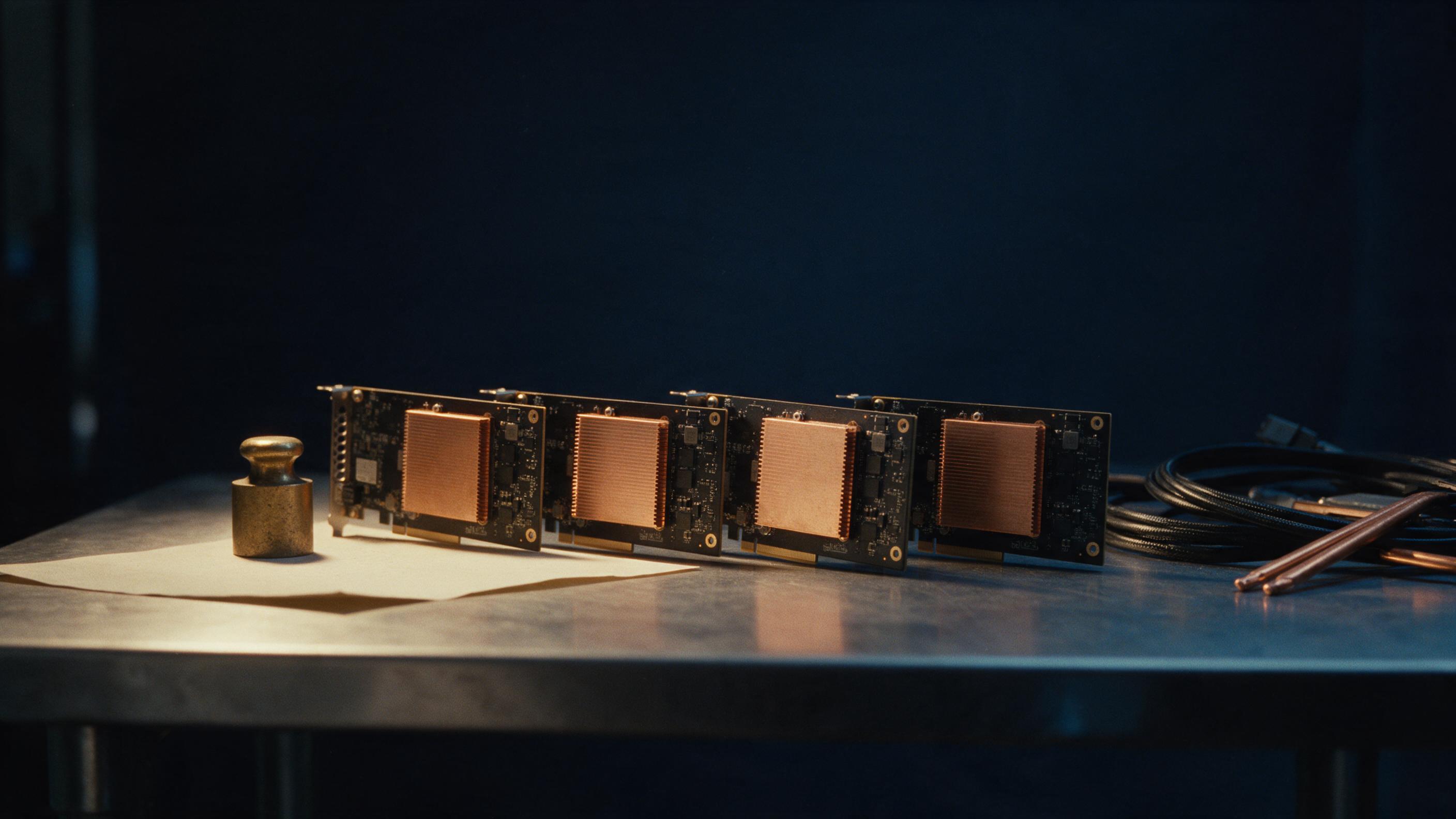
The smallest configuration that holds a 250 to 300 gigabyte job with room to move is four A100 cards at 80 gigabytes each. In Singapore in May 2026 that configuration was quoted at 7,800 to 9,500 dollars a month at Leaseweb, 6,500 to 8,000 at OVHcloud, 7,000 to 9,000 at Alibaba Cloud and 6,500 to 8,500 at Tencent Cloud. Halve the memory and the price roughly halves. Two A100 cards at 160 gigabytes came in at 4,200 to 5,500 dollars a month, with the same 500 to 1,000 dollar setup fee and the same one-month minimum standing in front of them. Four H100 cards at 320 gigabytes is the fast version and the expensive one: 10,500 to 15,000 dollars a month. Two H100 cards at 160 gigabytes sit at 5,500 to 8,000. Then the part the quote does not advertise. Lead times of two to eight weeks, because supply in the region is tight, and a reservation is the only thing that shortens it.
The cheapest listing in a region tells you what is idle there, not what is installable.
The Second Invoice Arrives As Bandwidth
Every configuration above includes bandwidth, and every one of them stops including it. Alibaba Cloud charges 0.08 dollars per gigabyte outbound, with a 100 megabit plan near 300 dollars a month and a 1 gigabit plan near 2,500. Tencent Cloud runs 0.08 to 0.12 dollars a gigabyte. Overage beyond the included allocation runs 500 to 2,000 dollars a month. Private networking is the part that is genuinely included, and it is worth naming because it replaces a rented appliance. Leaseweb ships a private VLAN with 10 to 20 terabytes of transfer. OVHcloud ships vRack with 10 to 30 terabytes. Isolation stops being a line item. Bandwidth is the number that never makes the first model and always makes the second year. A machine that streams every token out over the public internet is not a private machine yet.
Price The Commitment, Not The Hour
The market prices the hour, and the hour is the least important number in the document. The commitment is the number. One month minimum, a setup fee, a reserved term, a lead time of two to eight weeks, and a bandwidth allowance with a cheaper year attached to it. Those five items decide what a private machine actually costs. The pattern will be familiar to anyone who has built companies across twelve countries. The sticker price is a negotiation. The terms are the negotiation. The probability that the cheapest card listed in a region can host the job you opened the region for is close to zero, and most budgets price it at zero. Twenty gigabytes against three hundred is the honest unit of comparison, and checking it costs nothing before the quote arrives. The hourly rate is the price of the machine. The minimum term is the price of the decision.
The minimum term is what turns an hourly rate into a decision.
The map is dead. Nobody told you.
Bali State of Mind is the survival guide for the collapse of everything you were taught to believe.
Beyond this book
Building the same thing somewhere else.
Julien Uhlig is available for advisory work, board seats and media appearances. Write to media@exventure.co.
The academy that trains the operators, across every company in the group, is EX Epic Academy - 25,000 applications, 25 seats per cohort, 210 alumni across 19 countries. academy.epicsolutiongroup.com
18-20 November. Online, Las Palmas, Bali.
Three days on what happens to work, capital and institutions when the map stops matching the ground. Seats are limited by cohort.
ex-aisummit.com →