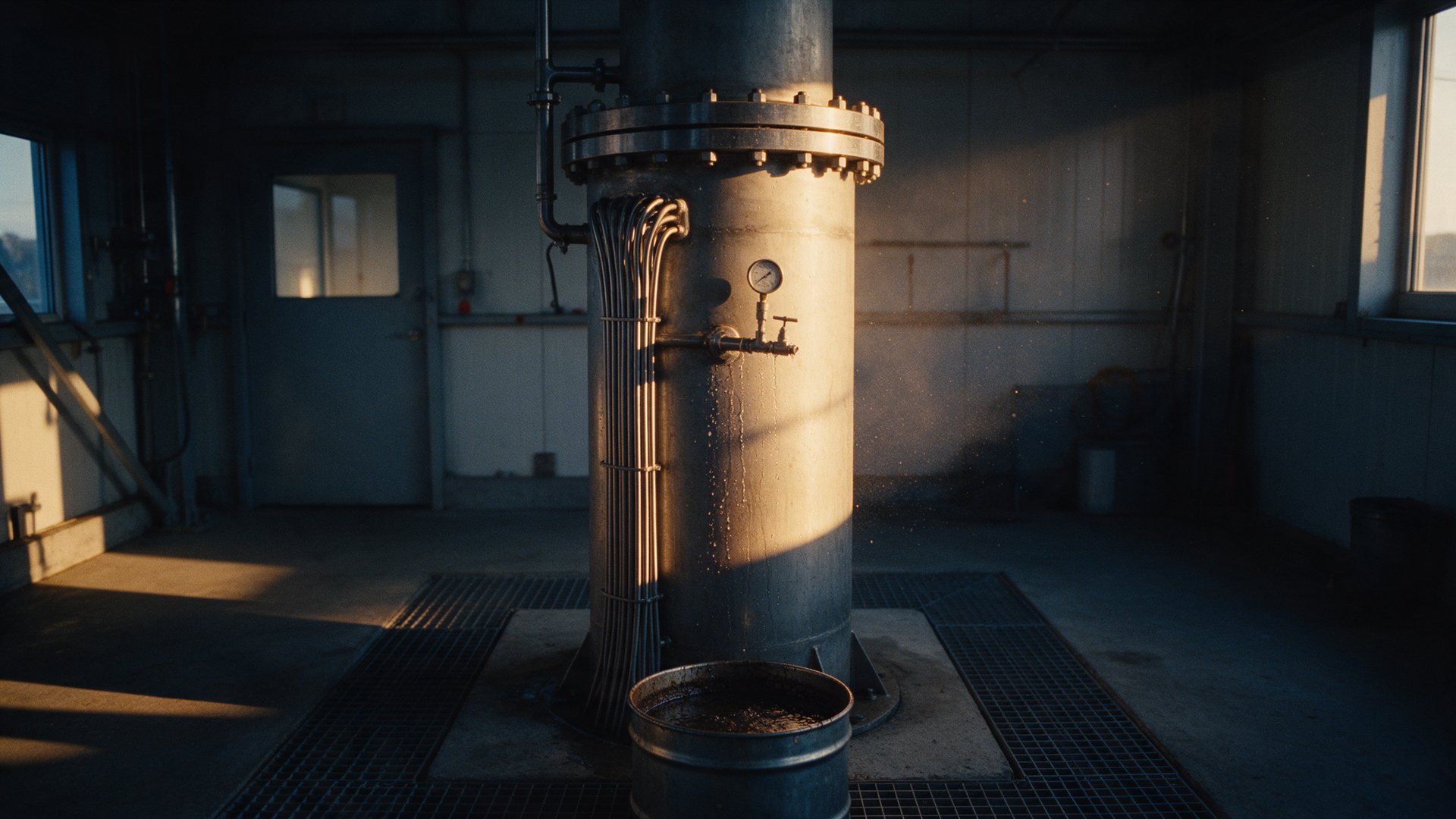
The Pressure Is The Project
Water at 350 bar stops being a solvent and becomes the reactor. The route with the best yields in the family is the one with the fewest plants built, and the vessel is the reason.
The Feedstock Nobody Can Dry
Twenty tonnes of sewage sludge arrives at 85 per cent water. A dry route needs it under 30. So the first machine in a pyrolysis or gasification line is not a reactor at all, it is a dryer, and drying that water costs more energy than the process it feeds. Hydrothermal routes delete the machine. They use water at 180 to 600 degrees Celsius and 10 to 350 bar as the reaction medium, so wet biomass goes in as it comes off the belt, out of the digester or out of the works. No dryer, no drying energy, no dust. That single design choice is the reason this family exists. It is also the reason every member of it is a pressure vessel business.
Three Routes, One Medium
Three routes are the same idea at three severities. Carbonisation runs 180 to 260 degrees Celsius at 10 to 40 bar of autogenous subcritical pressure, with 1 to 24 hours in the reactor. Liquefaction runs 250 to 400 degrees Celsius at 50 to 250 bar for 10 to 60 minutes. Gasification in its supercritical form runs 374 to 600 degrees Celsius at 220 to 350 bar in seconds. One threshold decides everything. The critical point of water is 374.15 degrees Celsius at 22.1 megapascals, which is 221 bar. Past that line the fluid stops behaving like water. Diffusivity goes gas-like, density stays liquid-like, and non-polar organics dissolve in it. No tar forms above that line. That single property is why the route gets funded.
What Each Route Makes
Carbonisation returns a solid. Hydrochar carries 45 to 70 per cent carbon against 40 to 50 in the raw material, at 20 to 30 megajoules per kilogram, which is close to lignite. Mass yield is 40 to 75 per cent and energy yield 60 to 90 per cent, and the product dewaters easily because it is hydrophobic. Liquefaction returns a liquid. Bio-crude yields 30 to 60 per cent by weight on dry feed at 30 to 36 megajoules per kilogram, against 42 to 45 for petroleum crude, with oxygen at 10 to 20 per cent where pyrolysis oil carries 35 to 50. Nitrogen runs 2 to 6 per cent and total acid number 50 to 200 milligrams of potassium hydroxide per gram, which is why upgrading is not optional. Gasification returns a gas. Hydrogen at 30 to 55 per cent, carbon dioxide at 30 to 45, methane at 10 to 20, carbon monoxide at 1 to 5 because the shift reaction runs forward in supercritical water. Yield is 20 to 50 moles of gas per kilogram of biomass, with 10 to 15 moles of hydrogen uncatalysed and up to 18 with an alkali salt or a nickel catalyst.
The Vessel Is The Cost
Capital cost per kilowatt of input separates the three more cleanly than any technical metric. Carbonisation sits at EUR 1,000 to 3,000, liquefaction at EUR 2,000 to 5,000, gasification at EUR 5,000 to 15,000, against EUR 3,000 to 6,000 for a dry gasifier. Two lines drive it. Pressure, because a 350 bar vessel is not a scaled pipe. And solids handling, because pushing a 20 per cent solids slurry into a 250 bar reactor without plugging it is its own discipline. Heating is the smaller bill. Lifting feed to 200 degrees Celsius takes about 0.6 to 0.8 kilowatt hours per kilogram, and up to 70 per cent of process heat returns with integration.
Drying water costs more energy than the process it feeds.
The Carbon That Ends Up In Water
Liquefaction puts 20 to 40 per cent of the biomass carbon into the aqueous phase rather than the product. That stream carries 10 to 20 grams per litre of total organic carbon plus organic acids, alcohols, phenolics and nitrogen heterocycles. It is the bottleneck that keeps liquefaction at demonstration size. Carbonisation loses 5 to 15 per cent and gasification 5 to 15 per cent, so the problem is gradeable rather than uniform. The handling options are known. Anaerobic digestion for biogas, with the caveat that phenolics inhibit the bugs. Recirculation as reaction medium. Microalgae cultivation. Catalytic steam reforming. Struvite precipitation to recover nitrogen and phosphorus.
The Readiness Ladder, Read Honestly
Carbonisation is commercial. Readiness 7 to 8, more than 10 plants worldwide: Ingelia in Spain, TerraNova Energy and SunCoal in Germany, C-Green in Sweden with the OxyPower process, AVA-CO2 in Switzerland. Continuous flow reactors replaced batch, which is the real advance of the last decade. Liquefaction is 5 to 7. Steeper Energy with Hydrofraction in Denmark and Canada, Licella with the catalytic hydrothermal reactor in Australia and the United Kingdom, MUIR in the United States. Two to five demonstration plants. Gasification is 4 to 6, under five pilot plants. The Karlsruhe Institute runs VERENA, and EPFL has coupled hydrothermal gasification to solid oxide co-electrolysis. That is a research instrument, not an asset class.
Where The Numbers Get Better
The case is strongest on the worst feedstock. Corre and colleagues reported in Energy Conversion and Management in 2025 that hydrothermal gasification of sewage sludge at 80 to 90 per cent moisture reaches 10.2 per cent exergy efficiency standalone. Coupled to solid oxide co-electrolysis the same system reaches 62.2 per cent. The wetter the feed, the less a dry route has to offer. Against a dry gasifier the trade is explicit. Supercritical water works at 400 to 600 degrees Celsius against 700 to 1,200, produces almost no tar against a tar cleaning step that is a major cost, and leaves almost no char against 5 to 20 per cent ash and char. It does all of it at 220 to 350 bar instead of 1 to 30.
The Decision Rule
Order the questions by what can kill the project. Measure moisture and ash first, because a dry feedstock deletes the only advantage this family has. Price the vessel second, because pressure is the line that decides capital cost. Price the aqueous phase third, because 20 to 40 per cent of the carbon leaving in water is a disposal bill before it is a product. Argue about catalysts last. I have built companies across twelve countries and deployed 210 energy systems across Africa and Asia, and the pattern that repeated was that the process chemistry was usually right and the containment was usually underestimated. Entrade built 200 wood-gasification machines across the UK and Europe. The machines ran. The steel around them decided the economics. Carbonisation is where the funding is today because readiness 7 to 8 is fundable. The more interesting position is the gap between liquefaction and gasification, where the yields are already the best in the family and the vessel is still the open problem. The probability that supercritical water becomes the default route for wet waste is not zero, and most of the market is pricing it at zero, because a vessel that holds 350 bar is easier to avoid than to build.
Above 374 degrees the water stops behaving like water.
The map is dead. Nobody told you.
Bali State of Mind is the survival guide for the collapse of everything you were taught to believe.
Beyond this book
Building the same thing somewhere else.
Julien Uhlig is available for advisory work, board seats and media appearances. Write to media@exventure.co.
The academy that trains the operators, across every company in the group, is EX Epic Academy - 25,000 applications, 25 seats per cohort, 210 alumni across 19 countries. academy.epicsolutiongroup.com
18-20 November. Online, Las Palmas, Bali.
Three days on what happens to work, capital and institutions when the map stops matching the ground. Seats are limited by cohort.
ex-aisummit.com →