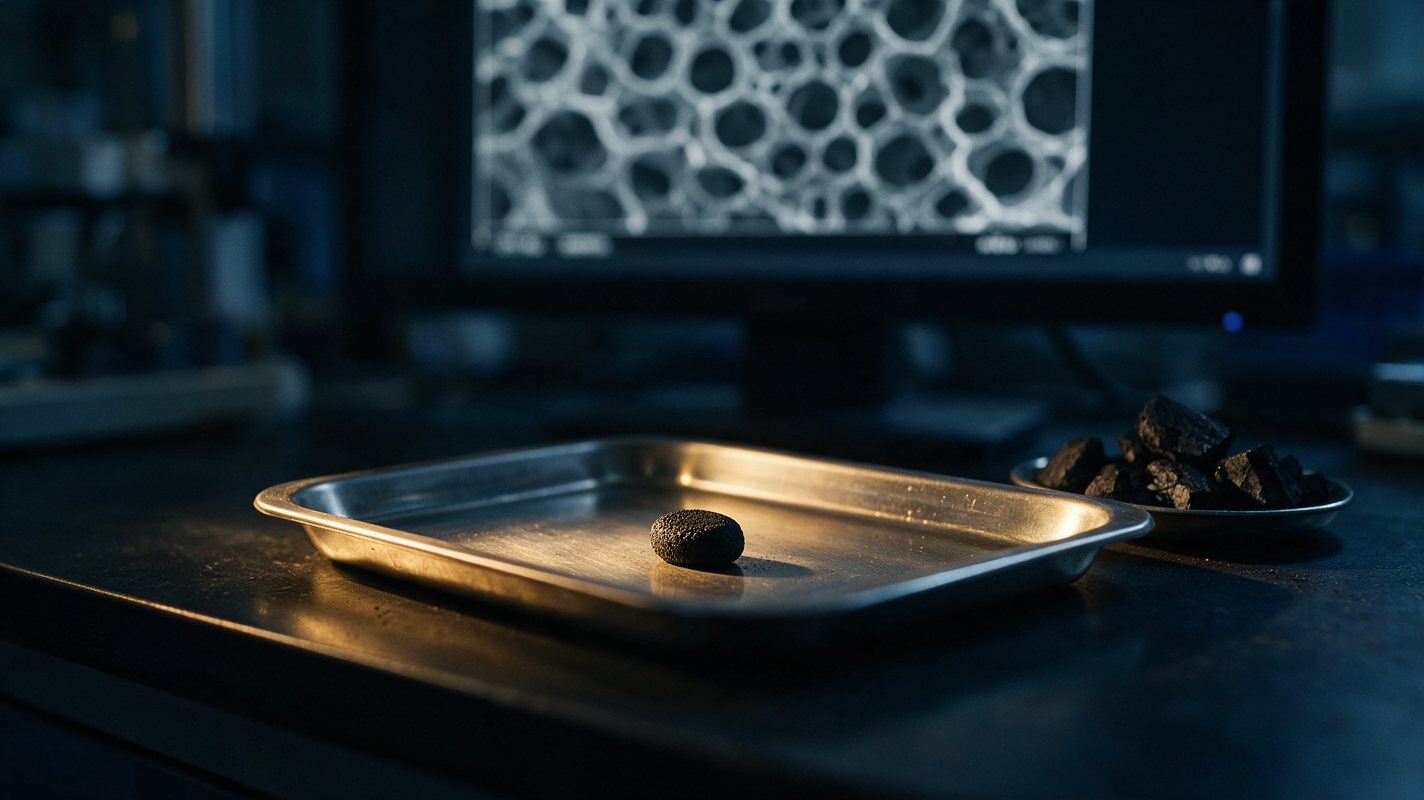
The Pore Is The Product
Raw char leaves a kiln at 200 to 500 dollars a tonne. The same wood, put through one more furnace pass, leaves at 3,000 to 8,000. Nothing in the feedstock changed. The pore changed.
The Tonne Nobody Priced
Raw char leaves a kiln with 50 to 200 square metres of surface per gram. That is enough to hold water and nutrients in soil, which is where most of it goes. The same tonne put through a second pass comes out at 1,500 to 3,500. VTT, the Finnish research centre, took pine bark to 3,505 square metres per gram with potassium hydroxide. Rice husk at a 3 to 1 KOH ratio reached 755 square metres per gram with a micropore volume of 0.243 cubic centimetres per gram, in ACS Omega in 2023. Corncob has been patented at 2,500. Nothing in the feedstock changed. The pore changed. Between 20 and 40 times the surface area, from one extra furnace pass. Raw biochar sells for 200 to 500 dollars a tonne. KOH-activated biochar sells for 3,000 to 8,000. The kiln is the cheap part. The second pass is where the tonne is re-priced. The probability that a tonne of char is priced by its feedstock rather than by its pore structure is not zero. Most of the market prices it at zero.
The Route Chooses The Pore
Two families of activation exist and they work in opposite directions. Chemical activation mixes a reagent into the char and cooks it. The reagent etches channels from the inside and is washed back out afterwards. Potassium hydroxide runs at 600 to 900 degrees Celsius, usually 700 to 800, at a reagent ratio of 1 to 1 up to 4 to 1. Phosphoric acid runs cooler, 400 to 600 degrees, at 1 to 1 up to 3 to 1. Zinc chloride runs at 400 to 700 and is on the way out, because of zinc toxicity and the disposal problem that comes with it. Physical activation adds no reagent. Steam or carbon dioxide is passed over hot char and steals carbon atoms off the surface. Steam runs at 800 to 950 degrees. Carbon dioxide runs at 800 to 1,000 degrees through the Boudouard reaction. The routes do not land in the same pore. KOH builds ultramicropores and micropores, the band under two nanometres. Phosphoric acid widens into mesopores between 2 and 50 nanometres. Steam and carbon dioxide dig narrower and slower. You do not buy a surface area. You buy a route, and the route hands you the pore you can sell.
What Each Route Costs To Run
The reagent is the bill. KOH is the strongest route and the most expensive one. It costs 1,000 to 1,500 dollars a tonne, it is corrosive, and it has to be washed out with water and acid and recovered, or the process does not close. Counting reagent production and recovery, the route takes 5 to 9 gigajoules per tonne of activated char. Phosphoric acid costs 500 to 800 dollars a tonne and up to 85 per cent of it can be recovered. It also runs 300 to 500 degrees cooler, which is energy the KOH route pays and this one does not. Energy demand sits at 5 to 8 gigajoules per tonne. Steam has no reagent bill at all, and it is the least efficient way to buy surface area. It consumes 8 to 12 gigajoules per tonne, and every kilogram of carbon it burns off is a kilogram of product no longer sold. That is why the surface area stops at 300 to 800. Per kilogram, the finished product lands at 3 to 8 dollars for KOH, 2 to 5 for phosphoric acid, 2 to 4 for zinc chloride, 1 to 3 for steam and 1 to 2 for carbon dioxide. Chemical activation buys surface area with a reagent bill. Physical activation buys it with the product itself.
The Pore Has To Match The Job
Surface area is the number everybody quotes and the number that matters least on its own. Post-combustion capture wants above 1,000 square metres per gram with pores under 0.7 nanometres, because the selectivity comes from pores that admit carbon dioxide and refuse nitrogen. Direct air capture wants above 1,500 with pores between 0.7 and 2 nanometres, usually with an amine grafted onto the surface. Dye removal wants 500 to 1,000 with mesopores between 2 and 50 nanometres. Heavy metals want the same range with sulfur or nitrogen groups attached. Supercapacitors want above 2,000 with a mix of both bands. Catalyst supports are content at 300 to 800. Soil wants 50 to 200 with macropores, because a microporous char does nothing for a root. The selectivity figures settle it. Rice husk char activated with KOH adsorbs 3.13 millimoles of carbon dioxide per gram at zero degrees Celsius and 1.55 at 50 degrees, with a carbon dioxide to nitrogen selectivity up to 131. A char with 3,000 square metres and a pore too wide for the molecule does not reach that. Three thousand square metres of the wrong pore underperforms eight hundred of the right one.
The kiln is the cheap part. The second pass is where the tonne is re-priced.
The Price Is Set By A Commodity
Activated carbon is a commodity with a published price, and that price is the ceiling. Intratec put United States prices at about 2,480 dollars a tonne in November 2025, South East Asia at about 2,350, China at about 1,780, and Europe at 2,500 to 3,500. United States prices rose 23 per cent year on year. The global market for the material is put at about 9.6 billion dollars. Now put the KOH-activated product beside it. At 3,000 to 8,000 dollars a tonne it is priced above the market it has to enter. Steam-activated biochar at 1,000 to 3,000 sits inside the range. Phosphoric acid at 2,000 to 5,000 straddles it. That is the commercial problem in one comparison. A premium pore is only worth the premium if the application can pay for it. Medical, high purity and specialty can. Municipal water treatment cannot, and it is the biggest buyer in the market. The buyer does not pay for your pore. The buyer pays for your pore at the price of a commodity.
Who Already Owns The Tonnage
The tonnage is already owned. Cabot Norit, in the United States and the Netherlands, runs above 100,000 tonnes a year with more than a billion dollars of revenue. Calgon Carbon, owned by Kuraray, runs above 100,000. Jacobi Carbons in Sweden and Germany runs about 80,000. MeadWestvaco runs about 50,000 out of wood. Datong Coal Mining in China runs above 100,000 on a Chinese cost base. Almost all of it is made from coal, coconut shell or peat. Almost none of it is made from biochar. The emerging list is small and honest about its size. Carbofex in Germany ships steam-activated biochar at small commercial scale. ArtiGras in the Netherlands runs a demonstration on sewage sludge. VTT pilots activation in Finland. Takachar builds low-cost units for agricultural residue. Novocarbo, CarbonFuture and Exomad Green sell removal credits on raw char. Most biochar is sold by the tonne into soil. Almost none of it is sold by the pore.
The Second Cheque Is The Removal
The second cheque is the removal, and it is paid today. Global biochar production was 520,810 tonnes in 2025, up from 180,150 tonnes in 2023. That tonnage is bought for carbon removal, not for adsorption. Saharudin and colleagues put removal at 60 to 204 dollars per tonne of carbon dioxide in STOTEN in 2024. Timmons at the University of Massachusetts put sequestration at 82 to 119 dollars in 2017. Production costs run 500 to 1,000 dollars a tonne at 1,000 tonnes a year and 200 to 500 dollars above 5,000 tonnes a year, with Malaysia recording 116 to 197 dollars including soil application. The machines that make the char already exist in the field. Entrade built 200 wood-gasification machines across the UK and Europe, and for most of their life the char was the line item nobody costed. I have watched 210 energy systems deployed across Africa and Asia on the same principle. The gas was the product. The carbon was waste. The removal credit is paid today. The pore premium is a bet on tomorrow.
The Order Of Operations
The order of operations is staged, not clever. First, produce raw char and sell the removal. Second, measure the pore structure on every batch, because activation is a furnace process and furnaces drift. Third, take a fraction of the tonnage and upgrade it on the route that matches the target application. Fourth, sell that fraction into a market that already has a price. The decision rule is arithmetic. If the target needs more than 1,000 square metres per gram, the route is chemical and reagent recovery has to hold above 80 per cent, or the economics do not close. If the target is soil or bulk water, steam at 300 to 800 square metres per gram is enough and it ships at 1 to 3 dollars a kilogram. Steam is the only route with no reagent bill and a readiness level of 9, and it is still improving. Continuous microwave steam activation has been demonstrated on waste palm shells in an auger system, published in 2025. The probability that the winning char producer of the next decade is the one with the best kiln rather than the best pore measurement is not zero. It is close to zero.
You do not buy a surface area. You buy a route, and the route hands you the pore you can sell.
The map is dead. Nobody told you.
Bali State of Mind is the survival guide for the collapse of everything you were taught to believe.
Beyond this book
Building the same thing somewhere else.
Julien Uhlig is available for advisory work, board seats and media appearances. Write to media@exventure.co.
The academy that trains the operators, across every company in the group, is EX Epic Academy - 25,000 applications, 25 seats per cohort, 210 alumni across 19 countries. academy.epicsolutiongroup.com
18-20 November. Online, Las Palmas, Bali.
Three days on what happens to work, capital and institutions when the map stops matching the ground. Seats are limited by cohort.
ex-aisummit.com →