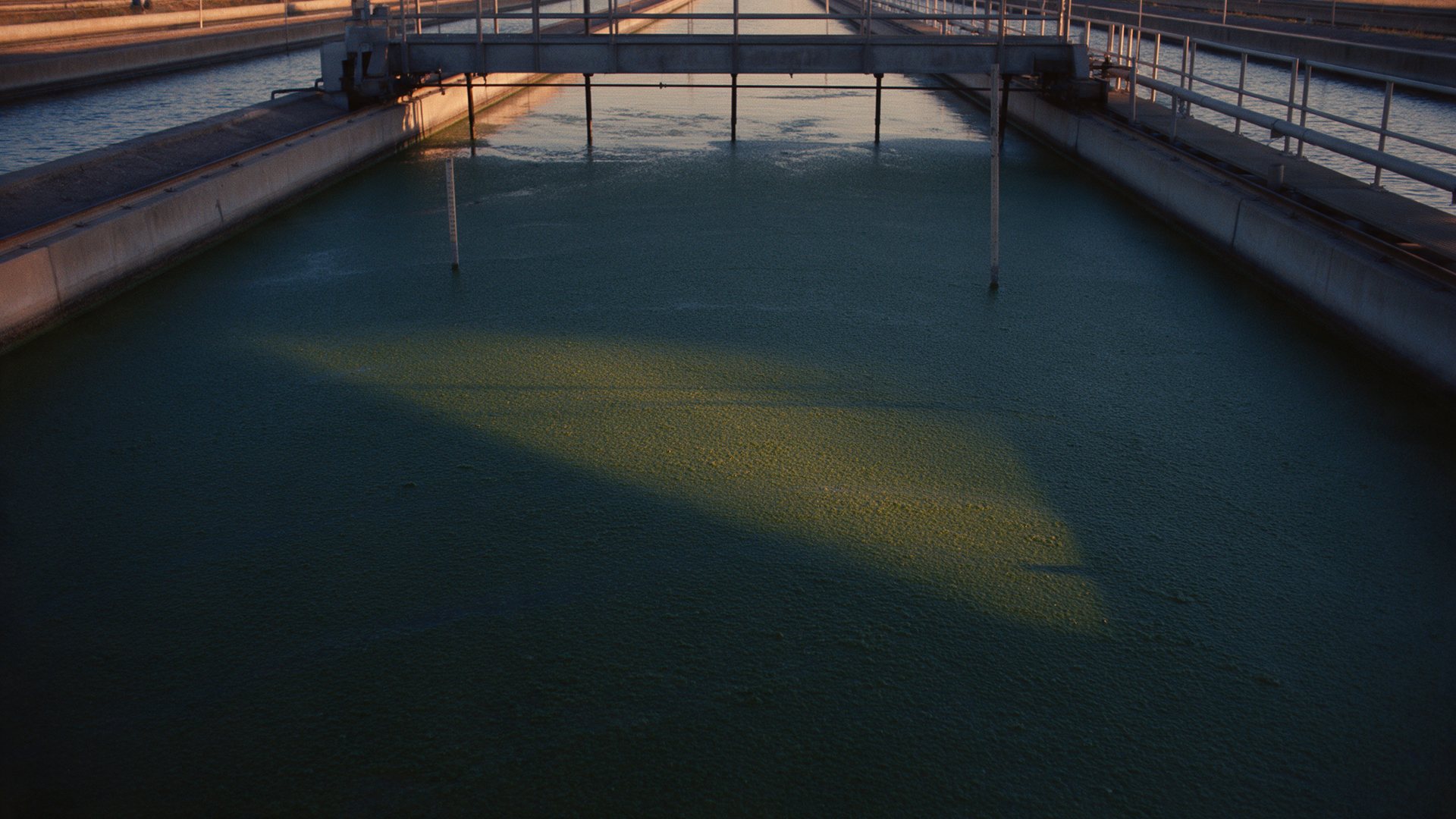
The Pond With The Worst Light
An open raceway and a closed reactor sell the same biomass at two prices. One of them moves a lake of water to catch a few grams of cells. The other lives inside the light path. What the cultivation system actually decides.
Three Ways To Grow The Same Thing
Microalgae are grown three ways, and the choice is made before anything is planted. An open raceway pond is a shallow channel, twenty to thirty centimetres deep, mixed by a paddlewheel and open to the sky. It has been built since the 1950s and it sits at technology readiness level nine. A closed photobioreactor runs the same organism through transparent tubes or flat panels, with no contact with the outside air. A fermenter runs it in stainless steel, in the dark, on sugar. The organism does not care. The capital does, and the capital sets the price of the biomass before the first harvest.
What The Open Pond Buys You
An open raceway gives you the cheapest biomass in the industry and the least control over it. Volumetric productivity is 0.05 to 0.15 grams per litre per day. Areal productivity is 10 to 35 grams per square metre per day. In a warm climate the annual yield is 40 to 80 tonnes per hectare. Capital is EUR 50,000 to 150,000 per hectare. Production cost lands at EUR 3 to 10 per kilogram. What you give up is control. The pond is open, so contamination risk is high and only robust species survive in it. In practice that means Spirulina, Chlorella and Dunaliella. Carbon dioxide utilisation is 20 to 40 per cent, and the rest returns to the atmosphere. It is a cheap way to make a commodity. It is a bad way to make a molecule.
What The Closed Reactor Buys You
A closed reactor buys control, and the bill arrives as capital and cooling. Tubular systems run transparent tubes five to ten centimetres in diameter, ten to a hundred metres long. Volumetric productivity is 0.3 to 1.5 grams per litre per day, biomass concentration is 1 to 5 grams per litre, contamination risk is low, and carbon dioxide efficiency is 70 to 90 per cent. Capital is EUR 200,000 to 500,000 per hectare equivalent. Cost is EUR 10 to 50 per kilogram. A warm climate adds a cooling system, because the tubes cook. Sprinklers or heat exchangers are not an option bolted onto the design. They are part of it. Flat panels push further. The light path runs two to five centimetres instead of a metre of water, concentration reaches 2 to 8 grams per litre, and volumetric productivity reaches 0.5 to 2 grams per litre per day. Capital is very high and scale-up is difficult, which is a polite way of saying each unit stays small.
The Light Path Is The Price
A panel beats a pond for one reason, and it is not engineering taste. It is the distance light travels before a cell that is not at the surface receives any. In an open pond that distance is the depth of the channel, and only the top few centimetres are productive. In a flat panel the culture is squeezed into a two to five centimetre light path, the shortest in the industry, and it produces the highest volumetric productivity of the three. The published productivity model puts numbers on the same comparison by latitude. In the south west of the United States an open raceway yields 5,000 to 7,200 tonnes per square kilometre per year, and a flat panel yields 9,000 to 13,000. In the mid west it is 3,000 to 5,000 against 6,000 to 9,000. In the north east, 2,000 to 3,500 against 3,800 to 6,000. The system does not change the sun. It changes how much of the sun the cells can reach. Across locations and systems the production cost ranges from USD 500 to 9,560 per tonne, and most of that spread is the light.
It is a cheap way to make a commodity. It is a bad way to make a molecule.
The Concentration Is The Harvest Bill
What leaves the reactor decides what it costs to catch. An open pond holds 0.3 to 1.0 grams per litre. Harvesting that means moving a large volume of water for a small mass of cells, and the step is 20 to 40 per cent of total production cost. A fermenter holds 20 to 200 grams per litre. Harvesting is a centrifuge and a fraction of the bill. Energy tells the same story in one line. A raceway carries three to five euro of energy per kilogram of product. A tubular reactor carries fifty. Dilute is expensive. The water you moved is the cost you paid.
The Reactor That Ignores The Sun
Fermentation is the one route that takes light out of the problem entirely. It runs in stainless steel fermenters, the same equipment class as industrial fermentation, at technology readiness level eight to nine. Volumetric productivity is 5 to 50 grams per litre per day, an order of magnitude above anything photoautotrophic, and there is no light limitation to design around. The trade is that the carbon comes from sugar, glucose or acetate rather than carbon dioxide, so nothing is fixed and the feedstock competes with food. Species capability narrows to what will grow in the dark. Capital is EUR 500 to 2,000 per litre of reactor. Cost is EUR 5 to 30 per kilogram. Corbion runs the largest algae fermentation facility in the world, in Brazil, on sugarcane, making DHA and EPA oils for aquaculture and human nutrition, inside a group that reported EUR 1.27 billion of revenue in 2025. DSM and Evonik put fermentation based DHA into aquafeed through a joint venture launched in 2022. The dark reactor did not win on yield per litre. It won on predictability.
Two Price Lists For The Same Biomass
Put the systems side by side and the same biomass arrives with four different price tags. An open raceway needs a product worth more than EUR 5 per kilogram to make sense, at a production cost of EUR 3 to 10. A tubular reactor needs more than EUR 15, at EUR 10 to 50. A flat panel needs more than EUR 30, at EUR 15 to 60. A fermenter needs more than EUR 10, at EUR 5 to 30. That is the strategic map in four lines. A pond can sell protein, feed and bulk biomass. A panel has to sell a pigment, because nothing cheap survives a capital line of EUR 200,000 to 500,000 per hectare. The commercial record agrees. Algae grown for bulk fuel did not work. Solazyme, later TerraVia, was founded in 2003, listed on the Nasdaq, and filed for bankruptcy in 2017. Sapphire Energy raised for green crude from raceway ponds and wound down in the same year. What worked was high value. Astaxanthin from Haematococcus sells at EUR 5,000 to 15,000 per kilogram. DHA comes out of a fermenter. Protein comes out of Chlorella. Photoautotrophic algae for a low value product has not been commercially successful. The market has said so twice, with a bankruptcy each time, and the probability of a third attempt pricing the biomass differently is close to zero.
The Part Nobody Prices
I restructured a industrial group and built companies across twelve countries. I have deployed 210 energy systems, and every one of them was a bet on a running hour and an input price. Entrade built 200 wood gasification machines across Britain and Europe. Those machines were sold on a feedstock number, and the feedstock number was the whole sale. This trade is the same trade wearing a biology. Nobody buys a cultivation system. They buy a production cost, and the production cost is set by the light path, the concentration, and the harvest that follows from both. Most of the market picks the pond and then looks for a product the pond can afford. The order is the other way around. The reactor does not decide what grows in it. The product does, and the product was chosen before the ground was broken.
The system does not change the sun. It changes how much of the sun the cells can reach.
The map is dead. Nobody told you.
Bali State of Mind is the survival guide for the collapse of everything you were taught to believe.
Beyond this book
Building the same thing somewhere else.
Julien Uhlig is available for advisory work, board seats and media appearances. Write to media@exventure.co.
The academy that trains the operators, across every company in the group, is EX Epic Academy - 25,000 applications, 12 per cohort, 200+ alumni across 19 countries. academy.epicsolutiongroup.com
18-20 November. Online, Las Palmas, Bali.
Three days on what happens to work, capital and institutions when the map stops matching the ground. Seats are limited by cohort.
ex-aisummit.com →