The Pipeline You Can Show Before The Award
A grant award is a decision about a document, not yet a decision about a plant. Twenty-four identical units across two jurisdictions, two registered entities and four named programmes read as execution evidence months before any award letter exists.
The Letter Arrives Downstream
Every funding round has one document that everybody wants and nobody can manufacture on demand: the award letter. It reads like proof. It is evidence of something narrower. A grant letter is a decision about a proposal, a document that a public body has assessed, scored and chosen to co-finance at a stated rate. It is signed by an agency, not by a construction firm. It does not pour a foundation, book a grid connection or sign a waste supply contract. Which means the letter arrives downstream of the work that makes it plausible, and a programme that funds deep technology before it earns revenue can see that work whether or not the letter exists yet. Europe's own accelerator logic says so explicitly: grant funding does not have to be already awarded. What the evaluation reads is the ability to execute. So the strongest asset in a traction section is not a document. It is a fleet that already exists on paper in every dimension somebody else can check: jurisdictions, entities, sites, permits, capacity, throughput and the arithmetic that connects them. A letter proves someone else read you. A pipeline proves you did the reading yourself.
Twenty-Four Identical Units Across Two Borders
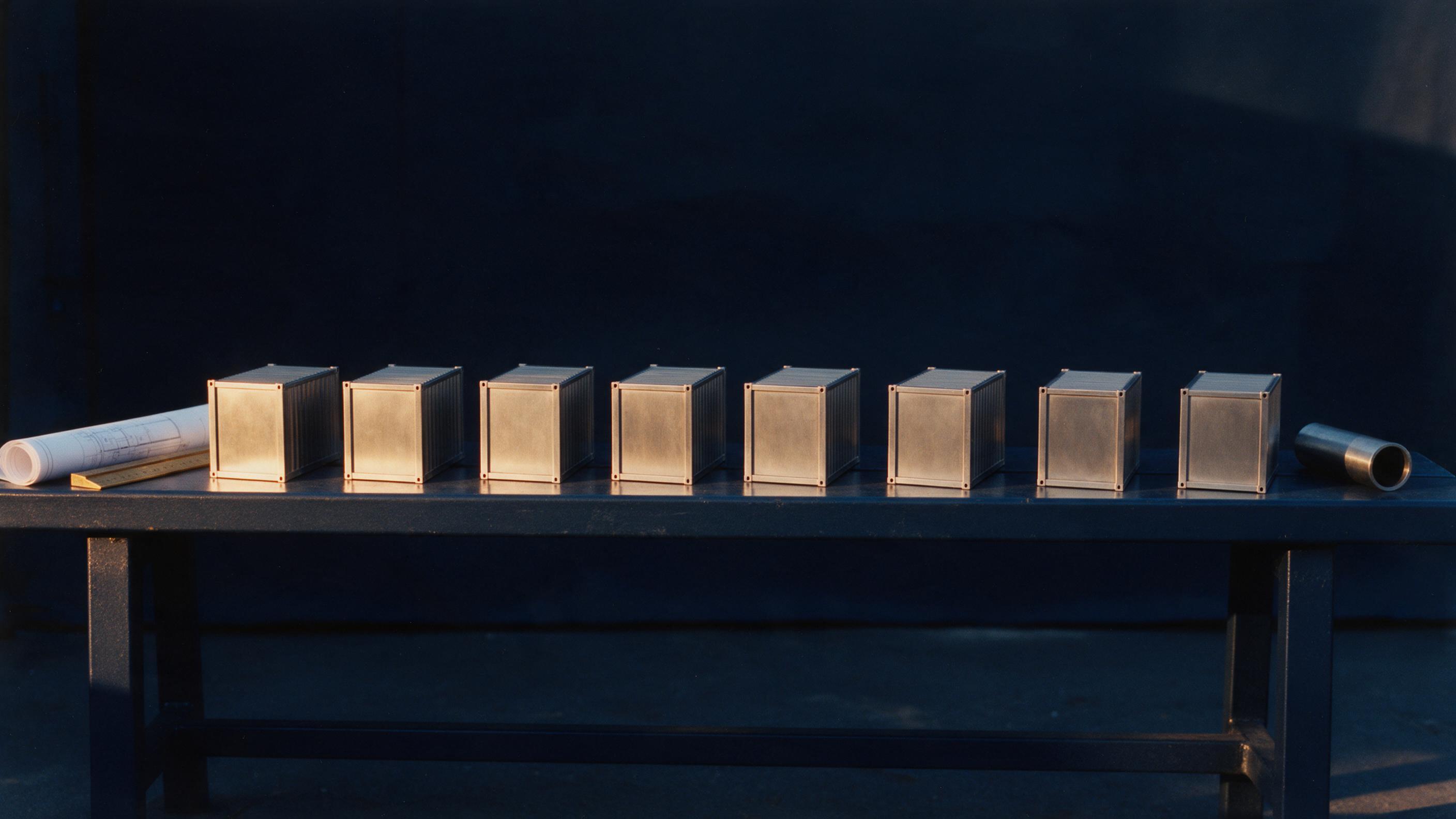
Take a concrete shape. Twenty-four containerised units, twelve in Andalusia and twelve in Portugal, about 100 kWe and 650 kWth each. That is 2.4 MWe and 15.6 MWth of installed capacity, 24 tonnes of refuse-derived fuel a day across two member states, on an estimated footprint of 500 to 800 square metres per cluster including feedstock storage and product handling. None of that is an award. All of it is execution evidence, and it is the kind an evaluator can interrogate line by line. What makes the shape persuasive is that it is one template applied twice rather than two bespoke projects. Identical unit, identical cluster layout, identical commissioning sequence: three to four months of civil works and grid connection, two to three months of batch delivery at four units per shipment, then one to two months of staggered commissioning per unit until the whole cluster is in commercial operation. A second jurisdiction doubles the compliance surface. A Spanish sociedad limitada and a Portuguese unipessoal lda are two legal persons, two commercial registers and two sets of state-aid rules. It also halves the doubt, because cross-border operation is the one thing a single domestic site cannot demonstrate at any price. Nobody reading it is counting reactors. They are asking whether that paragraph could have been written by someone who had never built one.
What A Maximum Rate Actually Certifies
A maximum co-financing rate is not generosity. It is a measurement of the region, not of the applicant. Andalusia sits below 75 per cent of average EU GDP, which is why the Programa de Andalucia FEDER 2021-2027, CCI 2021ES16RFPR002, cleared by Commission Decision C(2022)9728 on 16 December 2022, can reach 85 per cent of eligible expenditure inside a period that runs to 31 December 2029. The Just Transition Fund bands the same territory at 65 per cent for a large enterprise, 75 for a medium one and 85 for a small one. PERTE ERHA, run by IDAE, tops out near 65 per cent, with the renewable and cogeneration windows closed since February and March 2026 and the next expected early 2027. Portugal writes the same numbers differently. COMPETE 2030 reaches 75 per cent in the Norte region and falls to 50 to 60 in Centro and 40 to 50 in the Algarve. The rate moves with the map. Read that way, a filed application is itself a data point. It says an applicant has located the highest-intensity zone, matched the instrument to the asset class and accepted a state-aid process that will read its accounts. That is not an ask. It is a demonstration of fluency, and it is visible months before any decision letter exists.
Four Things A Site Owes You Before The Money
Programmes do not fund a technology in the abstract. They fund an installation at an address, and four conditions decide whether that address is worth anything. Start with the aid map. Andalusia carries three bands, a maximum-rate interior and east, a medium band around Sevilla and Cadiz and a lower-rate Almeria coastal corridor. The gap between two sites the same distance from the same substation can be twenty points of co-financing. In Portugal the same logic runs through Norte, Centro and Alentejo. Then the connection. An existing medium-voltage point, 10 to 20 kilovolts, within 500 metres. A promise of one is not the same asset. Then the heat. A 650 kWth module that sells electricity is a power plant. The same module beside a district heating network, a greenhouse cluster or an industrial process is a different business, because heat with no buyer is a rounding error with a chimney attached. Then the supply. More than 15 tonnes a day available inside a 30-kilometre radius, from an operator already paying to landfill it. Four criteria, all of them checkable by somebody who does not work for you. That is the difference between a project description and a site file.
A letter proves someone else read you. A pipeline proves you did the reading yourself.
The Same Arithmetic, Two Countries
Portugal is the easier argument on policy and the harder one on rates. It landfills 57 per cent of its municipal solid waste, the highest share in Western Europe, with five waste-to-energy plants to its name. Its landfill tax escalates to about 30 to 35 euros a tonne from 2026. Layer on the EU's 2035 landfill directive capping landfilling at 10 per cent, plus the PERSU 2030 strategy, and the direction of travel is legislated rather than forecast. The money follows the mandate. Portugal's recovery plan runs to December 2026 with roughly 22.2 billion euros committed, and its circular-economy component has paid up to 100 per cent of eligible cost in specific calls, including a 30 million euro waste-valorisation notice in September 2025. Spain answers with volume. FEDER at up to 85 per cent, the Just Transition Fund in designated Andalusian municipalities, and CDTI's NEOTEC at up to 325,000 euros on an 85 per cent rate with a doctorate hire. The 2026 NEOTEC call carried 20.38 million euros and closed on 14 May 2026. The next opens in 2027. Two programmes, two rate structures, two clocks. Filing in both is not doubling the paperwork. It is removing the single point of failure that a domestic-only applicant carries into every evaluation, because no single committee can end the whole story.
The Paragraph That Beats The Letter
In practice a submission has a rolling short stage and a full stage, and the traction section is where the pipeline goes. When the applications elsewhere are still under evaluation the section still works, because what is being scored is not the outcome of another programme. It is the evidence that somebody knows how to run one. The strongest paragraph is a statement of assembly. Two legal entities registered in two member states. Twenty-four units of one specification. A service hub that carries the spare parts and the monitoring for the whole fleet, so the same technician and the same component serve both jurisdictions. Four named programmes in two countries with published rates and published cut-offs. A site selection rule that would survive an auditor. No paragraph raises the probability of an award. A pipeline raises the probability that the reader believes the award would be spent well, and that is the judgement a committee actually makes with 15 pages in front of it, months before anyone signs anything. An award letter, when it arrives, certifies all of that from the outside. It is worth having. It is not worth waiting for, and no evaluator of a pre-revenue deep technology is going to treat a letter from another agency as the first fact they learn about you. Build the thing the letter will one day describe. Then file.
A grant letter certifies a proposal. It does not pour a foundation, book a grid connection or sign a waste supply contract.
The map is dead. Nobody told you.
Bali State of Mind is the survival guide for the collapse of everything you were taught to believe.
Beyond this book
Building the same thing somewhere else.
Julien Uhlig is available for advisory work, board seats and media appearances. Write to media@exventure.co.
The academy that trains the operators, across every company in the group, is EX Epic Academy - 25,000 applications, 25 seats per cohort, 210 alumni across 19 countries. academy.epicsolutiongroup.com
18-20 November. Online, Las Palmas, Bali.
Three days on what happens to work, capital and institutions when the map stops matching the ground. Seats are limited by cohort.
ex-aisummit.com →