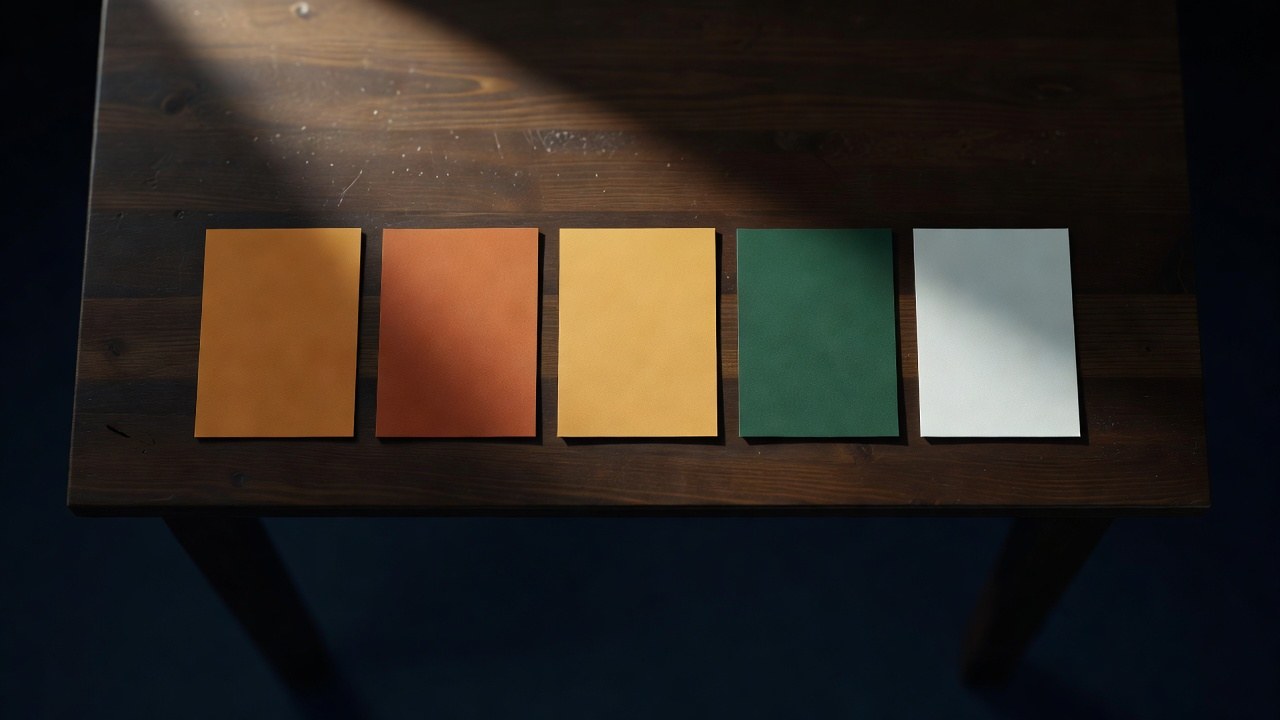
The Palette Decides What Warm Means
The brief asked for a warm 2:00 film about 1 woman's smile, and warm is not a setting on a renderer. It is 5 named colours, written down before the first frame exists to argue with. Get them wrong and 8 shots have to be rescued in the grade, which is the most expensive place to decide anything.
2 Minutes Is 8 Shots And 120 Seconds Of Decision
The brief arrived as 1 sentence: a 2:00 origin film of 1 woman, traced back to where her smile was made. Then the numbers that turn it into work. 8 shots at about 15 s each. Native 1080p. 24 fps. Fine grain, shallow depth, no slow motion anywhere. That is roughly 120 s of finished footage and 8 separate chances to get the warmth wrong. Shot 6 carries the film: the woman now, mid-30s, turning to the lens, 3 s hold. This is not a biography of facts. It is a biography of a smile, and the 2 are not the same job. A fact survives a bad grade. A smile does not. 16 years of field work across 12 countries taught me the same shape of problem: the piece that gets rescued at the end is the piece nobody decided at the start. In 2008 I signed a EUR 20 million personal guarantee against a plan that had its numbers and not its register, and the company folded on Christmas Day. The register is not decoration. It is the part that decides whether the other 8 shots are usable at all. The shot list is where the numbers first have to agree with each other: 8 shots of about 15 s each put the cut at about 120 s, and 120 s at 24 fps is 2,880 frames, which is the exact count a grader will scroll through 2 or 3 times if the palette drifts. Shot 6 carries the film. It is also the only shot in the set that cannot be re-shot cheaply, because it needs the woman who is the subject, on the day, in the light. Every other frame can be argued with. That 1 cannot.
Warm Is 5 Colours Or It Is A Guess
Warm is 1 adjective and 5 colours: golden-hour amber, salt-white sea light, terracotta, mango gold and deep green. Written down, the register is a decision. Left out, the renderer resolves the ambiguity in the direction it has seen most often, which for a woman in late afternoon light is usually 1 step too cold and 2 steps too clean. So the prompt spends its first 2 lines on the palette and its next 2 on what is excluded: cold blue, grey, desaturated, monochrome, sepia, black and white, low contrast, flat light. The order matters more than the wording. Saturation and warmth are established before wardrobe, before the location, before anything the eye can argue about. The same rule restructured a EUR 75 million industrial group: the standard is set once at the top, or it gets renegotiated in 12 departments and 200 small decisions. The probability that an unnamed palette survives 8 shots rendered separately and intact is not zero. Most people price it at zero, then pay for it in the grade. The exclusion list is short on purpose: 12 entries, 8 of them about temperature and 4 about cleanliness, because those are the 2 directions a renderer drifts when it is not told. A cold clean frame of a warm subject is not a near miss. It is a different film.
The Character Sheet Is Locked In 1 Pass
The sheet went down in the same sitting as the palette, because 1 without the other is half a lock. Mid-30s. Warm brown skin with a golden undertone. Dark wavy hair worn down over the shoulders. Laugh lines at the corners of the eyes. Hands mid-gesture, because she speaks with them. White linen, gold hoop earrings, 1 thin gold necklace, nothing else. And exactly 1 signature: the smile is wide, warm, genuine, and never performed. That is 7 traits and 1 signature, and every trait on the list is a gap the model does not get to fill. Traits are what stop a renderer from substituting an average. The 1 signature is the part no trait list can produce, so it gets named as a behaviour rather than described as a shape: the smile arrives at the eyes first. Her grandmother's line was that when you smile at someone you are giving them back to themselves. 1 sentence, and it does more work than 40 words of jawline. The traits get checked at 100% face consistency on the reference portrait before the first video frame is rendered, because a character sheet that has not survived its own portrait will not survive 8 shots. Portrait first, sheet second, film third. In that order, every time.
5 Beats, Written In Her Voice
5 beats carry the 120 s. The city that never learned to be cold. The grandmother's kitchen as the first school, mango on the table, salt in the air, hands always moving. The street with jasmine and drums, barefoot, laundry lines overhead. The lesson where the smile is handed over, 1 cupped face at a time. And the leaving. Each beat gets about 24 s of screen time, which is 1 shot and a half, so the count has to be honest before the shoot. The narration is first person and written to be read in her voice rather than narrated about her, because a film about a woman's warmth that talks over her is a film about the narrator. 5 beats also means 5 chances to state a fact the source material does not contain, so the rule is blunt: if the kitchen, the street, the drums and the leaving are not in the brief, they are not in the film. Writing what is there is a discipline. Writing what would be nicer is the reason 2 versions of the same 2 minutes cost 40 hours instead of 12. The 5 beats are timed to the 120 s before a single render is queued: 24 s for the city, 24 s for the kitchen, 24 s for the street, about 30 s for the lesson, and the last 18 s to the leaving and the held smile. If those 5 numbers do not add to 120, the script is wrong and the render does not start.
Warm is 1 word and 5 colours. Name them or the renderer picks for you.
8 Shots, Ordered So The Last Frame Answers The First
The order is the argument. 1, a golden-hour aerial drifting over the rooftops down to the water. 2, the kitchen: hands kneading dough, mango halves on a worn wooden table, a small girl's bare feet swinging under it. 3, the barefoot run down a sunlit street, jasmine in the air, a drum circle starting. 4, the grandmother cupping the girl's face and teaching her the smile, eyes crinkling on the first real attempt. 5, a face reflected in a bus window at dusk, the lights sliding past. 6, the woman now, turning to the lens. 7, the hands mid-gesture. 8, the smile held for 3 s after she stops smiling, then a fade to gold. Shot 1 and shot 8 are the same warmth seen 2 minutes apart, which is the whole trick: the film opens on the place that made the light and closes on the face that carries it. Sequence is not decoration either. 210 energy systems were deployed across Africa and Asia in an order, and 200 wood-gasification machines were built across the UK and Europe in an order, and in both cases the order was the part that had to be right before the first unit was switched on. Each shot gets 1 job and no more, so shot 3 does motion and joy and nothing else, and shot 5 does the leaving in 1 reflected face rather than in 3 lines of voice over. 8 shots, 1 job each, 8 checks.
The Edit Cannot Rescue A Register
A colour pass over 8 shots is 8 grade decisions and about 120 s of footage, and fixing a palette after the fact means every one of those decisions has to agree with the other 7. Naming 5 colours on 1 line takes 4 min and holds for all 8. The arithmetic is not close, and it never is, which is why the palette and the character sheet are locked in the same pass, before the render, and both are checked again at the end against the same written list rather than against a feeling. A check that is not written down is a mood, and a mood changes with the hour. The probability that 8 shots rendered in any order and graded afterwards come back with 1 consistent warmth is not zero. Most people price it at zero. So the last word of this pipeline is the first decision of it: what warm means was settled on 1 line of paper, and everything downstream, 15 s at a time, is that line being kept. The closing check is 4 items against the written list: the palette at 5 of 5, the face at 100% against the reference, the shots in the planned order, and the hold at 3 s before the fade. 4 items, pass or fail, and a fail is repaired at its own address rather than in the grade.
A fact survives a bad grade. A smile does not.
The map is dead. Nobody told you.
Bali State of Mind is the survival guide for the collapse of everything you were taught to believe.
Beyond this book
Building the same thing somewhere else.
Julien Uhlig is available for advisory work, board seats and media appearances. Write to media@exventure.co.
The academy that trains the operators, across every company in the group, is EX Epic Academy - 25,000 applications, 25 seats per cohort, 210 alumni across 19 countries. academy.epicsolutiongroup.com
18-20 November. Online, Las Palmas, Bali.
Three days on what happens to work, capital and institutions when the map stops matching the ground. Seats are limited by cohort.
ex-aisummit.com →