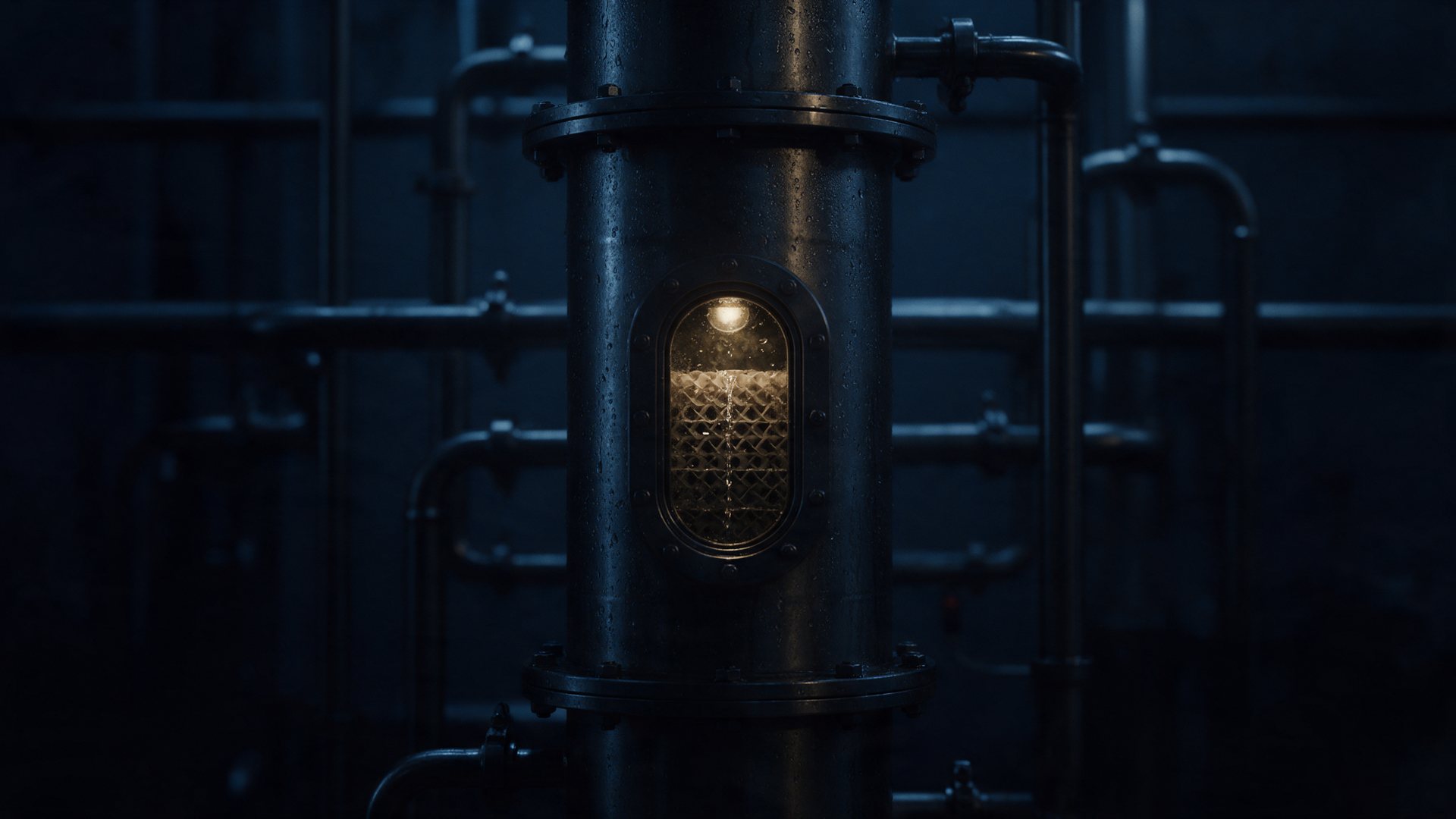
The Organism Does The Work
A nickel catalyst needs 300 degrees to hold the reaction. An archaeon holds the same reaction at 37, which is body temperature, and that difference decides where the capital goes.
Two Machines, Same Molecule
A methane molecule does not care who made it. The nickel catalyst route holds the reaction at 300 degrees and above, inside a furnace, at pressure, every hour the plant is running. The biological route runs the same chemistry inside a living cell at 37 degrees, which is body temperature for the mesophilic strains, and at 55 to 65 degrees for the thermophilic strains that commercial plants use. The stoichiometry is identical. Four hydrogen molecules and one carbon dioxide molecule become one methane molecule and two water molecules, with a free energy change of minus 131 kilojoules per mole. One route buys a furnace and a pressure vessel. The other buys a culture and keeps it alive. That is the whole comparison, and everything after it is maintenance.
The Seven Steps And The Nickel Heart
Methane is assembled in seven enzymatic steps, and the last one is the one that pays. Methyl-coenzyme M reductase, known as Mcr, carries a nickel tetrapyrrole cofactor called F430 at its active site. Nickel sits at the centre of the final reaction, and Mcr is the only enzyme known to run it. It is also the step that cannot be repaired. Oxygen inhibits Mcr irreversibly. One oxygen excursion into a reactor stops the reaction for days while the culture rebuilds itself, and there is no spare part. All known methanogens sit in Euryarchaeota, more than 160 described species, and a handful matter commercially. Methanothermobacter thermautotrophicus works at 55 to 70 degrees and doubles in 2 to 4 hours. Methanothermobacter wolfaei tolerates more shear inside a stirred tank because its cell wall is thicker. Methanocaldococcus jannaschii runs at 80 to 85 degrees and resists 50 bar of hydrostatic pressure, measured by Mauerhofer in 2021. The workhorse also eats formate on the days when hydrogen runs short.
The Bottleneck Is Water, Not Biology
Biology is fast. Water is the constraint. Hydrogen dissolves badly. The Henry constant at 55 degrees is roughly 0.015 moles per cubic metre per bar, which is about 1.4 milligrams per litre at one bar. A dense culture can pull more than 1,000 millimoles per litre per hour. A conventional reactor delivers a volumetric mass transfer coefficient of 50 to 300 per hour. That gap is the machine. Every reactor family is an answer to that one number. Pressure raises the saturation concentration linearly, which is why Electrochaea runs at 10 bar and Thema ran 13.5 bar in 2021. A trickle bed spreads a liquid film thin enough that the interface area does the work. A membrane contactor pushes hydrogen through pores directly into the biofilm and reached 268 per hour on a flat module, measured by Alfaro in 2018. If the gas cannot be dissolved, the reaction can be bypassed. Anthraquinone-2,6-disulfonate as a redox shuttle lifted hydrogen consumption by 110 to 160 per cent in the Tucci 2023 work. Magnetite particles of 10 to 20 nanometres built conductive networks between cells for up to a thirteenfold gain in the Tucci 2025 follow-up.
The Numbers Two Reactors Produce
A stirred tank delivers 0.4 to 5 cubic metres of methane per cubic metre per day, methane purity of 85 to 99 per cent and hydrogen conversion of 80 to 99 per cent, with a pilot at 7 reported by Jiang in 2022 alongside 151 days at 94.8 per cent methane. A trickle bed holds the records. Peak production of 15.4 cubic metres per cubic metre per day above 98 per cent methane, from Struebing in 2017. Endurance of 1,200 days at 5.75 and 97.7 per cent methane, from Burkhardt in 2019. A pilot reactor of 0.8 cubic metres held 6.1 for 450 days in the Fenske 2023 run. A bubble column returns 0.5 to 3, until biochips pre-colonised with a methanogen-dominated biofilm are added, which took one column to 15.7 in the Keramati 2024 trial at 84.4 per cent methane. A plug flow reactor reached 40 volumes per volume per day at 99 per cent methane in the Savvas 2017 study, with the lowest parasitic energy demand of the set. The solid-state unit from Q Power has no agitator and no pressure vessel at all. None of them dominates. Each one trades capital against mass transfer against the length of the experiment.
A methane molecule does not care who made it.
The Length Of The Experiment
Two studies have run past two years. Burkhardt 2019 is one of them and the Treu work is the other. Everything else in the literature is measured in months, and load following is the question that decides a commercial plant, because renewable hydrogen arrives when the wind does. Electrochaea holds a feed control patent from 2025 covering the dynamic response. Khesali Aghtaei showed in 2022 that a community under intermittent feeding shifts its membership within 48 hours and recovers. Jensen ran a 31 cubic metre in-situ pilot in 2025 with intermittent hydrogen injection and reached 97.5 per cent conversion. Akimoto ran 2 cubic metres for 137 days at 83 per cent methane in 2024. The reactor that survives interruption is worth more than the reactor with the best peak number on a chart.
The Cost That Decides It
Hydrogen is the bill. Grid-competitive methane needs hydrogen at 2 to 3 euros per kilogram, and the market has been running at 4 to 8. On the other side of the ledger, the European emissions trading system has been around 64 euros per tonne of carbon dioxide, and most methanation business cases do not collect it. Stacking grid, fuel and balancing revenue has been simulated by Elhaus in 2024 and not built. Around 35 plants run ex-situ biogas upgrading today at a technology readiness of 8 to 9. Ex-situ power-to-gas sits at 7 to 8. In-situ digester methanation sits at 6 to 7. No published capital cost curve exists above 10 megawatts, which means the number a bank needs does not exist yet. Entrade built 200 wood-gasification machines across the UK and Europe, and the cost lesson from that row of machines was never the chemistry. It was heat, pressure and steel.
The Part Nobody Has Written Down
Gasification syngas carries carbon monoxide, and carbon monoxide inhibits methanogenesis above roughly 20 per cent in the headspace. The workaround is a shift reaction that turns carbon monoxide and water into carbon dioxide and hydrogen, and then the methanogens take it from there. Goonesekera showed in 2024 that the real bottleneck in a syngas trickle bed was transfer inside the biofilm, not transfer between gas and liquid. Exactly one pending patent family covers direct syngas biomethanation, filed by SUEZ and LIST. That is the entire file on the integration between two industries that both already exist. The high temperature corner is emptier still. Methanocaldococcus jannaschii runs at 80 to 85 degrees, resists 50 bar, and has no patents filed against it at all. Its potential is 2 to 4 times the rate of the thermophilic workhorse, and no continuous culture has been published to prove it. The field also has no standard production measurement. The Thema 2019 framework exists and is not universally used, so two published numbers are frequently not comparable.
The Rule
The catalyst answer and the organism answer produce the same molecule with different capital behind them. The catalyst needs a furnace held at 300 degrees for every hour of operation, on the coldest day and at the worst gas price. The organism needs a warm tank, a feed line and a culture that never sees oxygen. The probability that the biological route takes the low temperature, low pressure half of this market within a decade is not zero. Most people pricing methanation today are pricing it at zero. I signed a EUR 20 million personal guarantee on a company that folded on Christmas Day 2008. Hardware forgives nothing. A machine that needs 300 degrees to hold a reaction needs that heat in the worst week of the year, and an archaeon needs the conditions of a compost heap. That is not romance. It is a smaller capital bill.
Biology is fast. Water is the constraint.
The map is dead. Nobody told you.
Bali State of Mind is the survival guide for the collapse of everything you were taught to believe.
Beyond this book
Building the same thing somewhere else.
Julien Uhlig is available for advisory work, board seats and media appearances. Write to media@exventure.co.
The academy that trains the operators, across every company in the group, is EX Epic Academy - 25,000 applications, 25 seats per cohort, 210 alumni across 19 countries. academy.epicsolutiongroup.com
18-20 November. Online, Las Palmas, Bali.
Three days on what happens to work, capital and institutions when the map stops matching the ground. Seats are limited by cohort.
ex-aisummit.com →