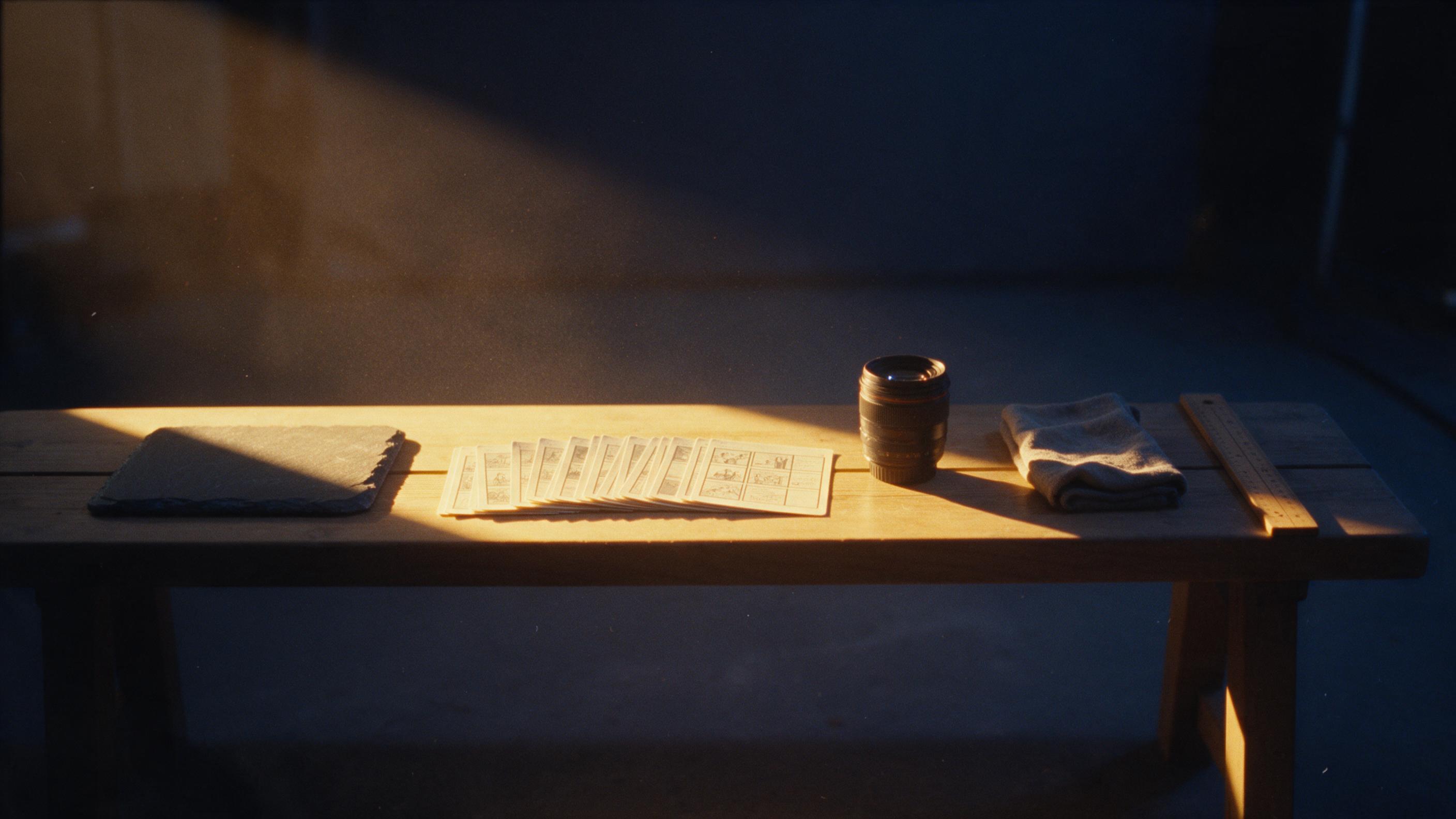
The Order Is The Decision
A film is made in 1 order: script, shot plan, shoot or render, grade, cut. 5 stages, each answering 1 question whose answer feeds the next. Follow the order and every shot is a decision. Skip it and every shot is a guess, handed back to the model to fill in.
The Order Is The Argument
Most people who make a film with a model start at the prompt. The prompt is stage 3 of 5, and starting there is the reason the result looks like a clip instead of a scene. The order is script, then shot plan, then shoot or render, then grade, then cut. 5 stages, each with exactly 1 question, and the answer to that question is the raw material for the next stage. Stage 1 asks whose point of view this is and what the audience should feel by the end. Stage 2 asks which shots, in which order, cover that story. Stage 3 asks what lens, composition, light and movement make each shot mean what it is meant to mean. Stage 4 asks which palette and which contrast carry the emotion. Stage 5 asks what rhythm and meaning live in the cut. Skipping a stage does not delete its question. It moves the question to a worse place. Decide the point of view during the edit of a render and you are not editing any more. You are negotiating with 360 finished frames. A prompt is assembled from decisions. Take the master template, subject with a fixed identity block, action, shot size and angle, lens, composition, lighting, camera movement, film look and a 35 mm documentary anchor, and count the slots. Each slot is a bracket. A bracket left empty is not a stylistic silence. It is the model improvising in the 1 place you were supposed to have decided. Leave 4 of them open and you have not written a shot. You have written an invitation. The cost of doing it in order is 1 afternoon with a pen. The cost of doing it out of order is a re-render of the whole scene, because the lens you can change and the point of view you cannot. By the time a wrong POV is visible, the coverage is built around it, the grade is timed to it and the cut is placed for it. That is why the order is not a preference. It is the only cost control in the pipeline.
Whose Eyes, And What Covers It
Stage 1 has 1 deliverable and it is not a shot list. It is a written beat breakdown: whose eyes we are in, what the arc does, and the single feeling the piece serves. The first question is the master decision. Objective or subjective. Objective means the audience watches from outside, which buys geography, distance and context. Subjective means the audience is inside 1 head, which buys intimacy and costs you the ability to show anything that character would not see. The canon treats this as the decision that governs every later choice, and it does. An 8 shot storyboard built on the wrong answer is 8 shots of evidence for the wrong thesis. Then the arc, which has a shape. Wide to close as the pressure rises. You start with the room and end with the face, because the audience earns the close-up by spending time in the space around it. Cut to the face in shot 1 and you have spent the only card you had. Stage 2 is where the story becomes coverage. The question is which shots, in which order, carry the beat breakdown. The kit is small and it has not changed in a century: a master that holds the whole space, over-the-shoulder frames that hold 2 people in relation, singles that hold 1 person and the performance, and inserts that hold the object or the detail that carries the meaning. Set the 180 degree line for each scene and never cross it. Lock the identity block per character, ethnicity, skin, hair and wardrobe, so the subject stays the same person from shot 1 to the last shot. The output of stage 2 is a numbered shot list with a size and an angle against every line. Not a mood board. A list, because the next stage reads it 1 shot at a time.
The Shot, Decided In Order
Stage 3 is the only stage that happens per shot, and inside it the decisions still have an order. Change the order and the shot fails for a reason you will misdiagnose. Lens first. 24 mm to 35 mm shows the world the subject is standing in. 50 mm is the natural frame, close to how a person sees a room. 85 mm and longer isolates, compresses the background and makes the audience look at 1 face and nothing else. Choose it once for the scene and hold it. A scene that changes focal length between cuts does not read as variety. It reads as 2 scenes. Composition second. Name the focal point before you name anything else. Thirds, leading lines, the space in front of a moving subject, the depth between foreground and background. A frame with 2 focal points has none. Lighting third. Motivate the source, then choose the direction. A directional key with negative fill gives skin its texture, and flat uniform light gives it the waxy finish that marks a render as a render. 90 degrees off the axis is a modelling key. Straight into the lens is a mugshot. Movement fourth. Static, dolly, crane or handheld, and at what speed. Deliberate movement is grammar. Undecided movement is drift. Look fifth. Format, film stock reference, grain, in-camera discipline, 35 mm as the anchor. Avoid sixth. The list of known failures: hands, dense lettering, waxy faces, reflection, fast motion blur. You do not out-prompt a failure. You design the shot so the failure has nothing to do. Run those 6 in that order for every shot and the prompt assembles itself, because by then there is nothing left to improvise. Run them in another order and the shot still renders. It just renders as somebody else's decision.
One Palette, Or No Film
Grade is stage 4 and its question is narrow: what mood do I finish in. The discipline is 1 palette for the whole film, matched shot to shot, with no drift between cuts. Shoot flat and grade in post. Capture flat so the decision is still available later, then place the mood in the lift, the warmth in the gain and keep the skin protected through both. The lift is where shadow becomes feeling. Neutral shadows read as documentation, cool shadows read as distance, warm shadows read as memory. The gain is where the film gets its temperature, and skin is the 1 thing that must survive both moves. Push the gain too far and every face in the film turns the same colour, which is the fastest way to make 12 locations look like 12 unrelated pieces of work. The gate at this stage is consistency, not beauty. 1 palette, and every shot matched to it. 2 shots of the same scene 2 stops apart will read as an error even to an audience that has never heard the word grade, because the eye compares constantly and it remembers the last frame it saw. That is the whole mechanism. The audience is not judging your palette. It is judging your palette against the palette you showed it 4 seconds ago.
Follow the order and every shot is a decision. Skip it and every shot is a guess.
The Cut Carries The Rhythm
Stage 5 answers what rhythm and meaning live in the cut, and the first thing to accept is that pace is an emotion, not a speed. Cut on action so the motion carries the seam. Hold the 180 degree line and preserve the eyelines across every edit. J-cut and L-cut the sound so audio leads the picture into the next scene instead of stopping at the boundary. Those 3 habits are invisible when they are right, and the audience only notices them when they are missing, which is the working definition of craft. Better cuts, faster shots. In a generated sequence the longer a shot runs the more it reads as generated, because a held frame with no new information is the shape of a machine waiting to be told what to do next. Cut on information, not on comfort. The moment the shot has delivered what it came to deliver, leave it. Where the story demands pressure, cross-cut 2 or 3 threads and let each 1 exit at its highest point so far, so nothing resolves downward until the 1 release you chose before you started cutting. That is the rise. The release is the only drop in the film, which is exactly why the audience feels it. Rhythm also has a floor. A cut every 4 seconds for 90 minutes is about 1,350 decisions, and if none of them changed what the audience knew, the film moved fast and went nowhere. Motion is not meaning. The cut is where the script stops being a document and starts being a feeling.
The 11 Answers, In The Same Order
The checklist is the part everyone skips and the part that decides whether a film ships. 11 answers, in the same order, before any shot leaves the drive. POV decided, objective or subjective. Size and angle named instead of defaulting to a medium at eye level. Lens named and held per scene, not described as cinematic. Composition chosen, with a focal point rather than a pretty frame. Light motivated and directional, with no waxy skin. Movement deliberate, or explicitly static. Identity locked, so ethnicity, skin, hair and wardrobe hold across every shot. Flat capture and grade in post, 1 palette, no drift. Cuts clean, 180 degrees held, eyelines held, matched grade, sound-led. Shots fast, with no long static runs. No AI artifacts, negative-prompted and checked on the frame. Those 11 are not a taste test. They are the difference between a scene and a set of renders. The same discipline is what makes the work legible to a room. Built companies across twelve countries. Restructured a EUR 75 million industrial group. Deployed 210 energy systems across Africa and Asia. Took a company through a Frankfurt IPO. Entrade built 200 wood-gasification machines across the UK and Europe. 16 years of field work from rural Nigeria to Fukushima. The probability that a film made in order fails to communicate is close to 0, and the probability that a film made in reverse order does is close to 1, not because the tools are weak but because a blank bracket is a decision you asked someone else to make for you. Whose eyes, and what should they feel. Answer that 1 question first and the other 10 answer themselves, in the order they were always meant to come.
Whose eyes, and what should they feel. Every other question in the film is downstream of that 1.
The map is dead. Nobody told you.
Bali State of Mind is the survival guide for the collapse of everything you were taught to believe.
Beyond this book
Building the same thing somewhere else.
Julien Uhlig is available for advisory work, board seats and media appearances. Write to media@exventure.co.
The academy that trains the operators, across every company in the group, is EX Epic Academy - 25,000 applications, 25 seats per cohort, 210 alumni across 19 countries. academy.epicsolutiongroup.com
18-20 November. Online, Las Palmas, Bali.
Three days on what happens to work, capital and institutions when the map stops matching the ground. Seats are limited by cohort.
ex-aisummit.com →