The Water That Decides The Machine
A downdraft gasifier wants fuel below 15 to 20 per cent moisture. Sewage sludge arrives at 75 to 85, digestate at 90 to 95, food waste at 70 to 80. That is more than half the wet waste on earth, standing outside the gate of a proven machine. The answer is 180 to 250 degrees under pressure, and a heat connection nobody owns.
A Dry Machine In A Wet World
The gasifier on the market is a downdraft fixed bed, and it asks for feedstock below 15 to 20 per cent moisture on a wet basis. That is not a preference. Below that line the bed holds temperature, the tar cracks, and the syngas comes out with a hydrogen and carbon monoxide content worth an engine. Now put the waste streams next to it. Sewage sludge arrives at 75 to 85 per cent moisture. Digestate out of an anaerobic digester arrives at 90 to 95. Food waste runs 70 to 80. Wet organic industrial residue sits somewhere in the same band, and between them they are the majority of the carbon that municipalities and processors are paying to move, dry or bury. Drying that material with bought energy is the arithmetic that kills the project before the first drawing. Boil a tonne of 85 per cent sludge and you spend more energy removing water than the solids will ever return. So the limit was never the chemistry. The machine works. The water is what stands between the machine and the stream.
One Hundred And Eighty Degrees Under Pressure
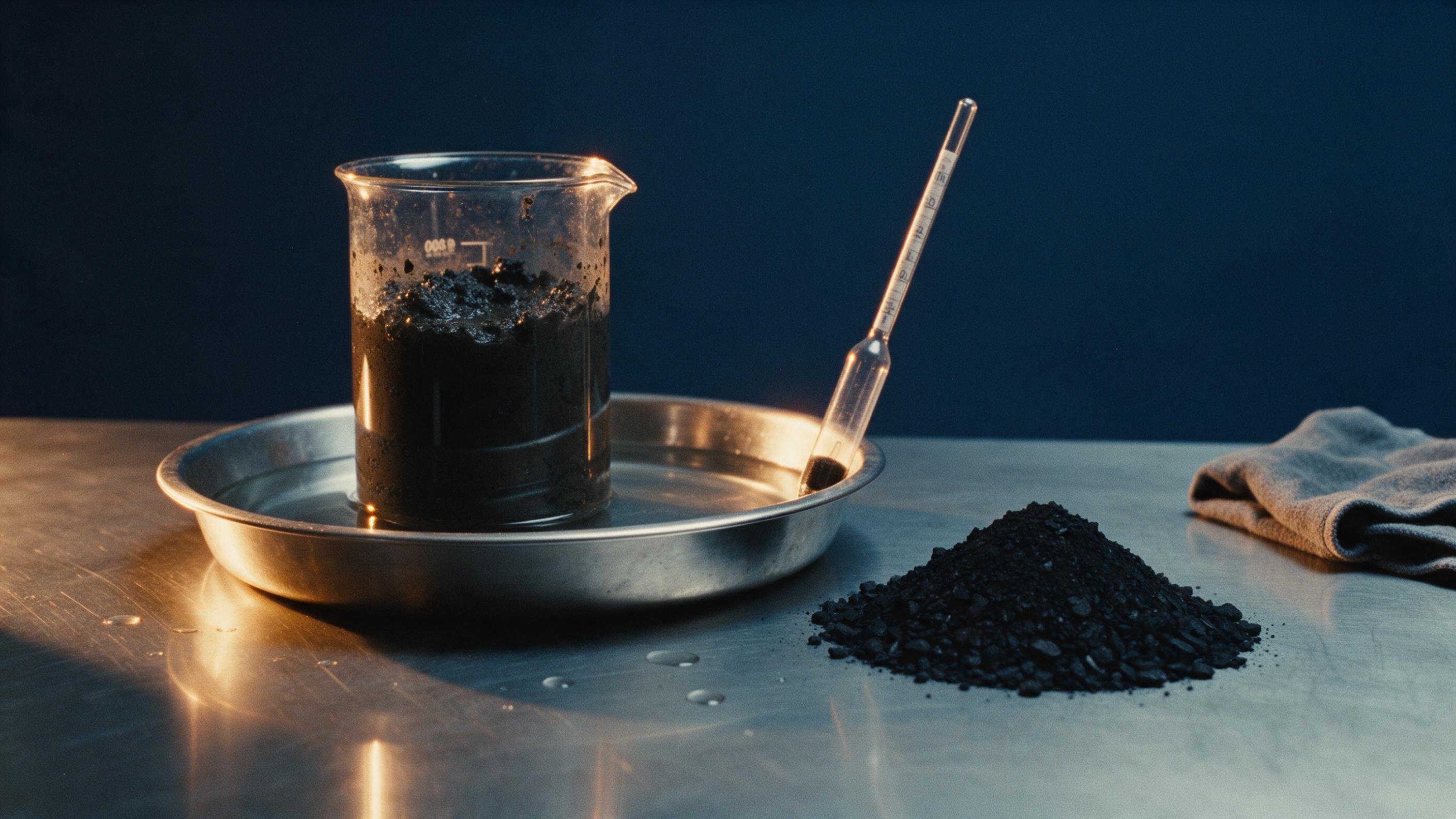
Hydrothermal carbonisation runs at 180 to 250 degrees Celsius and 2 to 6 megapascals, with water as the reaction medium rather than an obstacle. Feedstock enters at 70 to 85 per cent moisture. Nothing is evaporated to get it in. Four numbers come out the other side. The hydrochar leaves at 45 to 55 per cent moisture and dewaters mechanically to 30 to 35, which is the difference between a filter press and a dryer. Carbon content concentrates by 10 to 20 percentage points. Dewaterability improves by 300 to 500 per cent against raw sludge, because the cell structure that holds water has been broken. And the process water is not waste. It comes out carrying organic acids, ammonia, phosphorus and potassium. That is the detail the spreadsheets miss and the reason the loop closes later. It is worth keeping the sequence straight: HTC is not a competitor to the gasifier. It is what happens to the feed before the feed is allowed in.
The Heat Already On Site
The gasifier side has an exhaust nobody wants. A flare burns waste gas at 900 to 1,200 degrees, and a combined heat and power engine throws off jacket water and flue gas at temperatures a reactor can use. The HTC reactor needs 180 to 250 degrees. Recover the flue gas heat and it covers 60 to 80 per cent of the HTC thermal demand. Take the same stream and run it through a dryer and the hydrochar moves from 30 to 35 per cent moisture down to gasifier specification below 15. One machine's waste heat is the other machine's operating cost. The engineering question is the topology: which exchanger, at what temperature cascade, with what control loop holding it stable when the feedstock moisture swings. That is where the value sits. Heating a pressurised reactor from a flare you were burning anyway is not a science problem. It is a plumbing decision with a patent attached, and most integrators never make it because the two machines arrive from two different suppliers.
The Loop Nobody Owns
The second half of the integration is the wet half. Process water out of the HTC reactor carries the organic acids and the ammonia. Route it through filtration and pH adjustment, strip the ammonia, and it becomes steam for the gasification agent instead of a disposal bill and a permit conversation. Syngas out of the gasifier runs around 33 per cent hydrogen and carbon monoxide with methane in the mix. The process water loop is what lets a wet-waste plant keep both sides fed from one feedstock, with no tanker leaving the site and no external water draw to feed the reactor. Search the record and the combination is open. C-Green holds US11724952 on HTC with wet oxidation of sludge. Ingelia holds ES2768236T3 on a continuous HTC reactor. TerraNova holds US10343917 on HTC with thermal hydrolysis feeding anaerobic digestion. A Korean filing, KR102738784B1, covers a gasifier with an integrated tar reformer. SunCoal holds WO2008138637 on an HTC system with process control. Five owners, five single machines. Not one of them claims HTC integrated with a downdraft fixed-bed gasifier through a defined heat integration topology. The gap is not the concept. It is the connection.
The plant never fails on chemistry. It fails on water.
What Is Already Published
The broad idea is public and has been for over a decade. Erlach and colleagues put HTC in front of entrained flow gasification in 2012. Liu and colleagues ran HTC as pretreatment for steam gasification of kitchen and yard waste in 2023. Mularski and colleagues published computational fluid dynamics on HTC sewage sludge into entrained flow steam gasification in 2025. The closest document on the record is a 2025 MDPI Processes paper combining HTC, solar distillation and co-gasification in an autothermal downdraft gasifier, blending hydrochar with olive pruning at a modelled 590 kilowatts. Read that paper honestly and it does two things. It kills any claim built on the phrase HTC before gasification. And it leaves the specific heat integration topology and the process water route to gasification steam unclaimed, because solar distillation is a different answer to the same wet-liquid problem. That distinction is the whole filing. Broad concept: published, unenforceable, do not bother. Narrow topology: on the record nowhere, file as a system claim and be specific about the cascade.
Fifty-Eight Plants And A Score Of Six Point Four
Europe operates 58 HTC plants. Every wastewater treatment site is a candidate feed point, and the wet half of the waste market is the half that cannot currently reach a gasifier at all. Score the opportunity honestly and it comes out at 6.4 out of 10. Novelty 5, because the broad concept is published, rising to 7 or 8 on a narrow heat integration claim. Feasibility 7, because HTC sits at readiness level 9 and the gasifier sits at 9 as well. Business value 8. Enforceability 6, because a competing plant can hide its exchanger topology behind a fence. Design-around difficulty 5, because a different cascade bypasses a badly drafted claim and a control-system claim is harder to step around than a pipe. That composite is not a green light and it is not a red one. It is a file-with-care verdict, and the care is entirely in the claim language. Entrade built 200 wood-gasification machines across the UK and Europe. Every one of them was specified on dry fuel, because dry fuel was the only feed the market could hand us. The probability that a wet-waste plant fails on the reactor design is low. The probability that it fails on water nobody costed is high, and most project teams are pricing that at zero.
Two machines, one heat loop, and the loop is the part that is unclaimed.
The map is dead. Nobody told you.
Bali State of Mind is the survival guide for the collapse of everything you were taught to believe.
Beyond this book
Building the same thing somewhere else.
Julien Uhlig is available for advisory work, board seats and media appearances. Write to media@exventure.co.
The academy that trains the operators, across every company in the group, is EX Epic Academy - 25,000 applications, 25 seats per cohort, 210 alumni across 19 countries. academy.epicsolutiongroup.com
18-20 November. Online, Las Palmas, Bali.
Three days on what happens to work, capital and institutions when the map stops matching the ground. Seats are limited by cohort.
ex-aisummit.com →