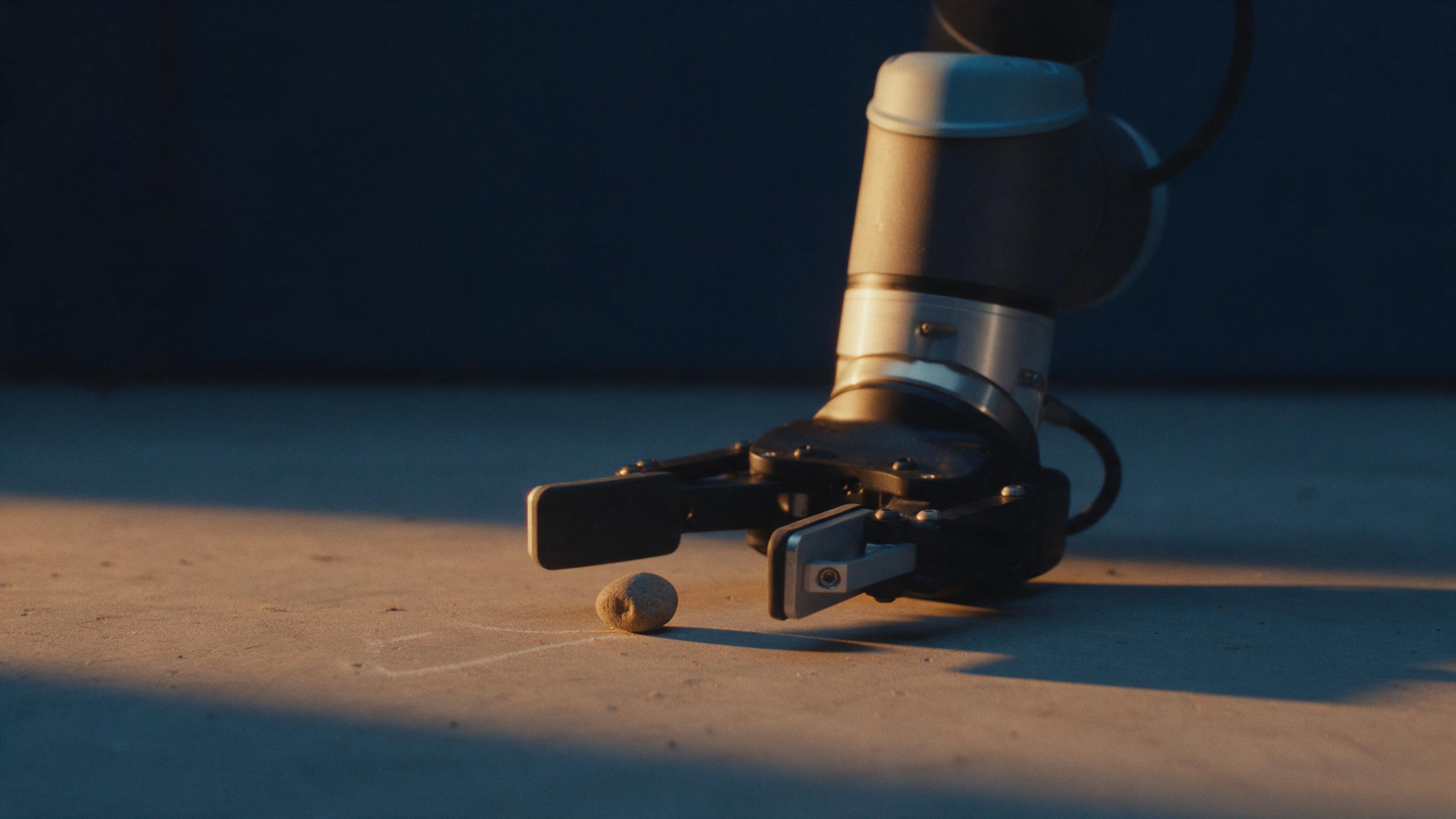
The Milliseconds Before The Drop
Humans detect incipient slip 60 to 80 milliseconds before an object moves, faster than the roughly 200 millisecond conscious reaction time, because the correction is a spinal-level reflex riding a 5 to 50 Hz vibration band. The machine target that follows is a latency budget: detection under 10 milliseconds, grip response under 50, at sub-micrometre sensitivity.
Sixty Milliseconds Of Warning
A human hand knows an object is slipping 60 to 80 milliseconds before it actually moves. Conscious reaction time is nearer 200 milliseconds. The gap is not a slowdown somewhere upstream. It is a different circuit: the correction is a spinal-level reflex, so the grip tightens before the person knows anything happened. The signal that triggers it is small. RA-I afferents, the Meissner corpuscles, carry a 5 to 50 Hz micro-vibration band, and that is the band that opens when an object starts to slide. The reflex borrows roughly 140 milliseconds of head start from a channel built for flutter. That window is the whole specification. Howe and Cutkosky described the phenomenon in 1989. Almost four decades later it is still the hardest thing to reproduce in a robot hand.
What The Machine Has To Beat
Translate the biology into numbers and the target reads like a latency budget, not a sensor count. Detection latency under 10 milliseconds, sensor and processing together. Grip-force response under 50 milliseconds from detection. Detection sensitivity down to sub-micrometre vibration at the contact surface. Three numbers, one budget. A hand that spends its latency on a central processor has already lost the 60 milliseconds the reflex exists to use. The fastest published reflex is 15 milliseconds from slip onset to grip force increase, and it took a dedicated hardware controller rather than a general-purpose compute path. The best lab demonstration sits under 5 milliseconds at better than 95 percent accuracy across 50 tested objects, using a hybrid of piezoelectric sensing and force-ratio tracking. Commercial availability of that performance: none. No off-the-shelf slip detection module exists for any major robot hand. Each research group builds its own.
A Front, Not An Event
Slip is not a switch. The contact patch loads unevenly, and the periphery moves while the centre is still stuck. A slip front propagates inward from the edges of the contact. Four things follow from that geometry. Local asperities break contact and re-establish it, which generates vibration from 50 to 500 Hz. The ratio of tangential to normal force, F_t over F_n, climbs toward the static friction coefficient. The area of static contact shrinks as the front advances. And the object has not moved yet. Every one of those four is separately measurable, which is why the detection methods differ so much in speed. A thermocouple reading friction heating takes 100 to 500 milliseconds and is worthless here. Optical marker tracking on a gel surface takes 10 to 30 milliseconds and is limited by the camera frame. Piezoelectric vibration sensing does the job in under 1 millisecond. The physics is generous. The electronics decide who wins.
The Five Millisecond Pair
A thin PVDF film at the contact surface, bandpass filtered from 5 to 500 Hz, is the fastest route. Slip registers as a vibration amplitude crossing the noise floor, at a detection threshold of 0.01 to 0.1 metres per second squared. Latency from onset is 0.5 to 5 milliseconds. The cost of that speed is noise. A piezoelectric channel hears the motors, the walking robot and the room. Published false positive rates run 1 to 5 percent, and the standard mitigation is a second opinion from force-ratio tracking. A three-axis force sensor watching F_t over F_n is slower, at 10 to 50 milliseconds, but it is sound at high force. The classical numbers are static friction between 0.3 and 1.0, dynamic friction between 0.2 and 0.8, and a slip margin of (mu_s minus F_t over F_n) divided by mu_s. Margin zero means imminent slip. A safe margin threshold sits above 0.2. Run the two together and the hybrid lands under 5 milliseconds. One channel for speed, one for confidence.
Humans detect a slip 60 to 80 milliseconds before the object moves. Conscious reaction takes about 200.
The Reflex Has To Be Stupid
Detection without response is a dashboard. The published loop has four steps and the fourth is the one teams skip. Increase normal force applied to the grip until F_t over F_n falls below 0.8 times the static friction coefficient. Do it inside 50 milliseconds of detection. Do not overshoot, because the objects worth holding are the fragile ones and the force limit is what stops the hand from crushing them. Then reduce back to the minimal force that holds. That last step matters more than it sounds. A hand that only ever adds force ends a shift holding everything at maximum grip, which is how a robot breaks the thing it was trusted with. The awkward part is the static friction coefficient, which is not known in advance for an unknown object. Three published answers: estimate it from the initial contact, since the first incipient slip event is a calibration reading; assume the worst case, which makes the lightest grip that does not drop the object the optimal one; or learn object-specific friction models across many grasps. The reflex has to run without a model of the object. That constraint is what forces it into dedicated hardware.
Resolution Is The Wrong Purchase Order
A hand with coarse pressure sensing and a working slip reflex is more capable than a hand with millimetre taxel maps and no slip detection. That comparison is not close. The reflex is the behaviour that separates functional grasping from the fragile, drop-prone kind. The purchasing logic gets inverted because taxel count is easy to put in a datasheet and latency is easy to leave out. A specification that lists a taxel pitch and no millisecond budget has described a sensor, not a grasp. I have built companies across twelve countries and deployed 210 energy systems. The same pattern shows up in every procurement I have watched: the number that travels is the one that fits on a slide, and the number that decides the outcome is the one nobody put there. The probability that a slip budget survives a vendor review depends on whether the buyer wrote the latency requirement down first. Write 10 milliseconds for detection and 50 for response, and the conversation changes from sensitivity to control loops. That is a better conversation, and it is the one the biology already had.
The reflex lives in the spinal cord. The report reaches the brain afterwards.
The map is dead. Nobody told you.
Bali State of Mind is the survival guide for the collapse of everything you were taught to believe.
Beyond this book
Building the same thing somewhere else.
Julien Uhlig is available for advisory work, board seats and media appearances. Write to media@exventure.co.
The academy that trains the operators, across every company in the group, is EX Epic Academy - 25,000 applications, 12 per cohort, 200+ alumni across 19 countries. academy.epicsolutiongroup.com
18-20 November. Online, Las Palmas, Bali.
Three days on what happens to work, capital and institutions when the map stops matching the ground. Seats are limited by cohort.
ex-aisummit.com →