The Master Template Carries Every Shot
Stage 3 turned 1 locked shot list into 8 per-shot render prompts, and every 1 of them was assembled from the same 9-block template in a fixed order. Nothing is invented at the prompt stage. 2 identity blocks pasted verbatim. 1 lens locked per beat-group. 18 named artefacts in the negative. The decisions were all closed 2 stages earlier.
Nine Blocks, One Order, Assembled Not Composed
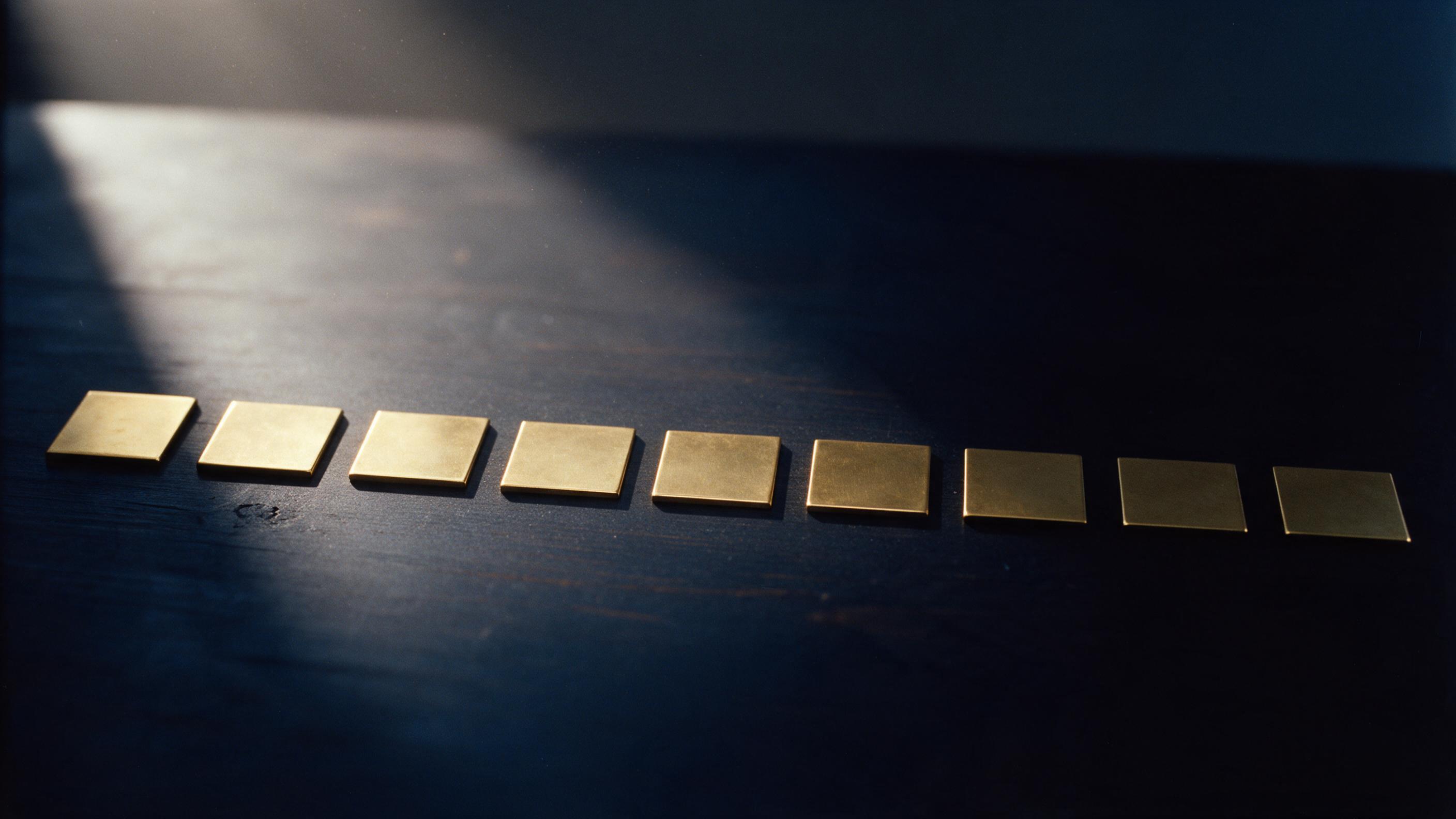
The master template has 9 blocks and they run in 1 fixed order: the identity, the subject and action, the composition, the lens, the lighting, the movement, the mood, the quality anchors, and the negative. 8 shots inherit that shape. Every prompt in the film is the same 9 blocks filled in, which means the prompt is assembled rather than composed. That distinction is the whole method. A composed prompt is written fresh each time, by feel, in the order the moment suggests. An assembled prompt is filled in that order, in the same order, on shot 1 and again on shot 8. The identity block is prepended verbatim when a character is in frame. The subject and action carry 1 clear beat and nothing else - no second idea, no subplot, no look that also happens to be a reveal. The composition carries the size, the angle, the framing and the screen direction. The lens is the locked lens for that beat-group, not a preference. The lighting carries source, direction and quality, with a far-side key wherever a face is lit. The movement carries 1 intention: locked-off, push-in, track, dolly or pull-back, and always slow and deliberate. The mood is 1 line. Then the last 2 blocks hold the line. The quality anchors fix the register: documentary film, 35 mm, natural skin texture, visible pores, unretouched, natural light, negative fill on faces. The negative names the failure modes outright. 18 artefacts, every 1 of them something a model will produce on its own if nobody says otherwise. 1 probability belongs here. The probability that a 1-off prompt holds a consistent frame across 8 shots of the same 2 people is low. The probability that 1 fixed template does is high, and the gap between those 2 numbers is not talent. It is order.
The Identity Line Is Pasted, Never Retyped
There are 2 identity blocks in the film and each 1 is a single verbatim line. She is described once. He is described once. Every character shot carries the block exactly as written, pasted rather than retyped, and the line ends with the same 4 words each time: same face throughout. 4 words do a lot of work. A face drifts because the description is rewritten from memory, and every rewrite is a small negotiation with the model. Change 1 adjective and 40 frames later the person in the frame is somebody else. The block is pasted so that nothing is negotiated at all. Shot 3 carries both blocks because both are in frame. Shot 5 carries 1 because 1 is alone in it. The count follows the frame, and the text does not change when the count does. 1 probability sits under the rule. The probability that a paraphrased identity line produces a recognisable repeat of the same person across a whole film is low. The probability that a pasted 1 does is high, and pasting costs nothing. So the rule is not about craft. It is about refusing to touch a line that already works. Which 1 of your own descriptions gets rewritten every single time you use it?
The Negative Names The Artefacts
The negative block is the longest 1 in the template and it is not a mood. It is a list of named artefacts: glossy, airbrushed, plastic skin, CGI, 3D render, digital painting, over-smooth, beauty filter, uncanny, doll-like, wax figure, cartoon, text, watermark, jittery, fast motion, extra limbs, deformed hands, waxy skin. Each word is there because it happened. Naming a failure mode is what stops it, and the failures cluster into 3 families: the skin family, the fabrication family, and the motion family. The skin family is the model's default polish. The fabrication family is anything added that was never in the frame - text, watermark, a 6th finger, a limb that does not belong. The motion family is speed the scene never asked for. 18 artefacts, on every generation, without exception. That includes the shots where nothing seems likely to go wrong, because the shots that seem safest are the 1s a model will happily over-smooth. The negative also protects the edit. A shot with jitter in it cannot be cut at the pace the film needs, and a shot with over-smooth skin cannot sit next to a documentary-grade frame without both looking wrong. 1 probability closes the argument. The probability that a model defaults to the glossy register when nothing forbids it is high. The probability that it produces waxy skin while the word waxy skin is in the negative is low. The cost of writing 18 words is lower than the cost of 1 reshoot.
One Lens Per Beat-Group, Locked
The arc runs wide to close as it rises, and the lens follows the arc as a set of locked groups rather than as a choice made shot by shot. Shot 1 opens at 24 mm: the empty room, the window light, the floor worn smooth. What follows holds 35 mm across 3 shots - the arrival, the teacher's entrance, the first touch - because a beat-group shot at 1 focal length reads as 1 continuous place. The middle of the film moves to 50 mm for 2 shots, the missed step and the proximity, where the frame tightens around the 2 of them. The last 2 shots move to 85 mm, on the hand and then on the faces, because by then the subject is no longer the room. 4 distances, 4 beat-groups, 8 shots. The lens never changes inside a group. A group that shifts focal length stops being a group and starts being a montage of unrelated frames. The same discipline governs movement. Every moving shot is slow and deliberate and happens in real time, whether it is a push-in, a lateral track, a dolly or a pull-back. Speed is not added later to make a shot feel alive. A shot that needs speed to work was the wrong shot. 1 probability belongs here too. The probability that 8 shots at 8 different focal lengths cohere into 1 film is low, however good each frame looks alone. The probability that 4 locked groups do is high, and the lock is the cheapest decision in the whole pipeline.
9 blocks, 1 order, 8 shots. Nothing is invented at the prompt stage.
Stage Three Chooses Nothing
The film was built in 5 stages: the story, the shot list, the render prompts, the renders, the edit. By the time the prompts are written, 3 of the 5 stages are already decisions taken and closed, and stage 3 is the 1 that transcribes them. Every 1 of the 8 shots was already locked in stage 2 - the size, the angle, the axis, the screen direction, the beat. Every character was already defined in stage 1. So stage 3 invents nothing. It fills 9 blocks per shot, pastes the identity, carries the negative, and stops. That is why the template works at speed. When the prompt is assembled rather than composed, writing 8 prompts is transcription work, and transcription does not need a fresh idea per line. A decision made at the prompt stage is a decision made late, and late decisions are the 1s that pull a film sideways. Stage 4 renders each shot through the video model with the identity block verbatim and the negative on every generation. Stage 5 edits on the 30 degree, 180 degree and match-cut rules, cutting fast, and grades once across the whole film rather than per shot. 1 probability under the whole chain. The probability that a late decision survives a 5-stage pipeline without being contradicted somewhere else is low. The probability that an early 1 does is high, and the template is what makes early decisions stay decided.
The Template Is The Film's Memory
A template that can be rearranged is not a template. It is a suggestion, and suggestions lose to whatever feels right in the moment. The 9 blocks hold the film's memory. The identity blocks remember who is in the frame. The lens remembers what distance the beat belongs at. The negative remembers every artefact that has already burned 1 render. The quality anchors remember the register the whole thing was commissioned in. The same discipline shows up outside a render pipeline. Companies built across twelve countries. 210 energy systems deployed across Africa and Asia. 200 wood-gasification machines built across the UK and Europe. 16 years of field work from rural Nigeria to post-conflict Serbia, Kazan and Fukushima. A book published on 8 April 2026 at 393 pages. 25,000 applications arrive for 25 places in a cohort, and 210 alumni across 19 countries now run the same order in their own work. None of that was assembled by feel. Each 1 of those ran on a fixed sequence, filled in the same order, on the 1st attempt and on the 40th. 1 last probability. The probability that a method survives contact with a real deadline is only as good as the number of steps a person can execute without deciding anything. The template exists so that number is 9. So the next step is small and it is yours. Take the 1 prompt you rewrite most often, and write the 9 blocks it should have been assembled from. Which 1 of your shots keeps getting composed?
The prompt is assembled. It is never composed.
The map is dead. Nobody told you.
Bali State of Mind is the survival guide for the collapse of everything you were taught to believe.
Beyond this book
Building the same thing somewhere else.
Julien Uhlig is available for advisory work, board seats and media appearances. Write to media@exventure.co.
The academy that trains the operators, across every company in the group, is EX Epic Academy - 25,000 applications, 25 seats per cohort, 210 alumni across 19 countries. academy.epicsolutiongroup.com
18-20 November. Online, Las Palmas, Bali.
Three days on what happens to work, capital and institutions when the map stops matching the ground. Seats are limited by cohort.
ex-aisummit.com →