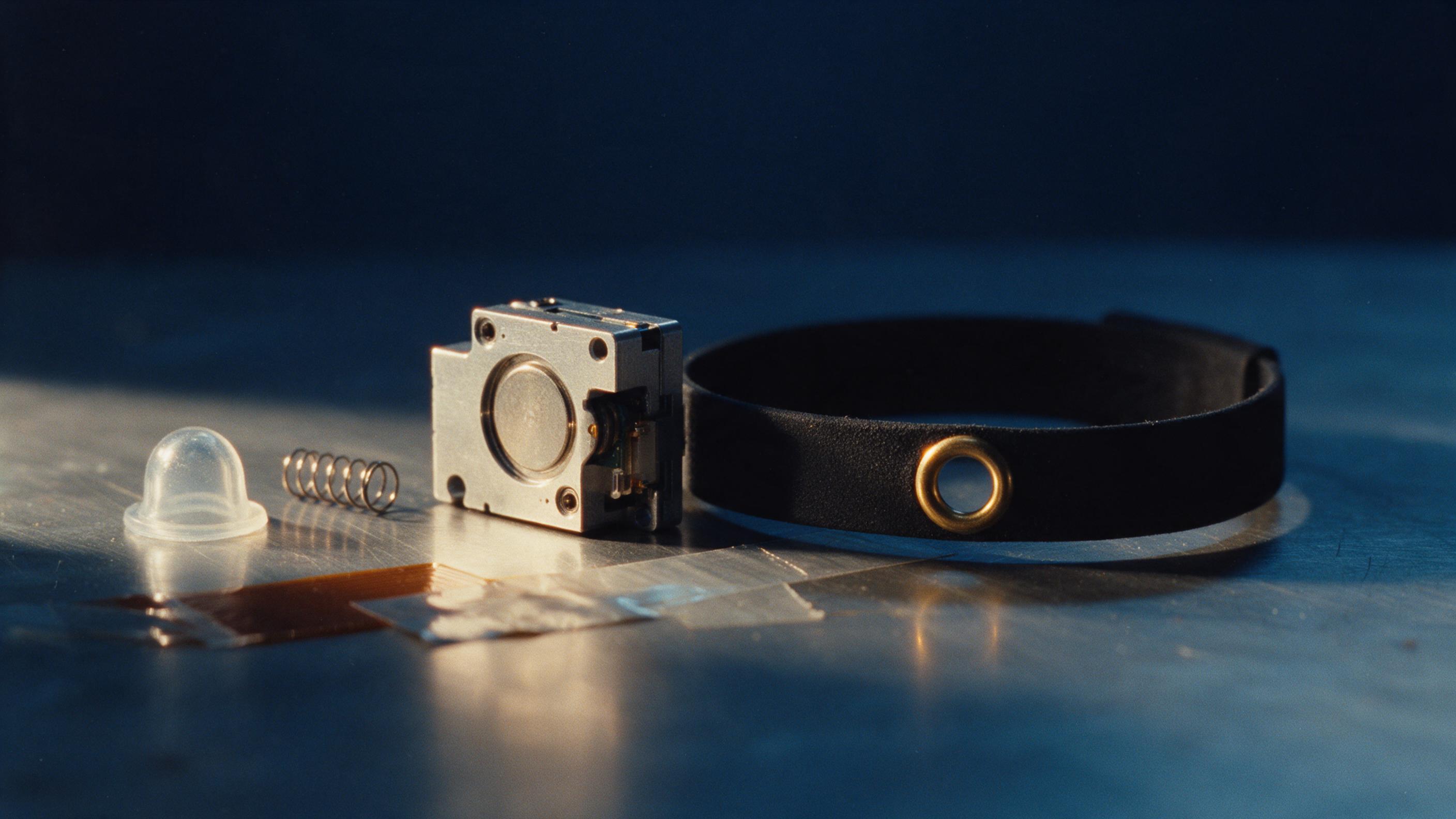
The Market That Will Not Wear A Glove
Phone vibration reaches 100 per cent of devices and plenty of owners switch it off. Controller rumble sits near 80 per cent, controller haptics matter to 30 per cent of virtual reality users, and haptic gloves sit below 0.1 per cent. The market for touch is put at 2 to 5 billion dollars by 2028. The whole category is selling buzz into the largest market it has.
The Largest Market And The Thinnest Experience
Phone vibration has 100 per cent adoption and a large share of owners turn it off. Game controller rumble sits near 80 per cent. Among virtual reality users, 30 per cent say controller haptics matter to them. Haptic gloves, the thing the field keeps pointing at, sit below 0.1 per cent. Read those four numbers in order. Engagement falls as fidelity rises, which is the opposite of what every hardware roadmap in the category assumes. The market for touch is put at 2 to 5 billion dollars by 2028, and most of what ships into it is a buzz. That gap is not a technology problem yet. It is a mismatch between what the feedback costs to add and what the buyer will wear, hold or pay for. Consumer haptics is the largest market for touch technology and the shallowest experience in it, and those two facts are connected. The brain is merciless about a mismatch here in a way it is not about a crude cartoon. Touch is a contact sense wired for safety, so an input that does not match expectation gets read as a fault.
Five Forces And What Each One Costs
Touch carries five channels that matter: vibration, pressure, shear, temperature and compliance. Every actuator on sale buys some of that list, and the price per rung is public. An eccentric rotating mass motor costs about 10 cents and delivers one channel, a buzz. A linear resonant actuator costs about 50 cents and adds frequency and amplitude control. A voice coil costs 2 to 5 dollars and gives broadband force fast enough to feel like a click. A piezoelectric bender costs 3 to 10 dollars and puts the sensation under a trackpad without a moving part. An electrostatic panel costs 5 to 20 dollars and simulates sliding texture on glass, but not pressure. A pneumatic band costs 10 to 50 dollars. An ultrasonic mid-air array costs 50 to 200 dollars and applies weak force to nothing at all. A dielectric elastomer film costs 20 to 100 dollars and is the only entry that plausibly reaches pressure and texture at the same fingerpad. Each rung is roughly linear in cost, and each one buys exactly one more channel. The trouble is that the channels do not add up the way a buyer expects them to.
Why A Glove Cannot Win
To render a cube in the hand, a glove has to apply pressure to the palmar side of every finger touching a virtual face, at the right magnitude, on every frame. That is an inverse problem in real time, and the unknowns include the geometry of the user's own hand. Then texture. Sliding a finger across a virtual surface should produce shear and vibration at the right frequency, and contact area changes as the finger rolls, so the rendering loop has to track it all inside a latency budget the skin will not forgive. Roughly 10 milliseconds is where a mismatch starts to register. Labs solve this at 40,000 dollars a unit and 500 grams a hand. Neither number survives a consumer box. A glove that renders all five forces is a beautiful demo and a bad product, and the failing constraint is not rendering quality. It is the weight sitting on the finger.
The Uncanny Valley Is A Comparison Engine
In vision a stylised cartoon is acceptable. The visual system generalises and the brain fills the gaps. Touch does not grant that licence. A haptic that arrives 20 milliseconds late, or lands on the wrong part of the finger, reads as fake, and some users report a mild disgust response to it. Crude graphics are tolerable. Crude vibration is not. A buzz that does not match the surface feels like an electrical fault, and the user reaches for a switch. That asymmetry sets the bar for every product in the category. The first 30 seconds decide whether the device stays on, and there is no version of this where a user invests 20 hours before the sensation becomes convincing. Every roadmap that assumes a learning curve is pricing in something the buyer will not give it.
Engagement falls as fidelity rises. That is the opposite of what a hardware roadmap assumes.
Four Constraints That No Shipping Technology Meets
The consumer version has to be glove-free, add less than 50 dollars to the bill of materials, land inside the first 30 seconds, and average under 100 milliwatts. Nothing shipping meets all four at once. Ultrasound passes the glove-free test and fails on force. Pneumatics pass the pressure test and fail on weight. Dielectric elastomers pass on cost per channel and are still a laboratory film. Voice coils and piezoelectrics pass on power and cost and top out at vibration. That is why the roadmap keeps producing the same product with a better motor in it. Each vendor optimises one constraint, and the four constraints sit on different engineering axes. My probability that a glove-derived device reaches mainstream consumer adoption by 2030 is under 10 per cent. My probability that a wristband or a controller-mounted actuator at under 30 dollars gets there is nearer 40 per cent, and neither figure is close to a sure thing.
Where The Volume Actually Goes
If you are allocating capital in this category, the volume does not go to the highest channel count. It goes to the cheapest device that is convincing on first contact, which is why the next wave looks like a 20 dollar wristband and a 5 dollar module inside a controller rather than a glove. I have built companies across twelve countries and restructured a 75 million euro industrial group, and the pattern in hardware is consistent. The product that wins is the one the buyer forgets they are wearing. Complexity is a cost centre, not a feature, and a device the user takes off after 10 minutes has sold nothing. The glove will still ship, for training, surgery rehearsal and defence, at 5,000 to 40,000 dollars a unit, where accuracy beats comfort and the buyer is an institution. Consumer touch will be won by whoever makes the cheapest thing that feels real in half a minute. Those are two different markets wearing one name, and only one of them deserves a consumer roadmap.
Every rung of the ladder costs more and buys one more channel. The channels do not add up.
The map is dead. Nobody told you.
Bali State of Mind is the survival guide for the collapse of everything you were taught to believe.
Beyond this book
Building the same thing somewhere else.
Julien Uhlig is available for advisory work, board seats and media appearances. Write to media@exventure.co.
The academy that trains the operators, across every company in the group, is EX Epic Academy - 25,000 applications, 25 seats per cohort, 210 alumni across 19 countries. academy.epicsolutiongroup.com
18-20 November. Online, Las Palmas, Bali.
Three days on what happens to work, capital and institutions when the map stops matching the ground. Seats are limited by cohort.
ex-aisummit.com →