The Magnet Is Under The Skin
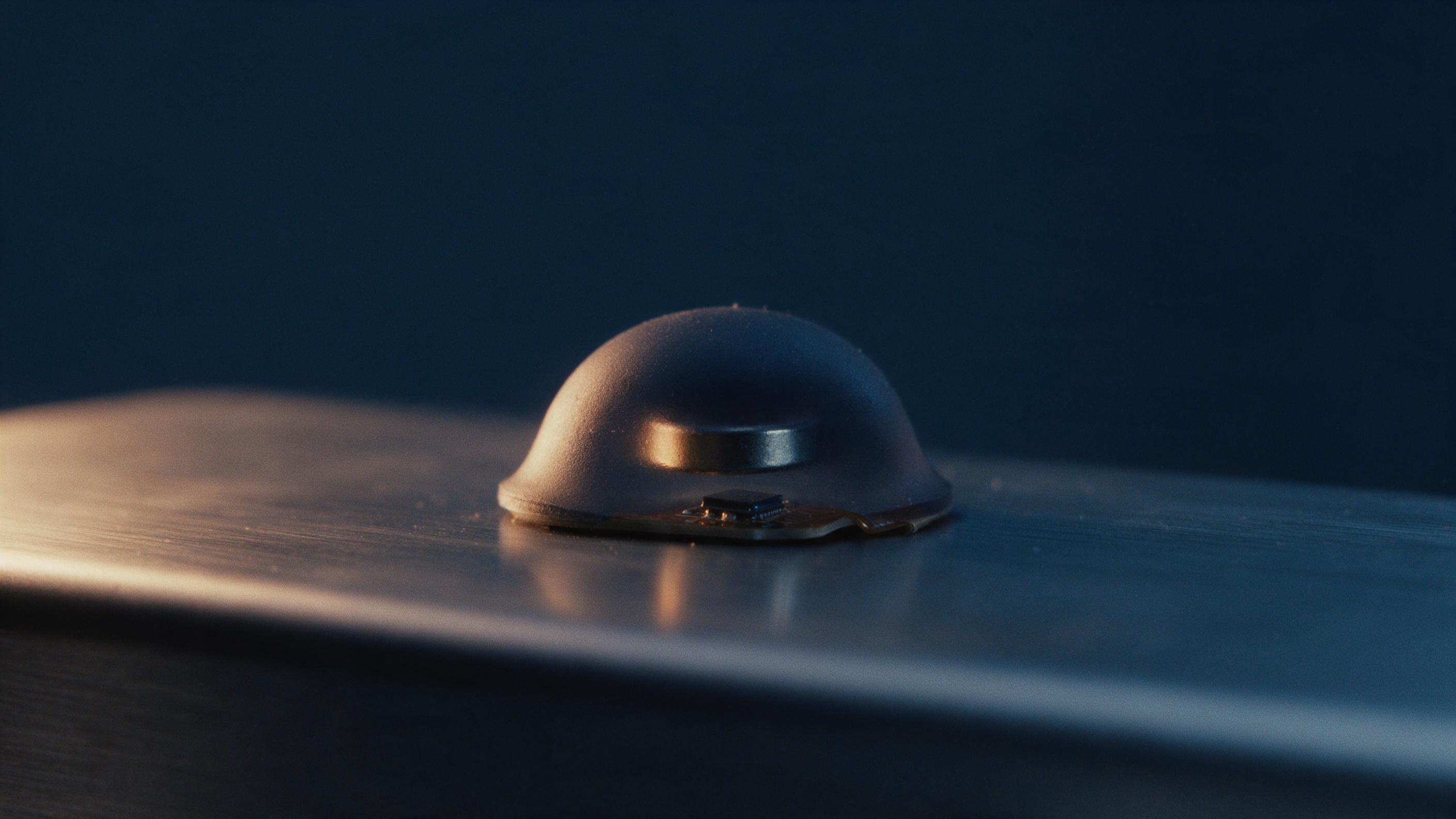
A magnetic tactile sensor buries a magnet in the elastomer and reads its displacement from a chip sealed underneath, so nothing electrical ever touches the contact surface. One element returns three axes of force, 0.01 to 10 newtons normal against 0.01 to 5 shear, from DC to 1 kilohertz. The ladder runs from a Hall chip at 0.1 millitesla, 0.01 newtons and 5 milliwatts in 1 by 1 millimetre, to a fluxgate at 0.0001 millitesla and 100 milliwatts in 10 by 10 millimetres. The price is resolution: 3 to 10 millimetres per element, and 10 to 15 millimetres of spacing in an array.
The Chip Sits Underneath
Every other tactile sensor puts its active material at the contact surface, so the surface is the part that wears out. Magnetic sensing inverts that. A permanent magnet is dispersed into a soft elastomer and cast as a dome or a layer over the skin. NdFeB microparticles in PDMS or Ecoflex are the standard recipe. Underneath that dome, sealed away from contact, sits a magnetic field sensor: a Hall chip, an anisotropic magnetoresistive part, a tunnelling magnetoresistive part or a fluxgate. When a force arrives, the magnet moves. The magnet does not need to report anything itself, because the chip under it reads the displacement as a change in the field vector. Displacement in three directions maps to three components of field change, delta-Bx, delta-By and delta-Bz. With calibration the three components decouple. The z-component change carries normal force and the in-plane gradients carry shear. Nothing at the contact interface is electrical, and that is the point: the elastomer and its magnet load take every scratch, every solvent and every abrasive particle while the electronics stay protected underneath. No percolation network fatigues. No fragile surface microstructure collapses. Cast magnet-doped PDMS over an off-the-shelf chip and the sensor exists.
Three Axes From One Element
A single magnetic element returns the full force vector, and the numbers are worth writing out. Normal force covers 0.01 to 10 newtons. Shear covers 0.01 to 5 newtons. Bandwidth runs from DC to 1 kilohertz, which means the same element measures a static load and a vibration without switching modes. Hysteresis is low, because the return of a magnet in an elastomer is elastic rather than structural. That combination is the trade being made. Most designs get three axes by stacking layers or by mounting three separate transducers at one point. The magnetic element gets all three from the geometry of one displacement, which removes the stacking, the alignment and the cross-talk between the layers. It also collapses the bill of materials to two parts. A magnet and a chip. The calibration is where the work moves. The three field components have to be separated, and the separation holds only as long as the magnet stays centred under its chip. A design that lets the magnet drift under load does not lose accuracy. It loses an axis.
The Sensor Menu Is A Price Ladder
Four readout types are available and the ladder is steep. A Hall effect element at 3 axes resolves about 0.1 millitesla with a force resolution of 0.01 newtons, in a package around 1 by 1 millimetre, drawing about 5 milliwatts. It is the common and cheap option. An anisotropic magnetoresistive part reaches 0.01 millitesla and 0.001 newtons, in roughly 2 by 2 millimetres, at about 3 milliwatts. A tunnelling magnetoresistive part reaches 0.001 millitesla and 0.0001 newtons, in about 3 by 3 millimetres. A fluxgate reaches 0.0001 millitesla and 0.00001 newtons and draws about 100 milliwatts in a package near 10 by 10 millimetres, which is why it is laboratory grade and impractical in an array. Read that as a purchasing decision. Ten thousand times the field sensitivity of a Hall chip costs roughly twenty times the power and a package one hundred times the area. For a fingertip with an array of elements, the power budget and the footprint kill the fluxgate on line one. Most products land on the Hall chip. The magnetic architecture is not bought for sensitivity. It is bought for protection and three axes.
The Price Is Resolution
The magnet is the limit, and it is a physical one. Each element occupies 3 to 10 millimetres, set by the size of the magnet and the chip that reads it. That is the resolution of the element, not of the electronics. In an array the constraint tightens further. Adjacent magnets interfere with each other's fields, so elements have to be spaced at more than 10 to 15 millimetres unless magnetic shielding is placed between them. Shielding between elements costs area, material and process steps, and it buys back only what the first spacing rule gave away. Compare that with capacitive and optical approaches, which reach sub-millimetre taxel spacing. A magnetic skin will not match them, and no improvement in the readout chip changes that, because the geometry of a magnet plus a sensing chip sets the floor before any electrical decision is made. So the honest specification reads: an element that senses force in three axes at 3 to 10 millimetres, not a pressure map at a fraction of a millimetre.
The chip never touches anything. The compliant surface takes all the wear.
Motors Lie To It
The failure mode of a magnetic sensor is not mechanical. It is the room it works in. Motors, current-carrying wires and ferromagnetic objects all distort the field the sensor is reading. On a robot arm the nearest motor is centimetres away and the nearest cable runs alongside the skin. System-level shielding or differential pairs are not optional refinements here. They are the difference between a measurement and a number. Temperature does the second half of the damage. Magnet remanence drifts about 0.1 per cent per degree, and the sensitivity of the readout chip drifts with temperature too, so the two errors move together instead of cancelling. Precision work needs active temperature compensation. There is also ageing. NdFeB particles can demagnetise under high temperature or under a reverse field, and a sensing element whose magnet has partly demagnetised does not fail. It reads low. The practical fix is the pair. Two identical elements wired differentially share the disturbance and cancel it in the difference, which is why the strongest magnetic skins are sold as pairs and the weakest are sold as single elements with a shielding claim attached.
Where It Wins And What It Costs
The applications are the ones where the contact surface has to survive. Robot fingertips, particularly where optical sensors would be contaminated by oil or dust. Prosthetic hands in daily use, where robustness and three axes matter more than resolution. Surgical tools, which can be made sterile and MRI-safe if every component is non-ferromagnetic, with three-axis force sensing at the tip. Collision detection in human-robot interaction, where normal force alone cannot tell a contact from a slide. Three variants are emerging. Liquid-metal magnets suspend magnetic particles in a gallium alloy and remove the elastomer fatigue problem entirely. Magnetic micro-pillars scale the magnet side down to micron dimensions to close the resolution gap. Hall sensor arrays, an 8 by 8 grid of readouts under one large magnet, recover spatial information from several readout points instead of one. The probability that a magnetic skin reaches a fingertip's sub-millimetre spacing is close to zero. The probability that it is still working after five years of a hand that knocks against everything is not zero, and most procurement sheets price that second number at zero. I have built companies across twelve countries and restructured a 75 million euro industrial group. The rule is the same every time. Reliability is a line item or it is a surprise.
One element returns three axes of force. That is the whole trade.
The map is dead. Nobody told you.
Bali State of Mind is the survival guide for the collapse of everything you were taught to believe.
Beyond this book
Building the same thing somewhere else.
Julien Uhlig is available for advisory work, board seats and media appearances. Write to media@exventure.co.
The academy that trains the operators, across every company in the group, is EX Epic Academy - 25,000 applications, 25 seats per cohort, 210 alumni across 19 countries. academy.epicsolutiongroup.com
18-20 November. Online, Las Palmas, Bali.
Three days on what happens to work, capital and institutions when the map stops matching the ground. Seats are limited by cohort.
ex-aisummit.com →