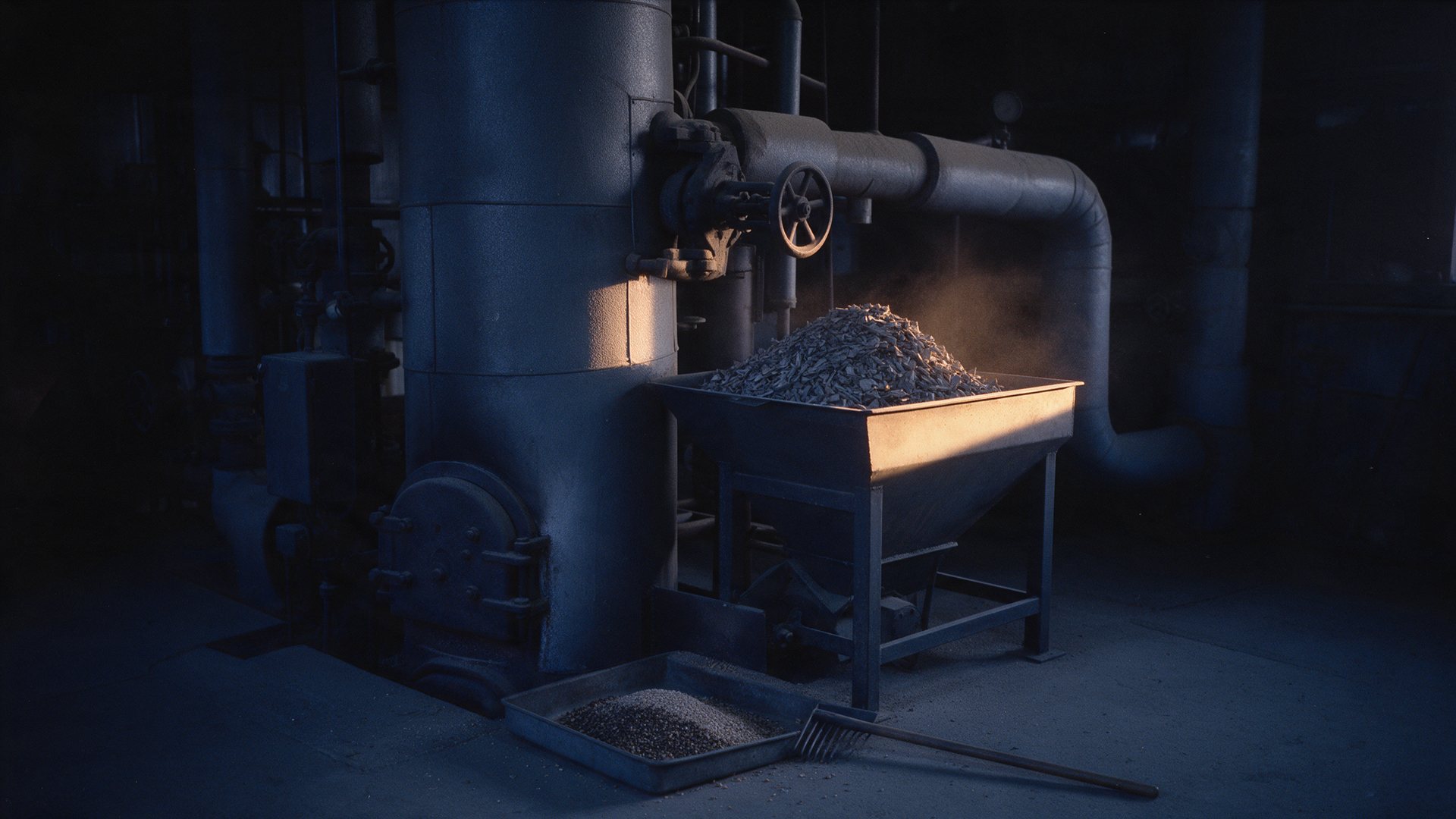
The Machine That Eats Anything
A downdraft gasifier eats wood chips up to 51 millimetres. An entrained flow reactor eats coal ground below 0.15 millimetres at 1,600 degrees. Both make gas. The pile decides which machine you are allowed to buy.
The Pile Is Not One Fuel
Every waste stream is a fuel. Water, ash, particle size and how much of the carbon is already oxidised decide which machine can eat it. A wood chip at 15 per cent moisture, a tonne of food waste at 80 per cent, a bale of straw, a shredded mattress and a barrel of refinery off-gas are all carbon carriers. They are not the same feedstock. There are four machine families in commercial use because no single design handles that range. A downdraft gasifier will not run on slurry. An entrained flow reactor will not run on a 400 millimetre log. The machine that eats anything does not exist. The machine that eats your pile does.
The Machine For The Small Farm
Fixed bed is the workhorse below a megawatt. In a downdraft fixed bed the fuel and the gasifying agent move through the bed in the same direction. Wood chips up to 51 millimetres go in. Ash has to stay under 5 per cent or it slags, and feed moisture has to stay under 20 per cent or the bed cools and the gas stops forming. What comes out carries 10 to 20 per cent hydrogen, 20 to 25 per cent carbon monoxide and 1 to 5 per cent methane, with tar under 50 milligrams per normal cubic metre in the best cases. It is cheap, it is tolerant of dirty fuel, and it stops at about 500 kilowatts of electrical output. Beyond that diameter, moving a packed bed through a hot zone stops being predictable. South Tyrol installed roughly 50 of these plants from 2011 onwards. Hundreds more run across Germany and Austria. Burkhardt in Germany, ESPE and CMD in Italy, HoSt in the Netherlands and Eqtec in Ireland all build in the 20 to 200 kilowatt band. Small is not a downgrade. It is the size the physics allows.
The Machine That Floats The Fuel
A fluidized bed suspends the fuel in a rising stream of air, oxygen or steam. The bed behaves like a liquid, heat transfer is uniform, and particle size stops mattering much. Six millimetres instead of five centimetres. The range is 0.5 to 50 megawatts thermal. Steam blowing reaches over 50 per cent hydrogen in the dry gas with a hydrogen to carbon monoxide ratio of 2 to 3, which is ready for synthesis into fuel or methanol. The price is tar at 500 to 3,000 milligrams per normal cubic metre and a gas cleaning train that has to remove it. The commercial record is real. GoBiGas in Gothenburg ran 21 megawatts thermal on wood chips from 2014. Kymijarvi II at Lahti has run 112 megawatts thermal on municipal waste and waste wood since 2012. Sumitomo SHI FW has run an oxy-steam fluidized bed at Varkaus in Finland since 2010, above 10 megawatts thermal. The fluidized bed market for biomass was put at 2 billion dollars in 2025, going to 4 billion by 2033 at about 8 per cent a year. The machine scales. The gas cleaning is what you buy with it.
The Machine That Will Not Tolerate A Fibre
Entrained flow is the cleanest gas in the family and the least forgiving. Fuel ground below 0.15 millimetres is blown with oxygen at 20 to 80 bar into a reactor at 1,200 to 1,600 degrees Celsius. Carbon conversion passes 99 per cent. Tar comes out under 1 milligram per normal cubic metre, the lowest of the four designs. Ash leaves as slag. It is also the design that biomass fits worst. Grinding fibrous wood below 0.15 millimetres costs more energy than the fuel will return, moisture has to be driven off before the fuel can be fed at all, and the economics only close above 50 megawatts thermal. Coal entrained flow sits at readiness level 9. Biomass entrained flow sits at 6 to 7, with the University of Utah, Linde and Ensyn running a Department of Energy pilot on biomass and plastic slurries. The most advanced machine in the family is the one the feedstock hates most.
The machine that eats anything does not exist. The machine that eats your pile does.
The Machine That Runs On Electricity
A plasma torch runs between 4,000 and 7,000 degrees Celsius and breaks down whatever is pointed at it, including mixed municipal waste and hazardous material. The slag leaves vitrified and inert. Tar is negligible. The bill is electricity, 0.5 to 1 kilowatt hour per kilogram of feed, which is 500 kilowatt hours on a tonne. No plant in this family closes on the value of its gas. It closes on the gate fee it is paid to take the waste away. That is a disposal business wearing a gasifier. Deployment is thin and it has been thin for twenty years. Japan runs the Utashinai plant and a handful of demonstration units. Readiness sits at 5 to 7. Every gasifier that takes waste for money is a waste business. Only some of them are energy businesses.
What Each Machine Costs To Build
Per kilowatt, the four families line up in a fixed order. Fixed bed costs EUR 1,000 to 3,000. Fluidized bed costs EUR 2,000 to 5,000. Entrained flow costs EUR 3,000 to 8,000. Plasma costs EUR 5,000 to 15,000. Readiness runs in the same direction. Fixed bed is at 9 and has been for decades. Fluidized bed is at 8 to 9. Entrained flow is at 9 on coal but 6 to 7 on biomass. Plasma is at 5 to 7. The cheapest machine is the proven one, and the most expensive is the least proven. That ordering holds across every catalogue in the sector, and it is not a coincidence. Capex tracks how much of the design is still being learned. The purchase decision is not which machine is best. It is which machine is finished.
The Gap At One Megawatt
Below one megawatt, almost the entire commercial fleet is air-blown fixed bed. Nothing in it runs oxy-steam. Oxy-steam replaces air with oxygen and steam. Nitrogen leaves the gas, hydrogen rises above 30 per cent, and the syngas becomes something a Fischer-Tropsch or methanol unit can use directly without a nitrogen separation step. At small scale it sits at readiness 5 to 7, and the blocker is the oxygen supply. A 500 kilowatt thermal oxy-steam gasifier consumes 0.3 to 0.5 kilograms of oxygen per kilogram of biomass. Pressure swing oxygen at that size costs EUR 50 to 80 a tonne, which adds EUR 0.015 to 0.04 to every kilogram of biomass processed. On a small plant, that is the margin. Gabbrielli and colleagues modelled biomass and sewage sludge oxy-steam gasification with methanation below one megawatt in Applied Energy in 2022, at 0.25 to 0.35 normal cubic metres of methane per kilogram of biomass. Di Bisceglie and colleagues modelled the AIRE project in Energies in 2025. Both sit at model and pilot. A gap that has been open for a decade is either an opportunity or an answer. This one has been open because of the oxygen bill.
The Decision Rule
What is moving now is not a new reactor. It is everything around one. Machine learning runs real-time optimisation of gasifier operation, reviewed by Kumar and colleagues in Sustainable Energy and Fuels in 2025. Chemical looping gasification replaces pure oxygen with an oxygen carrier and sits at readiness 4 to 5, which removes the oxygen cost entirely. Ceramic candle filters clean tar and particulate above 400 degrees Celsius at readiness 6 to 7, and that is the point where the gas cleaning train stops being the largest line in the plant budget. IEA Bioenergy Task 33 tracks more than 135 operational or planned gasification plants across its member countries. Entrade built 200 wood-gasification machines across the UK and Europe before the market moved. The machines worked. The measurement did not. The order of operations is fixed. Measure the pile first, because moisture, ash and particle size decide which machine can eat it at all. Then price the machine per kilowatt, because the cheap ones are the finished ones. Then price the gas against what it displaces, because a gasifier that makes gas nothing wants is a furnace with extra steps. The probability that a project fails because somebody bought the wrong reactor is not zero. Most of them are priced before the feedstock has been measured once. Every waste stream is a fuel. The machine is a decision.
The cheapest machine is the proven one, and the most expensive is the least proven.
The map is dead. Nobody told you.
Bali State of Mind is the survival guide for the collapse of everything you were taught to believe.
Beyond this book
Building the same thing somewhere else.
Julien Uhlig is available for advisory work, board seats and media appearances. Write to media@exventure.co.
The academy that trains the operators, across every company in the group, is EX Epic Academy - 25,000 applications, 25 seats per cohort, 210 alumni across 19 countries. academy.epicsolutiongroup.com
18-20 November. Online, Las Palmas, Bali.
Three days on what happens to work, capital and institutions when the map stops matching the ground. Seats are limited by cohort.
ex-aisummit.com →