The Line You Do Not Cross
A shot list is not a checklist of camera positions. It is a language with a small alphabet and a strict grammar, and it runs on three dials: how close the camera stands to someone's inner life, who holds the power inside the frame, and which side of the room you are allowed to shoot from. Get the third one wrong and the audience is lost in a scene they can see perfectly.
Size Is How Close You Stand To Someone's Inner Life
There are 8 shot sizes and no reason to invent a ninth. Extreme wide makes a figure small against a place, and its meaning is scale, isolation, the world itself. Wide carries geography and action. Full shows a character inside their own space. Medium wide takes the frame to the waist or the knees, which leaves body language and some context in the same shot.\n\nMedium is the conversational default, waist up, the size a person actually holds in your attention across a table. Medium close-up sharpens that attention to the chest. Close-up lets the frame be filled by a face, and it is where a performance is finally read. Extreme close-up holds one eye, one hand, one detail, and it is the tell.\n\nThe progression is the grammar. A scene almost always moves closer as the emotion rises: wide to establish the room, close to land the feeling. Run that backwards and the audience feels a scene retreating at the exact moment it should be leaning in.\n\nThe cut is where the meaning is made. A jump from wide straight to extreme close-up is a punch. A slow drift through medium close-up, close-up, extreme close-up is a seduction. Same 3 sizes, opposite feeling, decided by the order and the speed and nothing else.
Angle Is The Power Relationship
The second dial is where the camera stands. Eye level sits at the subject's eye line and reads as neutral, equal, an audience standing beside someone rather than over them. It is the default and it earns the most screen time, because a scene shot entirely at eye level feels like a conversation and not like a verdict.\n\nHigh angle looks down and makes a person small, vulnerable, subject to something larger than themselves. Low angle looks up and makes them large, dominant, a problem the audience cannot get around. The canted frame tilts the horizon and says the world is off, which is a statement about reality rather than about the character.\n\nOver-the-shoulder puts the audience inside the exchange. Point of view is total subjectivity, the camera wearing a character's eyes, and it costs the audience their own position in the room, so it is spent deliberately or not at all.\n\nThe working rule is short. Deviate from eye level only when the power has to shift, because every deviation is a claim. Reserve the tilted frame the way you reserve roll: it lands once, in the moment the ground under the story actually moves. Inception spent it in 2010 and made it mean something by refusing to spend it again.
The 180 Degree Line Is Not A Preference
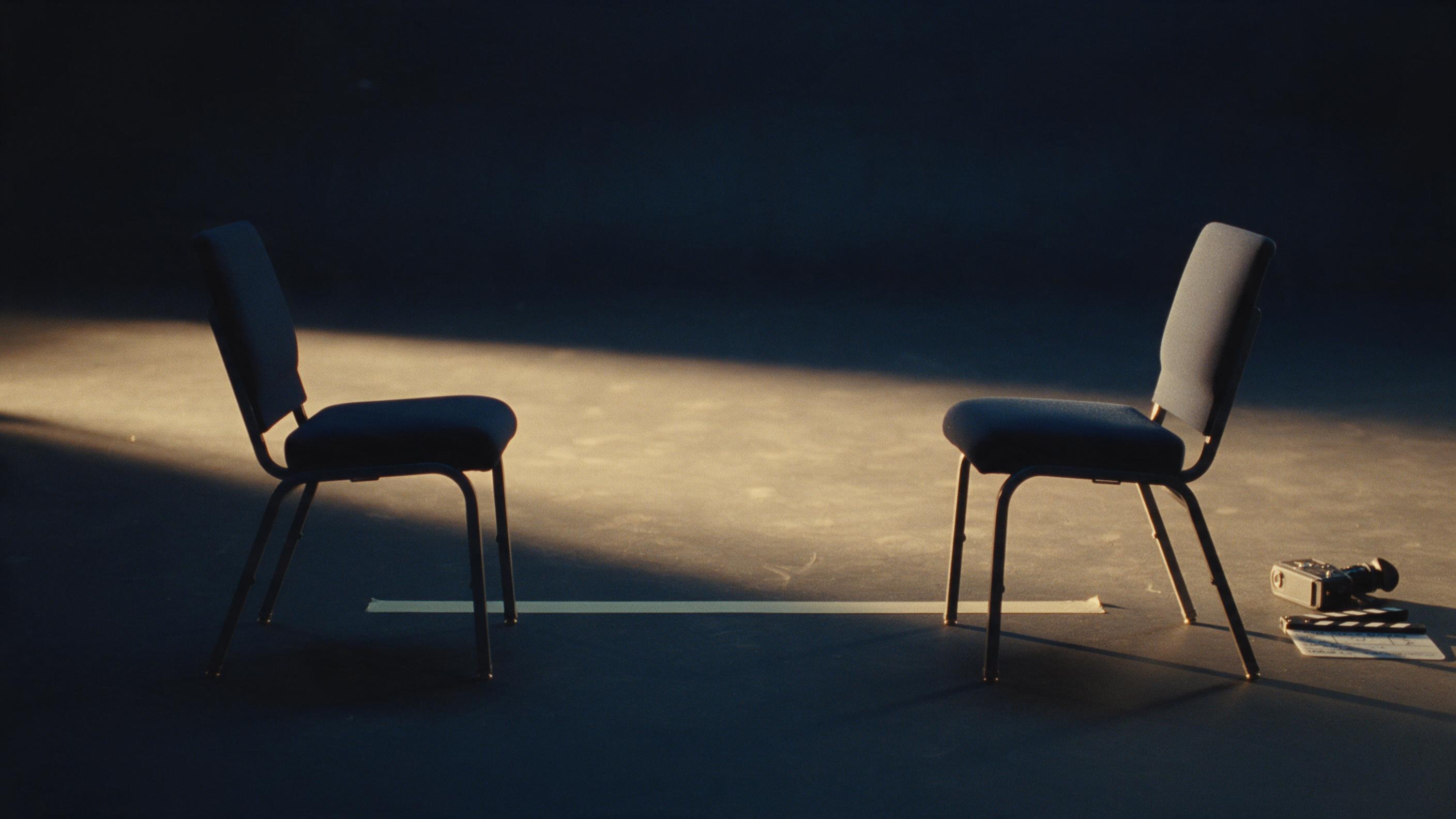
Draw an imaginary line through the two people in the scene. That is the line of action. Keep the camera on one side of it for the whole scene and screen direction holds: the first character always looks left, the second always looks right, and the geography of the room stays solved in the audience's head without them ever noticing it was solved.\n\nCross that line and the first character flips sides mid-conversation. The audience is suddenly lost in a room they can still see perfectly. Nothing about the lighting or the performance has changed, and the scene has stopped working, which is why this is the one rule a beginner breaks without knowing they broke anything.\n\nA 180 degree arc is the legal territory, and there are exactly 2 ways to leave it. Walk the camera across inside one continuous move, so the audience travels with it and re-solves the room on the way. Or insert a neutral shot, a cutaway or a straight-on frame, which re-establishes the new side before the exchange resumes.\n\nWhat is never legal is a jump cut across the line. The audience is handed a teleport with nothing to walk across and no landmark.\n\nOn a stitched sequence the same discipline applies per shot. If the first frame puts her on the left of the screen and the second puts her on the right, the edit will not flow no matter how good either frame looks on its own. One 180 degree frame that reads correctly beats 10 beautiful frames that disagree with each other.
Eyelines And The 30 Degree Rule
A scene is held together by 2 quiet rules, and neither of them is visible when it works. The first is the eyeline match: where a character looks has to match where the thing actually is, and the reverse shot has to look back from that direction. If she looks off screen right at a door, the frame containing the door must carry the look back. Break it and the scene snaps.\n\nThe second is the 30 degree rule. Between 2 shots of the same subject, move the camera at least 30 degrees, or the cut reads as a jump cut, which the audience experiences as a stumble. Two close-ups of the same face from nearly the same position do not read as a new angle. They read as a mistake, and the audience cannot tell you why the scene felt cheap.\n\nBoth rules survive into the edit, which is the point. They are not shooting conventions that a good cutter rescues later. They are the reason the footage can be cut at all, and the reason a scene assembled from 40 minutes of coverage still lands in the order the director intended.
Wide establishes. Close lands the feeling. Everything between them is a dial.
Coverage Is The Plan, Not The Insurance
Coverage means shooting the scene from enough positions that it can be cut afterwards, and the standard kit is 4 legs. The master is a wide of the whole scene: it carries the geography, it is the safety net, and it is the frame everything else is matched against.\n\nThen 2 over-the-shoulders, one per character, which carry the conversation across the line. Then the singles and close-ups, one per character, which carry the emotion. Then inserts and cutaways, a hand, a letter, a clock, a door, which carry the texture and quietly buy every edit in the scene.\n\nThe shot list is the plan, and coverage is decided in 20 minutes on paper and paid for in 12 hours on set. A scene is covered when it can be cut a dozen ways without breaking the line or an eyeline. That is the test, and it is a test you can run before a camera is ever switched on.\n\nInserts and cutaways are the cheapest part of the day and the most beautiful part of the film, and they are the first legs cut when the schedule slips. That is why the scene afterwards has no texture and no exits.
Name The Size And The Angle, Or The Model Chooses
For anyone writing this into a prompt, the failure mode is arithmetic. A generative model has one default: medium shot, eye level, centred. If the size and the angle are not named, that default comes back every single time, and a film made of 20 identical framings has no rhythm at all, however beautiful the individual frames are.\n\nThe fragments that work are the plain ones. Extreme wide establishing shot, tiny figure in a vast landscape. Full shot, head to toe. Medium shot, waist up. Close-up, face filling frame. Extreme close-up on the eyes. Then the angle: eye level, neutral. High angle, looking down, making her small. Low angle, looking up, dominant. Dutch angle, tilted horizon, uneasy. Over-the-shoulder shot. Point of view, seeing through her eyes.\n\nFocal length pairs with size, and the pairs are known. A 32 to 35 mm lens for the over-the-shoulder, a 50 mm for the close-up, a 65 to 75 mm for the big close-up, because each one delivers the frame the size promised.\n\nThen hold the 180 degree side across the whole stitched sequence. Each model call is blind to the others, so the line is the one thing the operator has to carry by hand from frame to frame.\n\nThe sequence runs in the same order every time. What is the geography, so where is the line. What is the emotional arc, so which sizes. Whose power is it, so which angle. What coverage, so what is on the list. Will it cut, so does the line hold and does the eyeline match. Five questions, then anyone can shoot it.\n\nThe probability that an unnamed shot list cuts together is close to zero, and the probability that it reads as intention rather than accident is lower still. The probability that a named one cuts is the entire reason coverage exists. Sixteen years of field work across rural Nigeria, post-conflict Serbia, Kazan and Fukushima taught the same thing outside film: the plan is what survives contact with the day, and the instinct is what you fall back on when there is no plan. The book that came out of 12 countries of building runs 393 pages, published 8 April 2026, and every one of them was assembled one named decision at a time. Name the size. Name the angle. Stay on your side of the line, and the audience never gets lost.
Eye level is neutral. Every deviation from it is a claim about power.
The map is dead. Nobody told you.
Bali State of Mind is the survival guide for the collapse of everything you were taught to believe.
Beyond this book
Building the same thing somewhere else.
Julien Uhlig is available for advisory work, board seats and media appearances. Write to media@exventure.co.
The academy that trains the operators, across every company in the group, is EX Epic Academy - 25,000 applications, 12 per cohort, 200+ alumni across 19 countries. academy.epicsolutiongroup.com
18-20 November. Online, Las Palmas, Bali.
Three days on what happens to work, capital and institutions when the map stops matching the ground. Seats are limited by cohort.
ex-aisummit.com →