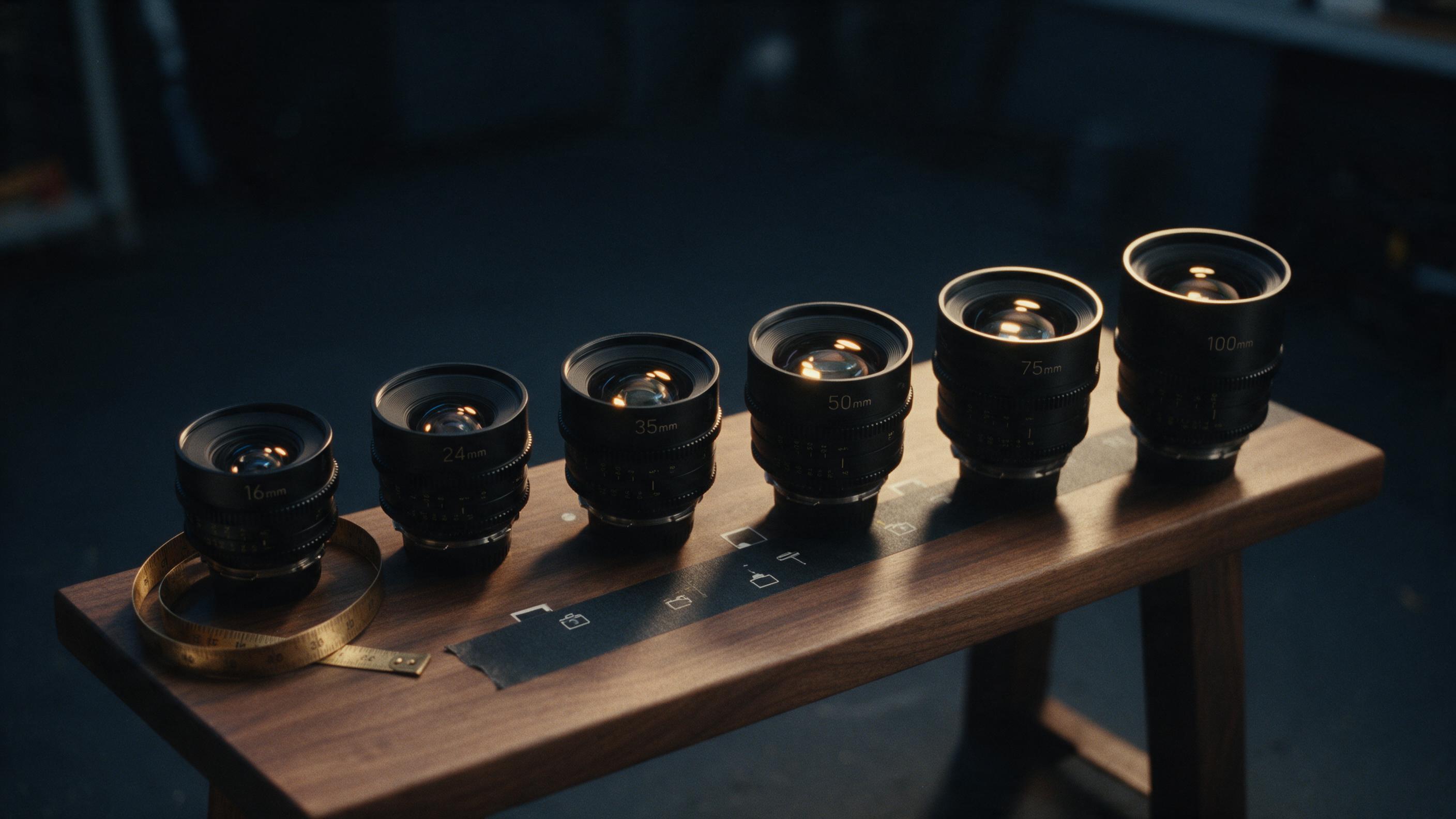
The Lens Is A Decision
A lens is chosen at the moment of maximum ignorance and it governs everything that arrives afterwards. It fixes how much of the world is in the frame, how close the viewer stands to the person in it, and whether the space behind that person reads as depth or as a flat wall. All of it is decided before the first light is placed, and none of it can be fixed later. That is why the choice is psychological before it is technical, and why convenience is the worst of the available reasons.
The Decision Made Before Anything Is Lit
Every lens is one question wearing equipment: whose eyes is the audience borrowing, and how does the world look from there. A 14 to 35 millimetre lens makes space feel larger than it is. A 40 to 50 millimetre lens makes the framing disappear. A 65 millimetre and beyond makes the world arrive flat and puts the subject inside a frame of its own.\n\nNone of that is visible on a spec sheet, and all of it is felt. The viewer never learns the number. The viewer learns whether they are standing inside the room or watching from a doorway, and that is a decision the director made while the set was still empty.\n\nThis is the part that gets skipped when a production is running late. The lens is the cheapest decision on the day and the most expensive one to get wrong, because it cannot be corrected in the grade, in the edit, or by any amount of money spent after lunch. The frame is chosen at the exact moment when the least is known about what the frame will contain.
The Table Is Narrow And It Does Not Negotiate
There are three working families and the useful range inside each one is small. Wide runs 14 to 35 millimetres. Normal runs 40 to 50, which is the band that matches the roughly 40 degree foveal view of the human eye, with a 50 millimetre landing at about 39.6 degrees. Long starts at 65 and runs past 200.\n\nThe three do not blend into a smooth curve. Each one makes an argument. Wide says the world is bigger than the person in it and worth more attention. Normal says the world is simply true. Long says the person is the only thing left.\n\nThe working shortcuts fit on a card. A 24 to 35 millimetre lens says show me the world. A 50 says natural conversation. An 85 and above says isolate this person. One cinematographer's entire kit may live between 32 and 75: over-the-shoulder at 32 or 35, mid-shot at 35 or 40, standard close-up at 50, big close-up at 65 or 75, and portraits at 60 to 70 and never longer. Another shoots a feature almost entirely at 12 to 15 millimetres on a large-format body. Both are correct. Only one of them is correct for the film in hand.
The Physics Is Distance, Not Optics
People explain the wide lens by talking about glass. The truth is about standing. A 14 millimetre lens cannot fill the frame with a face from across the room, so the camera has to move in close. At that distance the background is proportionally much further away than the subject is, and the relative gap between the two is what reads as depth. The exaggeration is a consequence of where the camera had to stand.\n\nThe long lens runs the same mechanism backwards. The camera steps back to fit the subject, the distance between subject and background collapses into proportion, and the space flattens. Faces read fuller, the background melts into soft colour, and everything in the frame appears to occupy one plane.\n\nCompression also changes time, which is the part most often missed. A runner sprinting toward a long lens never seems to arrive, because each stride produces almost no change in apparent size. On a wide lens the same runner closes the gap in seconds. And the trade is not free: doubling the focal length drops depth of field to roughly a quarter, so the same shot on a longer lens loses its background whether or not anyone wanted it lost.
Two Decisions Before The Camera Rolls
A fixed focal length forces two choices before anything starts. Where does the camera stand, and what is on it. A zoom lets both of those be postponed, and postponement is almost never deliberation.\n\nThe distinction is simple. Moving the camera changes perspective, because perspective is a function of position. Zooming only magnifies, because the camera has not moved and the geometry of the scene is untouched. Punching in on a 100 millimetre to grab a close-up that should have been a dollying move on a 50 will produce the magnification and none of the meaning.\n\nA zoom belongs on a shot that is itself a zoom. It does not belong on a schedule. Where the convenience is weighed against the perspective the piece demands, the perspective is the deciding factor and the schedule is the thing that bends. That is the discipline. It is also the reason a kit of primes produces better work than a kit of zooms at the same price, since the primes remove an option that was never going to be used well.
A lens is chosen at the moment of maximum ignorance.
Perspective Belongs To A Person
When a film lives inside one character's point of view, the lens plan follows from a single rule. Shoot the character whose eyes the audience is borrowing on the wider lens, and shoot everyone they talk to on a longer one. The main character anchors the world because they are standing in more of it. The other person features less, and recedes a little with each cut.\n\nNo line of dialogue explains this. The audience simply ends up feeling that one person is larger in the story, and they will not be able to say why.\n\nThe same principle explains why a huge amount of modern production ends up feeling like nothing in particular. When the instruction is to photograph everything and choose in the edit, every shot is shot on the same safe middle length and the film has no point of view because nobody chose one. Some of the most durable work in the medium was shot the other way: one director, one shot, tracked out through a doorway into a wide emptiness, chosen in advance and never covered from a second angle.
One Lens, Held For The Whole Thing
The hardest case is the piece that cannot change lenses at all, because it is one continuous take and continuity is the whole point. There the choice has to be right the first time, and it is made against the format rather than against a table.\n\nThe instructive answer was a normal lens on a large-format sensor, about 40 millimetres on a body that makes it behave like 42. It reads wider than it is, so a single take never feels like standing on a stage, while keeping slightly less depth of field than a true wide would, so the background falls away just far enough to keep the person from being swallowed by the room.\n\nThat is the move worth stealing. When the lens cannot change, change the character of the lens by putting it against a different sensor, and let the format carry the part the focal length cannot.\n\nThe same logic sets the limit on artifacts. Flare, vignetting and focus breathing are defects that arrive uninvited, and on a long static take they are unforgivable. But the same tools, used on purpose and built to spec, can carry a whole sequence: a clear centre, edges deliberately smeared, the frame softening at the corners as if remembered rather than seen. The rule is not clean or dirty. It is chosen or accidental.\n\nThe probability that most of the difference between a memorable frame and a competent one is settled before the camera turns over is high, and the evidence is that almost nobody remembers a zoom and almost everybody remembers a face. A 393-page book published on 8 April 2026 cannot be zoomed either. It has one lens for the whole thing, and every page was committed to it.
A wide lens forces you closer. That is the whole mechanism.
The map is dead. Nobody told you.
Bali State of Mind is the survival guide for the collapse of everything you were taught to believe.
Beyond this book
Building the same thing somewhere else.
Julien Uhlig is available for advisory work, board seats and media appearances. Write to media@exventure.co.
The academy that trains the operators, across every company in the group, is EX Epic Academy - 25,000 applications, 12 per cohort, 200+ alumni across 19 countries. academy.epicsolutiongroup.com
18-20 November. Online, Las Palmas, Bali.
Three days on what happens to work, capital and institutions when the map stops matching the ground. Seats are limited by cohort.
ex-aisummit.com →