The Harvest Is The Cost
Two ponds grow the same biomass and sell it at prices twenty times apart. The difference is not the species. It is the grams per litre you have to get out of the water.
One Gram In A Litre
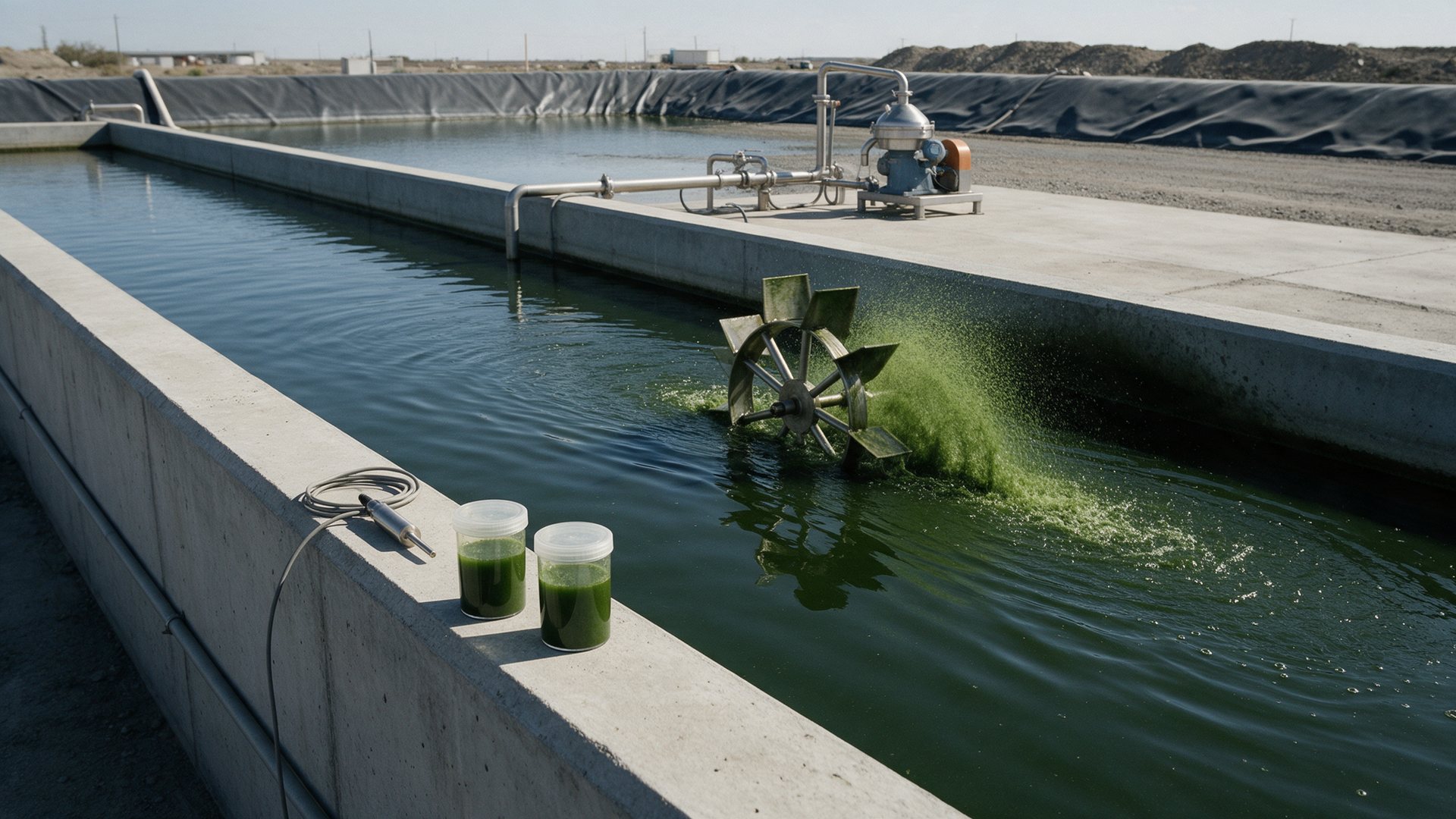
An open raceway pond runs 15 to 30 centimetres deep and holds 0.3 to 1.0 grams of algae per litre. A flat panel reactor holds 2 to 8. Same organism, same sunlight, same carbon dioxide, and the first one is carrying 999 grams of water for every gram of product. That ratio is the business. Volumetric productivity in a raceway is 0.05 to 0.15 grams per litre per day. In a flat panel it is 0.5 to 2.0. The pond is cheaper to build and cheaper to run, and it hands you a stream that is 99.9 per cent water. Everything downstream is priced from that number.
The Bill Arrives At The Centrifuge
Harvest and dewatering run 20 to 40 per cent of total algae production cost. The cells are 2 to 10 micrometres across, about the size of a bacterium, and they sit at almost the same density as the water around them. No screen takes them out. So you centrifuge. Or you dose a flocculant to make the cells clump, and then you centrifuge. Either way the machine is in the capital stack and the energy is in the operating cost, and both of them are there because of how small the product is. Now the comparison. Duckweed fronds are 2 to 10 millimetres. A thousand times longer. Harvest is a screen and a pump, and it costs 5 to 10 per cent of production instead of 20 to 40. One crop leaves you a machine problem. The other leaves you a net.
Four Machines, Four Prices
The same kilogram travels a different road in every system. An open raceway produces at EUR 3 to 10 per kilogram, at readiness 9, with 40 to 80 tonnes per hectare per year in a warm climate. A tubular photobioreactor produces at EUR 10 to 50, at readiness 7 to 8, and it needs sprinklers or heat exchangers because 10 to 100 metre tubes in the sun get hot. A flat panel reactor produces at EUR 15 to 60, at readiness 6 to 7, and it is the hardest of the three to enlarge because a 2 to 5 centimetre light path does not grow by adding metres. Heterotrophic fermentation produces at EUR 5 to 30, at readiness 8 to 9, and it does not care about the sun at all. Capital says the same thing. Per hectare equivalent, a raceway is EUR 50,000 to 150,000. A tubular reactor is EUR 300,000 to 800,000. A flat panel is EUR 500,000 to 1,500,000. You are not buying productivity. You are buying grams per litre, and it is priced like real estate.
Location Moves The Price Further Than Hardware
Banerjee and Ramaswamy modelled the same two systems in three American climates in 2019. An open raceway in the US Southwest: 5,000 to 7,200 tonnes per square kilometre per year. A flat panel in the same place: 9,000 to 13,000. Move to the Northeast and the raceway falls to 2,000 to 3,500, while the flat panel drops to 3,800 to 6,000. Across locations and systems the published production cost spans USD 500 to 9,560 per tonne. That is a nineteen-fold spread inside one technology family, and most of it is latitude. So the first decision is not which machine to buy. It is which climate to buy it in. Sunlight hours, temperature and the cost of cooling move the number further than the reactor design does.
One pond carries 999 grams of water for every gram of product.
What Has Actually Sold
Algae for fuel has failed twice in public. TerraVia, once Solazyme, listed as TVIA and ran heterotrophic fermentation for oils before filing for bankruptcy in 2017. Sapphire Energy raised money on green crude from open ponds and stopped the same year. Corbion, running the same fermentation model, reported EUR 1.27 billion of group revenue in 2025 and sells into aquaculture and human nutrition. Its algae plant in Brazil sits beside sugarcane fields, because the feedstock is sugar, not sunlight. Volumetric productivity is 5 to 50 grams per litre per day against 0.05 to 0.15 in a pond, and the biomass leaves at 20 to 200 grams per litre, so the harvest is a centrifuge step on a strong stream instead of a rescue operation on a weak one. Haematococcus pluvialis, grown for astaxanthin, sells at EUR 5,000 to 15,000 per kilogram. The molecule decides which machine you are allowed to own. Fuel cannot pay for a flat panel. A pigment can pay for almost anything.
The Reactor With No Light
Heterotrophic fermentation is a stainless steel tank, not a pond. Dark, controlled, no light limitation, standard industrial equipment, readiness 8 to 9. The trade is honest and it is not small. No photosynthesis means no carbon dioxide fixed, so the carbon has to arrive as glucose, acetate or sugar. That feedstock competes with food, and its price lands in your cost per kilogram. The novel reactors are where the claims outrun the readings. Brevel, funded under Horizon 2020, runs optical fibres and LEDs inside the culture and claims 400 per cent more yield than a conventional photobioreactor, at readiness 5 to 6. Algenie uses a helix geometry and claims roughly USD 1 per kilogram, at readiness 4 to 5. A one cubic metre LED cube for Spirulina in the UK reports 80.5 milligrams per litre per day, GBP 12,777 per cubic metre of capital, and a 1.7 year payback on Spirulina pricing. Every one of those is a claim at a stated readiness level, not an audited plant. Read them as a direction of travel, and hold the two numbers apart: the yield claim and the readiness level.
The Cheaper Crop Harvests Easier
Duckweed inverts the trade. Doubling time is 24 to 48 hours against 4 to 24 for microalgae, so it grows slower, and everything after the pond runs the other way. Starch reaches 75 per cent of dry weight under nutrient limitation, against 10 to 50 per cent for algae. Lignin stays under 10 per cent, which makes saccharification for fermentation easier. Nitrogen removal runs 42 to 62 per cent in total, Kjeldahl nitrogen 56 to 95 per cent, phosphorus 60 to 96 per cent. The frond mat shades out competitors, so contamination stays low in a system that is open to the air. Biomass yield on wastewater is 10 to 40 grams per square metre per day, the same band as the pond. The same yield, a tenth of the harvest cost, and a lower risk of a crashed culture. The slower crop is the cheaper one to process.
The Decision Rule
The probability that a fuel-only algae plant reaches profitability is not zero. It has been priced twice, in public, and both times the market settled on zero. So build the rule backwards from the product. Ask what the kilogram sells for, then pick the machine whose cost per kilogram sits below that number. A raceway needs above EUR 5 per kilogram to make sense. A tubular reactor needs above EUR 15. A flat panel needs above EUR 30. Fermentation needs above EUR 10. Those floors are the whole strategy, and they come from the harvest. Ponds and reactors are biology problems up to the moment the water has to come out. After that they are finance problems. The machine that gets the water out cheapest wins, and that is why the cheapest crop to grow is not always the cheapest to sell.
Harvest is 20 to 40 per cent of the cost, and it is a plumbing problem.
The map is dead. Nobody told you.
Bali State of Mind is the survival guide for the collapse of everything you were taught to believe.
Beyond this book
Building the same thing somewhere else.
Julien Uhlig is available for advisory work, board seats and media appearances. Write to media@exventure.co.
The academy that trains the operators, across every company in the group, is EX Epic Academy - 25,000 applications, 25 seats per cohort, 210 alumni across 19 countries. academy.epicsolutiongroup.com
18-20 November. Online, Las Palmas, Bali.
Three days on what happens to work, capital and institutions when the map stops matching the ground. Seats are limited by cohort.
ex-aisummit.com →