The Hand That Feels Like A Hand
A modern prosthetic hand can hold an egg without crushing it. It cannot tell the wearer it is doing that, so the hand gets watched instead of used. Wire touch back in and visual attention drops 40 to 60 per cent, grip force control improves 30 to 50 per cent, acceptance climbs from about 50 per cent to 80 or 90, and phantom pain falls. Every route to that feedback still loses information at four stages, and the one users care about most has not been attempted.
A Tool You Have To Watch
Take a current prosthetic hand off its charger and it can close around an egg without breaking it. It can pick up a key, hold a cup, carry a bag of groceries to the car. It cannot tell the wearer it is doing any of that. With no feedback in the loop, the only instrument that says what the hand has is the eye. So the hand gets watched instead of used. That is not a small inconvenience. It means one of your hands is permanently occupied with the other one. Reach for something behind your shoulder, or inside a bag, or under a table, and the limb is working blind. So are you. The grip was never the hard part. The reporting was.
Forty To Sixty Per Cent Of Your Attention
Put touch back into the loop and the numbers move like a clinical outcome, not a product feature. Visual attention falls by 40 to 60 per cent, because the hand now reports its own contact. Grip force control improves by 30 to 50 per cent, which is the distance between holding a paper cup and knowing you are holding one. Acceptance of the prosthesis rises from roughly 50 per cent to 80 or 90 per cent. Phantom limb pain falls by 40 to 60 per cent, because a cortex that had been listening to nothing starts receiving again. Daily wear climbs by 2 to 4 hours. Embodiment, the limb reading as part of the body rather than as equipment, is measured at 60 to 70 per cent of users. The clinical target is above 90. The functional gain is real and it is not the point. Ask the people wearing them.
Ten To Thirty Percepts
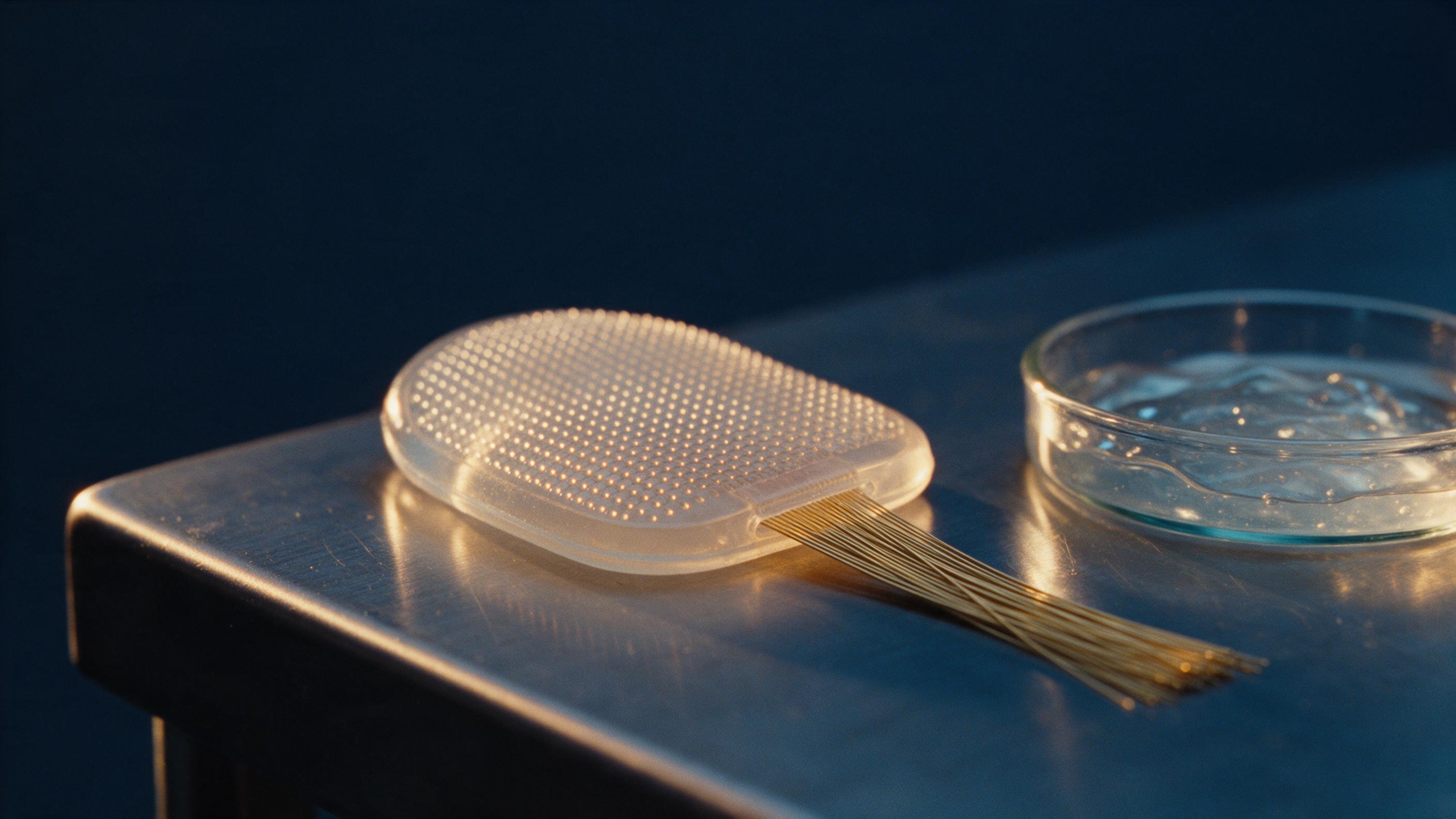
Three routes exist to deliver touch to a nerve, and all three sell resolution they do not have. Non-invasive feedback runs vibrators on the residual limb, or current through surface electrodes, or a small actuator that presses proportional to grip force. No surgery, no implants, and it cannot produce natural-feeling touch. Spatial resolution is poor, and the wearer has to learn to read the code. Peripheral nerve interfaces go inside the body. A nerve guide can coax severed ends to grow through electrode channels. A cuff wraps the nerve and addresses individual fascicles. Intraneural arrays push electrodes into the nerve tissue itself. The ceiling across all of them is 10 to 30 distinguishable percepts, counting location and intensity together. That is enough to grip. It is not enough for texture, and it is nowhere near enough for a touch that reads as human. Cortical arrays sit in the somatosensory cortex and are capped by electrode count in the hundreds against thousands of neurons doing the work. What they produce is tingling or pressure, and the wearer can tell the difference. The channel count on the table is 10 to 30. The target for clinical adoption is 100 to 500.
Four Stages, Four Losses
A complete sensory prosthetic runs four stages, and every one of them leaks. Skin on the fingertips senses force, texture and temperature. An encoder turns those signals into stimulation patterns. An interface delivers them to a residual nerve or into the cortex. A brain interprets whatever arrives as touch. Each stage loses information, and no encoding recovers it. Sensor coverage that never spanned the fingertip decodes nothing. A 30-channel interface cannot carry a signal that arrived on 3,000 points of skin. Stimulation that lands between neurons produces a feeling with no location attached. The design rule that survives the losses is to protect the functionally relevant information first: grip force, the onset of slip, temperature. Those three keep the hand useful. Texture fidelity is what you spend when the budget forces a choice. Pressure magnitude restores well, at 80 to 90 per cent accuracy in discrimination. Coarse texture reaches 60 to 70 per cent across 3 to 5 surfaces. Temperature is good. Object shape is poor, and a restored spatial map of a held object is not on the near-term board. Affective touch has not been attempted at all. Four stages, four losses, and the field has spent a decade arguing about the encoder.
A limb that cannot report contact is a limb you supervise with your eyes.
What The Clinic Keeps Saying
Every clinical study lands on the same finding, and it is not the one the grant applications lead with. Patients rate the emotional half of restored touch above the functional half. Feeling a wife's hand through the prosthesis counts for more than feeling the tool being held. A child's hug arrives through the limb, and the report changes. Depression falls. Social contact goes up. The functional case is already strong on its own: 30 to 50 per cent better grip force control, 40 to 60 per cent less visual attention spent on the hand, 40 to 60 per cent less phantom pain. None of it moves a patient the way being touched does. There is a mechanical reason the emotional half keeps getting left out. Standard interfaces target the fast discriminative fibres that carry pressure and vibration, the A-beta channel. The slow fibres that carry the pleasant register of contact are a separate system with a separate tuning curve, tuned to a narrow band of velocity and temperature, and nobody has wired them into a prosthesis. The people who would wear these devices have said what they want. The field has been building the other half.
The Half Of The Loop Nobody Funds
I have built companies across twelve countries and restructured a 75 million euro industrial group. The pattern in hardware is stable. What demos well gets funded, and what demos badly gets deferred, and the deferred list is where the user experience lives. A sensor demo takes twenty seconds. Softness, warmth and a stroke at 3 centimetres a second take a materials programme, an actuator programme and a force control loop that yields instead of holding. None of that photographs. The demand side is already proven. Structured tactile comfort cuts agitation in dementia patients by 30 to 50 per cent, comparable to medication without the side effects. Amputees report the same thing in different words. That market has been served by human hands for a very long time. The probability that a prosthesis capable of a wanted touch ships within the next decade is not zero. It is priced at zero on most road maps, because every stage between the fingertip and the cortex is bought as a separate line item, and the emotional channel belongs to none of them. The sensor is not the bottleneck. The channel count is, and so is the brief.
Ten to 30 percepts is enough to grip. It is not enough to feel.
The map is dead. Nobody told you.
Bali State of Mind is the survival guide for the collapse of everything you were taught to believe.
Beyond this book
Building the same thing somewhere else.
Julien Uhlig is available for advisory work, board seats and media appearances. Write to media@exventure.co.
The academy that trains the operators, across every company in the group, is EX Epic Academy - 25,000 applications, 25 seats per cohort, 210 alumni across 19 countries. academy.epicsolutiongroup.com
18-20 November. Online, Las Palmas, Bali.
Three days on what happens to work, capital and institutions when the map stops matching the ground. Seats are limited by cohort.
ex-aisummit.com →